In some cultures, people believe that photographers have the power to steal their subjects’ souls. In a way, this is exactly what the Palestinian-Jordanian photographer Mustafa Sabbagh is trying to do. This Milan-based artist creates powerful images that aim to scratch beyond the surface, stripping away the social veneer of humanity to reveal something deeper – the noble savage. As Sabbagh puts it, man uncorrupted by civilisation.
A suited, masked man stands alone in a dimly lit parking garage, staring straight at the camera. A curvaceous woman wearing nothing but scarlet stilettos, a lacy crimson blindfold and red lipstick caresses her nude body. The beard, face and hair of a man wearing a sailor’s peaked cap, a black suit and black leather gloves are coated with what looks like shiny black tar. The vulnerable pink rims and exposed whites of his eyes are all that reveal him as human. Moody, dreamlike and gothic, Sabbagh’s photographs always contain this element of the unexpected.
Born in Jordan in 1961, Sabbagh studied architecture before shifting his focus to photography. While working as a model in Milan, he met influential American fashion and portrait photographer Richard Avedon. The two hit it off and Sabbagh ended up working as Avedon’s assistant for two years. Today, his eerie, inventive photographs grace the walls of galleries around the world.
The night we’ve agreed to discuss his work, settling for a virtual meeting courtesy of Skype, Beirut is being battered by a freak storm. Icy wind tears its way through the near-deserted streets and chunks of hail coat the pavements with a shifting layer of ice. There’s a citywide power cut, and by the time I manage to find a spot with a generator and get online, I’m out of patience and long since out of time.
Sabbagh is waiting for my call. A garbled explanation for my late appearance is met with a warm laugh and a wave of the hand. The dark, sexually charged photographs on his website, where the front page warns visitors that they must be 18 to enter, have led me to expect an intense, perhaps brooding man. Like his work, Sabbagh’s disposition confounds my expectations. Cheerful, upbeat and quick to laugh, he is at once frank and exceptionally courteous, asking my permission before lighting his cigarette, as though I might be inconvenienced by secondary smoke half a continent away.
A self-professed gypsy, Sabbagh’s nomadic lifestyle has taken him all over the world, but it’s Italy that he currently calls home. “When you love culture, Italy is like Mecca,” he says, laughingly. “I used to travel around. I lived in Berlin, London, New York for a few years, but I can say that it doesn’t matter where you live – what’s important is how you live your life. My father was Palestinian and I was born in Jordan but there was always something inside me that drew me to other places... What I love is to cross over all cultures and matrices, to connect everything together. But of course, I’m very happy to have my Arab background. When you grow up with two cultures, I think it helps you to embrace all of them.”
Having started taking photos at the age of six, Sabbagh says photography is the most natural means he has of expressing himself. “Now I’m speaking bad English, but usually I speak bad Italian – and I speak really bad Arabic,” he laughs. “My language is photography.”
Sabbagh has worked for magazines including Arena, The Face, Rodeo and Vogue Italia but his photographs have little in common with commercial fashion shoots. Bold and irreverent, Sabbagh’s photos challenge heteronormative appearances, playing with both the beautiful and the grotesque.
His ideas for shoots, he says, are rooted in the classics. “I grew up devouring books, looking at hundreds and millions of paintings, so in some of my work now, I try to relate to the history of art, plastic art, like Michelangelo’s Pieta. Nothing comes from nothing.”
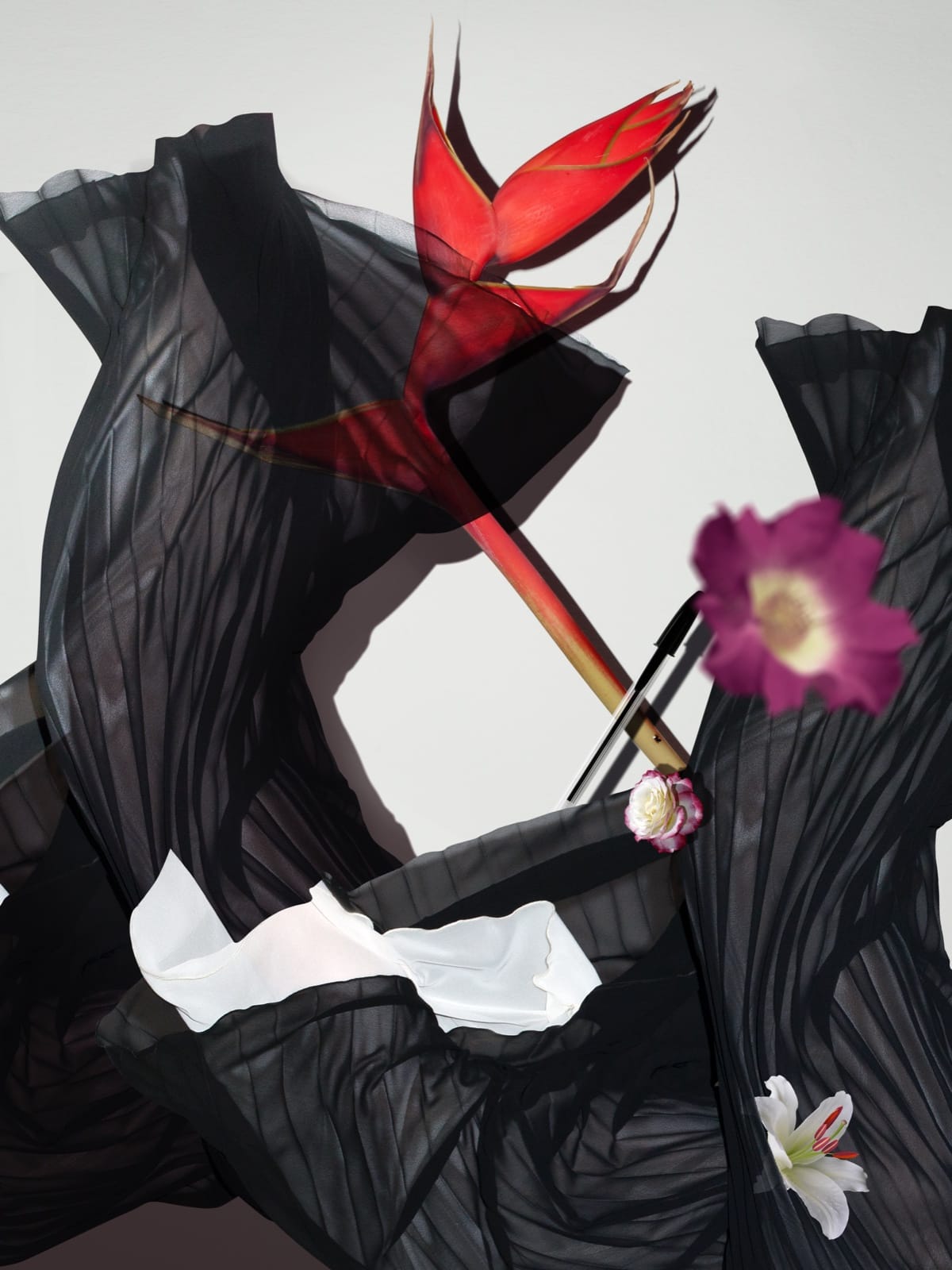
Many of Sabbagh’s photos also play with animalistic elements. In one, a naked woman crawls in a furry mask, her fingernails sharpened into claws. In another, a bare-chested man lays on his side, hampered by legs encased in a black latex fishtail.
“What I want to explore about humans is not about gender or about status,” Sabbagh elaborates, “it’s about how we feel. I often use masks, because I think that the real daily mask is something much more harmful. It’s a kind of ludic… I play with life. Though it all seems to be dark, my mood is actually to play.
“The modern mask is much worse. Women have to be skinny, men have to be pretty. Everyone feels like when people ask, ‘How are you?’ they have to say, ‘Pretty good.’ This is the real mask. I use masks in my photos [because] when you make somebody project with his eyes, he connects with his soul.”
Recently, Sabbagh has been photographing his subjects dressed all in black, skin painted black, posed against a black backdrop. Associated with death and mourning but also with sex, glamour and fetish, in Sabbagh’s photographs, black is celebrated in all of its subtlety, his lens emphasising every tiny variation in texture and tone.
“I have been working in black so much for the last two years because I think black is its own palette,” the photographer explains. “Usually people have a negative opinion about black. What I want to say is that black is not that negative. It’s very hard to make pictures with, but it’s very generous, because white reflects all the light, but black absorbs all the light, and this is generosity, no?”
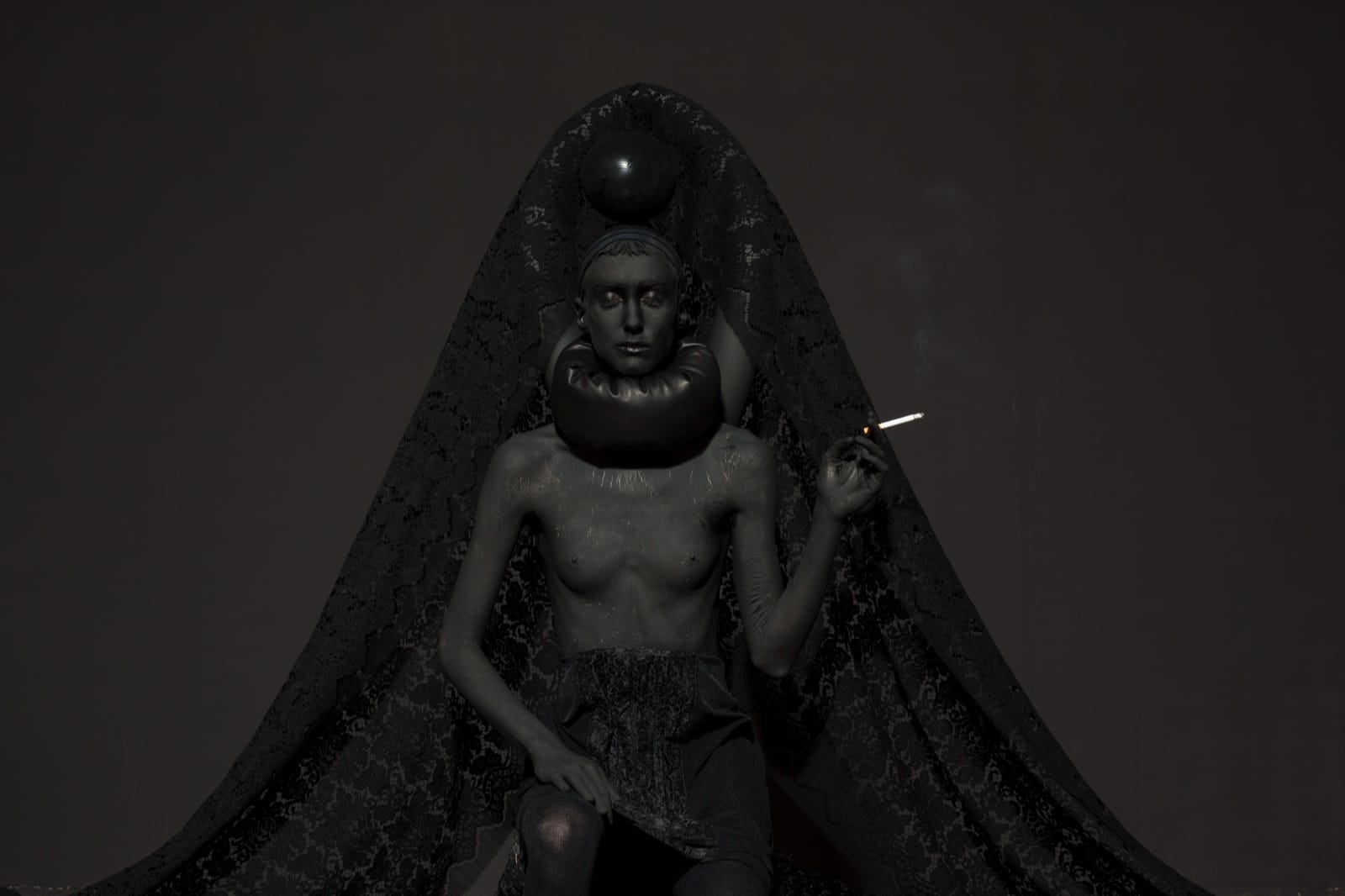
Seemingly frozen, dressed in dramatic concoctions of leather and lace, the subjects of Sabbagh’s black photographs might be mannequins, props in some bizarre bondage fantasy, were it not for the smouldering cigarettes they hold. These props, Sabbagh says, are a means of capturing passing time, the subject of his book, “Skin.”
“Skin is my dilemma,” he muses. “Our skin is our diary, you know? Time is written in our skin, as well as in our minds. I can’t photograph the mind, so the best way to photograph someone’s diary is to photograph their skin. That’s why I’m not into Photoshop or making people more fake, instead of showing how they are beautiful in real life. I think everybody’s cool. If you love someone’s defects, I think you’ll love him for real. If you want to love perfection, it’s simply going to be shallow.”
As we end our conversation, I realise how Sabbagh’s last statement perfectly sums up his nuanced way of looking at the world, and the people in it. There’s always more than what you see.