The last couple of years have seen the city map of Vienna extensively redrawn by the Austrian developer René Benko and his Signa Holding company with the opening of the Golden Quarter, a new high-end shopping, residential and lifestyle district on Tuchlauben. For the moment at least, there’s just one hotel in this pedestrian zone – the spectacular Park Hyatt – and I’ve just stepped into one of its suites, which is serving as a private dressing room.
The resident stylist, Wolfgang Reichl, takes a single look at me and points to a long, sleek, strapless red dress hanging on a rail of ballroom gowns of varying sizes. “This is the one for you,” he says with full confidence.
Only an hour later do I come to the realisation that he was absolutely right. Given that I’m quite lanky, with broad hips and have always had issues in finding the right fit when it comes to long dresses, or even trousers for that matter, I had felt compelled to try on all the other dresses, just to be sure. Nothing fazes Wolfgang though, as he goes about his business of selecting the perfect gown for each of the remaining, fortunate, press associates. Clearly he’s a man who knows what he is doing and has been doing it for a long time.
Of course, he has does have an intrinsic advantage: he’s from Vienna. And this is the city that forever changed balls when in 1773, Emperor Joseph II, an enlightened monarch with respect for the common man, decreed that the ballrooms in the Hofburg Palace be made available to the public and not just the nobility. By doing, so he created ballroom culture among all the classes and, unwittingly, spread the popularity of the waltz from the commoner to the aristocracy. The rest, as they say, is history.
Two hundred and forty odd years later and I’m prepping for this, my very first ball. After we’re done with dress alterations, we discuss shoes. Wolfgang nods approvingly at the black snakeskin pumps I’ve brought from home but it isn’t because they happen to go so well with the dress, which they do, but because, as he puts it, “Visible toes are a big no-no at the opera ball.” Then he offers me another golden nugget of wisdom: wristwatches aren’t allowed either. In a way, our male counterparts have got it easy, they merely have to stick to the standard formalwear of white tie, which encompasses a starched wing collar shirt, a white bow tie, a white waistcoat and black tails.
Some further preparations later, including a 3-hour primping and preening session for hair and make-up, as well as a crash course in dancing the waltz, I feel as ready as I’ll ever be. Even if my dance skills leave much to be desired, at least my hairdo, a side-chignon with a few loose curls (negotiated by yours truly), has won Reichl’s praise. “You look like Carmen!” he exclaims, in an appropriate opera reference, to which I blush a deep red that almost matches my dress.
Finally on our way to the venue, in a limousine no less, I realise just how alive Vienna is at this time of year. The slow rhythm of this baroque city (designated as the world’s most liveable for the fifth time in a row) has been transformed by the exuberant celebrations of ballroom extravagance. Swathes of red carpet spill onto the streets outside the state opera house Wiener Staatsoper, our destination, the women radiant and shimmering in gorgeous attire, the men sleek and dapper in black and white, the cameras blinking madly to photograph all the arriving dignitaries. It’s like a fantasy come true.
Among the 450-strong balls that Vienna hosts every year – there’s one for just about any occasion, from the Philharmonic Ball to the Bonbon Ball (where a Miss Bonbon is selected, and the equivalent of her weight in sweets is donated to charity), the Lawyers’ Ball to even the one for coffeehouse owners (Vienna’s famous for its 19th century Kaffeehäuser) – the Vienna Opera Ball is the most prestigious and probably the most traditional. As the highlight of the carnival season, it takes place on the Thursday preceding Ash Wednesday and is hosted by the country’s president, with leading cultural figures as well as high-ranking politicians among the 5,000 guests, roughly half of whom come from abroad. In the past, these have included international celebrities like Paris Hilton, and more recently, Kim Kardashian (last year) or George Clooney’s old flame, Elisabetta Canalis (this year), usually escorted by the now-82-year-old Austrian construction magnate, Richard Lugner, who’s always up for a good scandal. Although this kind of news is what often hits the front pages of international high society magazines, there’s more to the traditional Viennese ball than the stars.
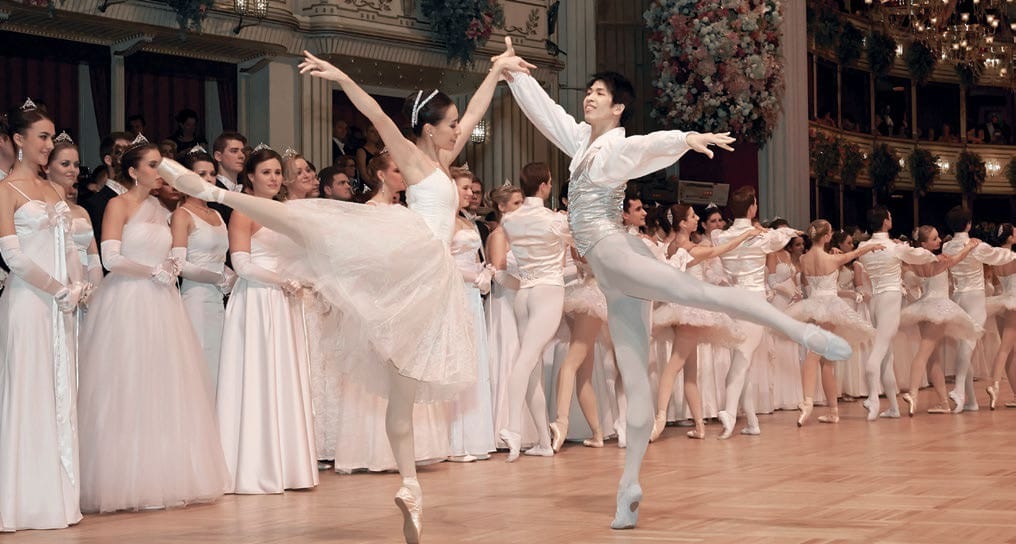
For one, it’s much more than just glamour, it’s history, an art form that recaptures a time long gone and an expression of the pinnacle of the Austro-Hungarian Empire. Set in a city that bears its weight in ‘haute’ culture and the performing arts, the opera ball also carries with it the musical legacy of the Strauss dynasty, which I got to witness for myself. Johann Strauss’ opening waltz, ‘On the Beautiful Blue Danube,’ was a wonder to behold. Stepping to its rhythm, the debutantes (usually between 17 and 24 years old) glided in like princesses, resplendent in elbow-length satin gloves, sheer white dresses and tiaras, arm in arm with their male escorts. Before the stage was opened to the public, the young couples moved gracefully around each other in an entrancing waltz ceremony that dates back to the monarchy. So elaborate and majestic was it that it was hard to believe it originated among the working classes.
Not everything is steeped in the past though. Facing our balcony draped with flowers (where champagne seemingly flowed like water), we see the only woman other than the debutantes, who had been allowed to wear a white dress – Naomi Campbell, a special guest with special privileges.
From our eight-seat 13,000 USD box, as it were, (standing tickets cost upwards of 250 Euros) overlooking the gilded ballroom stage, the sounds of music resonate with clinking glasses, bursts of laughter, the rustling fabric of expensive gowns, and the three-four beat of synchronised feet. The musical interludes are ethereal, coming from lone sopranos whose voices pierced the air, rising above to meet us, punctuated only by the vigorous compositions of the symphony orchestra and sometimes, the flurry of movement in a sudden ballet performance, part of an extensive repertoire that included The Gadfly Suite by Shostakovich and Le Nozze di Figaro by Mozart.
Then there’s the intriguing underbelly of the opera, without which the picture I’m painting wouldn’t be complete. Rooms just off the stage lead to a 1950s cocktail bar here, a disco or oyster bar there, and musical performances spanning all the genres absent centre stage: Sinatra and jazz, boogie and funk, swing and rock’n’roll, you name it, there’s something for everyone. It’s a labyrinth of experiences and encounters, where aristocrats mingle with socialites, and journalists with artists and dancers.
The night ends past 5 am and as is the custom, the revellers end up huddled around sausage stands and from here, the comparison of our surroundings past and present seems almost absurd. The next morning, after feasting on the Park Hyatt’s lavish breakfast buffet at their Bank restaurant (the property had formerly served as a historic bank building), I go down to the spa pool tiled with bars of gold, fabulously set in the bank’s original cave-like underground vault. As my poor feet take solace from last night’s action in the cool water, I can’t help but wonder if my memories are real, there are certainly few things in life that could be quite so grand.