I must say that I find it most peculiar that none of the major Middle Eastern airlines fly directly to Zürich. Companies such as Kuwait Airways, MEA, Saudi Airlines, Etihad, and even Emirates somehow have all managed to overlook the city. Strangely, only Royal Jordanian and Qatar Airways offer direct flights.
Zürich may not be the capital of Switzerland - Berne is; it may not be the country’s private banking hub - Geneva is; but Zürich is Switzerland’s largest city and probably its most misunderstood city too. A boring banking capital, business-minded and uptight, a spotless Singapore of the West: these are common descriptions yet they miss the point of modern Zürich. The city may remain Switzerland’s financial engine, but it is also becoming surprisingly vibrant and trendy. With the reopening of the Dolder Grand, that claim has been made significantly more credible.
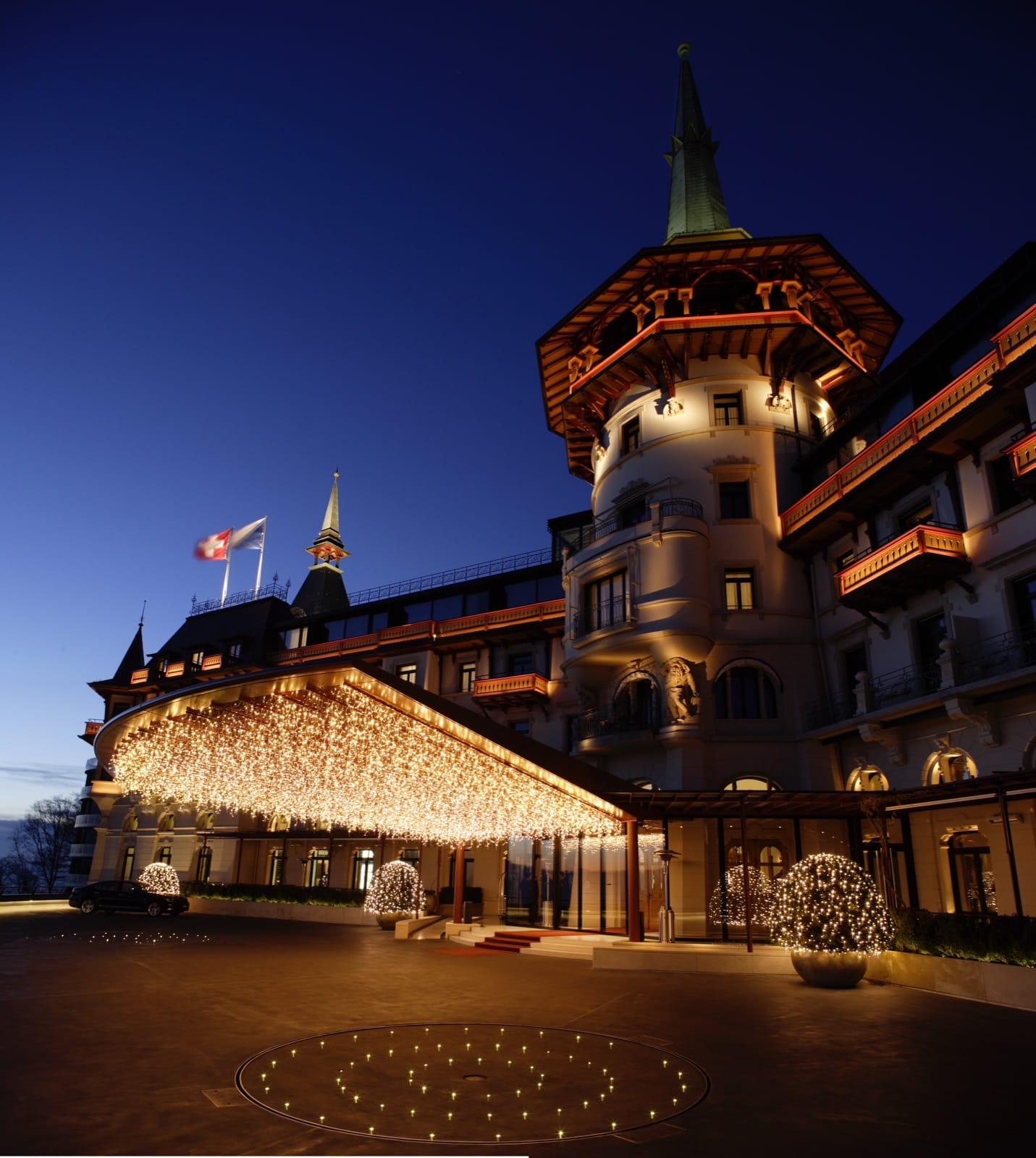
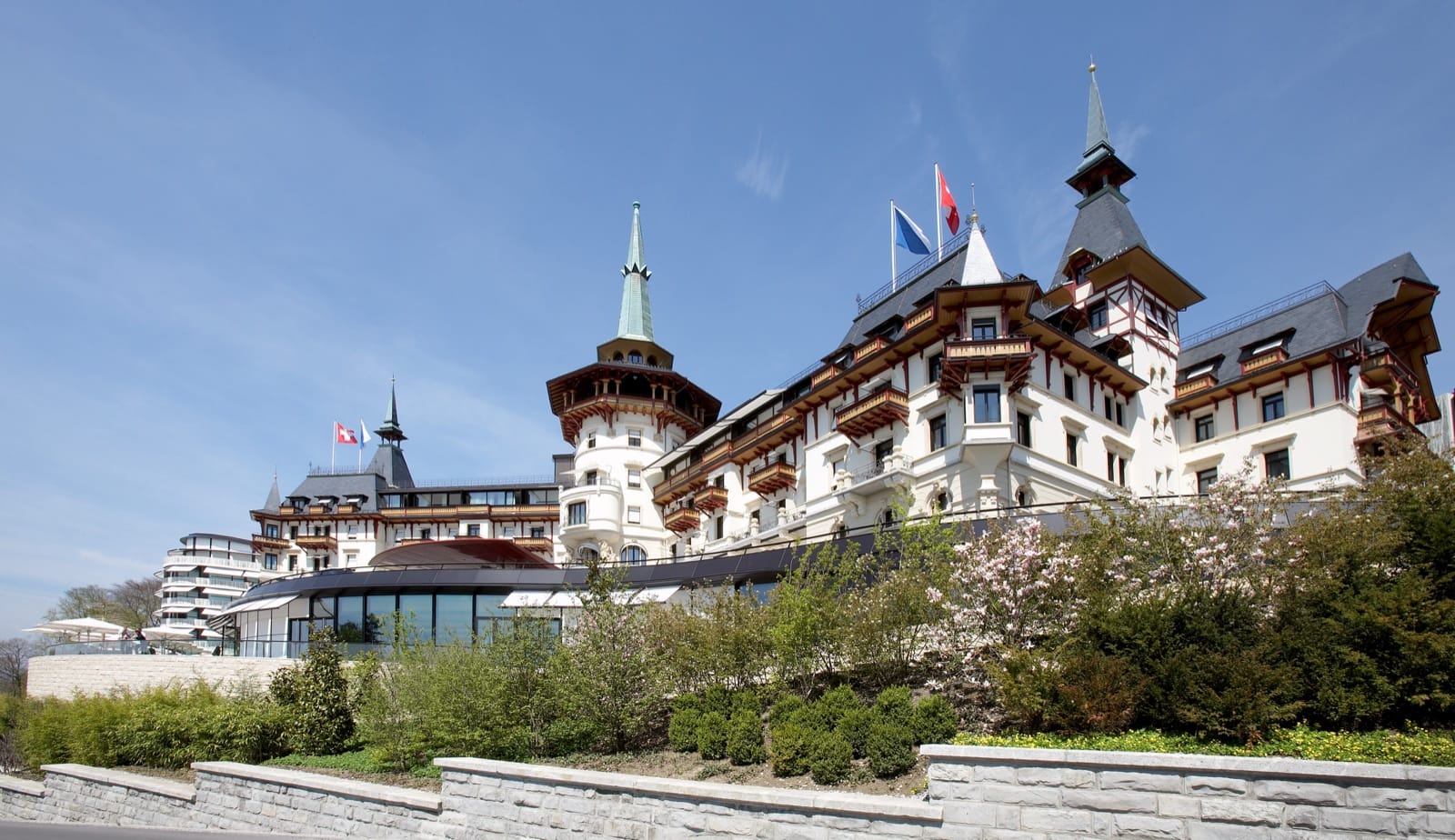
The Dolder Grand originally opened its doors in 1899. Designed in a Swiss rustic style that was popular at the time, it featured fairytale turrets, chalet like timberwork and 220 bedrooms. Archives show it was a great source of pride that there was a telephone, a telegraph and bathrooms on every floor. Times have certainly changed, but the emphasis then, as now, was on rest, relaxation, active leisure and the feeling of being close to nature.
The hotel underwent alterations in the 1920s in order to accommodate more staff. In the 1960s a modern extension was added to increase the number of guest rooms. Eventually by the 1990s the hotel was starting to show its age and was in need of some love and attention. It was not until the noughties that a rescuer finally emerged: a man with a vision, patience, perseverance and most importantly very deep pockets. Swiss-born financier, Urs E. Schwarzenbach, was the saviour who managed to acquire the majority shareholding of the hotel in 2001.
Schwarzenbach, then aged 51, had made his fortune (after) setting up Interexchange, Switzerland's largest private foreign exchange company. He was a well-known yet reserved figure in his home country, having taken up residence in England since the early 1980s. Married to a former Miss Australia, he continues to live in Oxfordshire with his wife and two children. Apart from the Dolder Grand, Schwarzenbach is the owner of two palatial sized houses in rural England, a 100km2 estate in Scotland, a splendid chalet in St. Moritz, 500km2 of land in Australia, an old palace in Morocco (that he is currently turning into a hotel) and four other homes in Switzerland.
But the Dolder Grand was not just another addition to this portfolio of properties; rather Schwarzenbach saw an opportunity to do something very special with the hotel. A key figure he wanted to engage in the project was his good friend, the Pritzker Prize-winning architect, Lord Foster. The problem was that, at that time, Norman Foster had never accepted a commission for a hotel before. Of course, he had designed the mixed-use Al Faisaliah Complex in Riyadh but that project merely encompassed a hotel, it was not a hotel design per se. So, after a skiing break in St. Moritz, Schwarzenbach arranged for his helicopter to take both of them on an aerial tour of the hotel. Apparently upon seeing the property for the first time, Foster was in.
The old Dolder Grand closed in the summer of 2004 and work began immediately. First all buildings added since 1899 were demolished. Foster+Partners had decided to restore the main building and return the façade to its original 1899 appearance. They also reinstated the main entrance on the south side of the complex so that guests would come face to face with the hotel’s view upon arrival. Then in the place of the demolished annexes, the plan was to create two modern sweeping structures that would house the majority of the rooms.
A rather 21st century aspect of the civil works involved plunging 70 geothermal probes 150 metres into the ground. This ground source heat recovery system resulted in the hotel conserving more than 50 per cent of its energy consumption even though the new design had doubled the usable floor space.
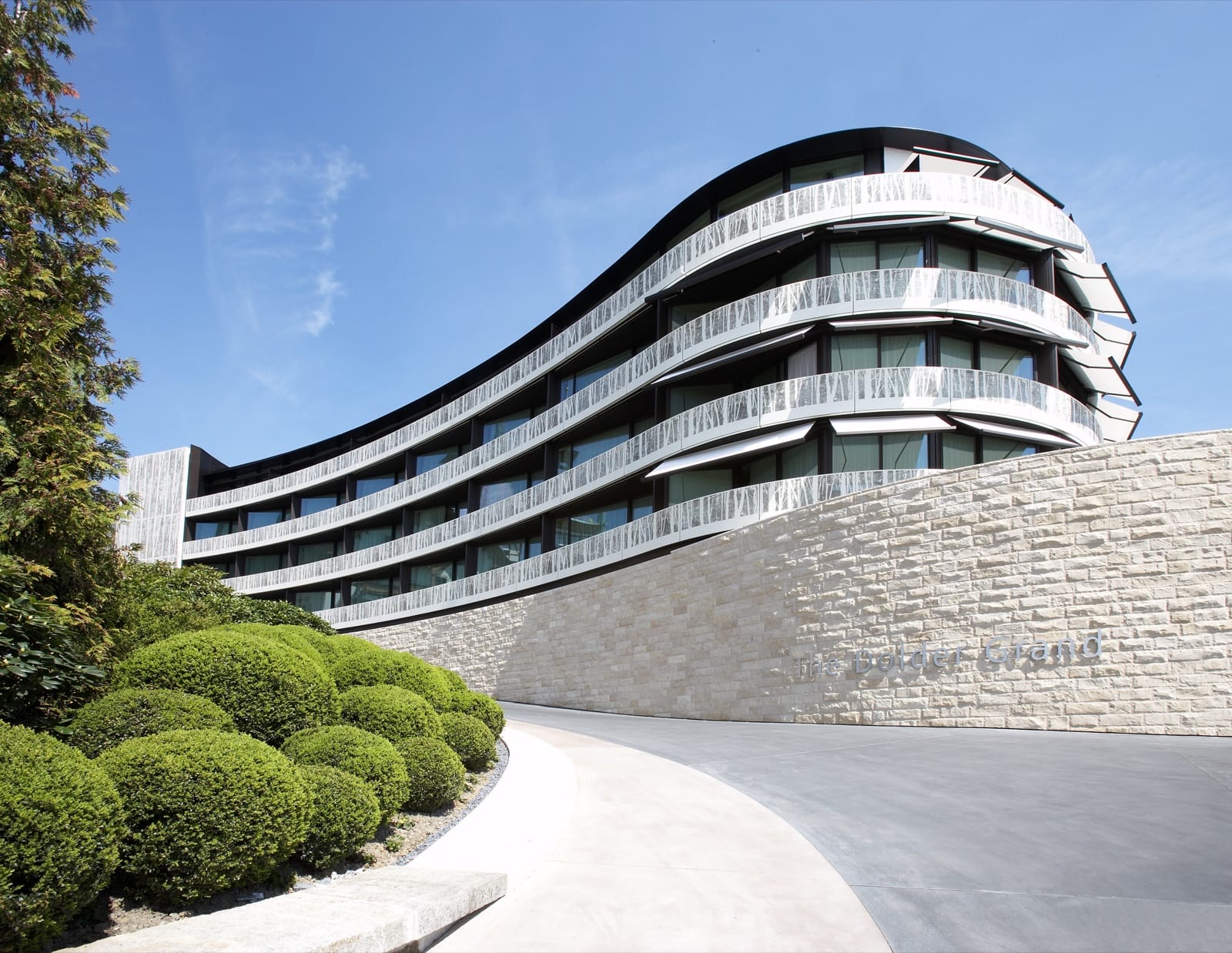
Finally, four years and 400 million USD later, the new Dolder Grand was unveiled with great pomp as a 173-room, five-star, luxury city resort, complete with an ambitious 4,000m2 spa and a new design that seamlessly embraced history in a fusion of tradition and modernity.
Six months on and it was finally time for Bespoke to try out this wonderful hotel. Of course, as I stated before, getting there is half the issue so I decided to go with the most trusted mode of Swiss transport, the train. I had flown into Geneva and conveniently the train station is adjacent to the airport. This being Switzerland, everything runs on time and exactly two hours and forty-three minutes later I arrived in Zürich. If you too decide to take the train then follow suit and opt for a first-class ticket because it is worth the additional space and privacy. I had a whole carriage to myself although that may just be indicative of these credit-crunched times.
Waiting for me on the platform at Zürich station was a Dolder Grand chauffeur. He loaded up a trolley with my luggage and led me to an eco-friendly yet super-luxurious hybrid Lexus LS600h. It was my first time in the hybrid version of the new LS and I found the completely silent manner in which it pulls away a little disconcerting. Of course the choice of cars complements the new Dolder Grand’s green aspirations. (In any case) It was a comfortable ride and about ten minutes later we were pulling up to the hotel.
As expected, the view from the new south side entrance is quite breathtaking. The hotel occupies a uniquely elevated position atop the city, between the city-centre and the surrounding woodland. Therefore the view is of the city, the lake and the surrounding Alps. But just as beautiful as the view, is the hotel itself. It manages to combine classicism with modernity in a refreshingly unforced manner. The original building does not look at all incongruous between the two new elegantly curved, architecturally modern wings.
The hotel interior features the same old-new juggling act although modern seems to prevail. The interior design was undertaken by United Designers, the multi-disciplinary London based consultancy responsible for such projects as the ME Hotel in Madrid, the Metropolitan Nobu in London as well as the Parrot Cay Resort in the Caribbean. They have done an outstanding job with the Dolder Grand; my only gripe was the soulless lobby that perhaps goes too far in its modernism and misses the mark in terms of a welcoming ambience. The other public areas around the entrance are stunning including the reception area, the beautiful library and the bar.
Another minor criticism of the hotel is how the restaurant and bar do not attract many of the locals. The Dolder Grand is larger and more distinguished than the Bvlgari in Milan yet it does not manage to integrate itself into the local scene as well as the latter and this hurts the overall ambience. Pay a visit to the magnificent black marble bar, with hanging crystal candles and gold beaded curtains, and you might just find yourself speed dialling the concierge to find somewhere a little less lonely. Then again you can always stay in your room and order room service, as quite honestly you will never feel like leaving anyway.
Of the 173 keys available at the hotel, 15 are singles, 99 are doubles, and there are 48 junior suites, 7 regular suites and 4 top suites. The double rooms start at a rather steep 750 USD and the regular suites are about 3,000 USD a night. If you can afford to stretch your budget a bit then definitely go for one of the four top suites. One is the Rolling Stones-inspired ‘Suite 100’ that is a 1960s retro affair, but the crème-de-la-crème is the 400-square-metre Maestro suite. The late world-renowned conductor, Herbert von Karajan, was the inspiration for this two-tier suite, which can be found at the highest point within the original tower of the main historic building. For a cool 12,000 USD a night, the Maestro boasts two bedrooms with two palatial bathrooms (each has a steam room and sauna), a sitting room within the hotel’s spire, a dining room with a private kitchen, a TV room, a grand piano, a harp and two roof terraces.
There are certainly no thrifty options available here so the most important aspect you must decide on is how you want your room: super-modern or modern-classical. While the majority of Arab clients prefer the more classical rooms I feel I should buck the trend and say that the super-modern room is the way to go. I stayed in a junior suite within the Golf Wing - so named because it looks over the 9-hole golf course. It was perfect in every way, although for 1,000 USD a night I suppose it should be.
My junior suite had enormous floor-to-ceiling windows that extend across the whole bedroom and even across the bathroom. Just beyond the windows is a wrap around balcony furnished with some Dedon weatherproof seats and tables for when the weather permits. But whichever room you opt for do listen attentively when you are first shown around as the gadget information will come in handy.
The bedroom is slick, contemporary and very white and airy except for the dark parquet and the purple Pierre Frey curtains. One clever touch was the De Sede leather sofa whose back-support system slides left or right to allow for better TV viewing from the bed. The entire room is operated via the Bang & Olufsen remote control. From this intuitive control unit you can play with the curtains, the TV, the lighting, the room temperature and so much more. The gadgetry does not end there either, just walk through the dressing room into the bathroom and you will find a TV in the bathroom mirror, electronically operated blinds for the huge windows, a control pad to control the steam multi-jet shower as well as a control pad for the stand alone Jacuzzi bathtub.
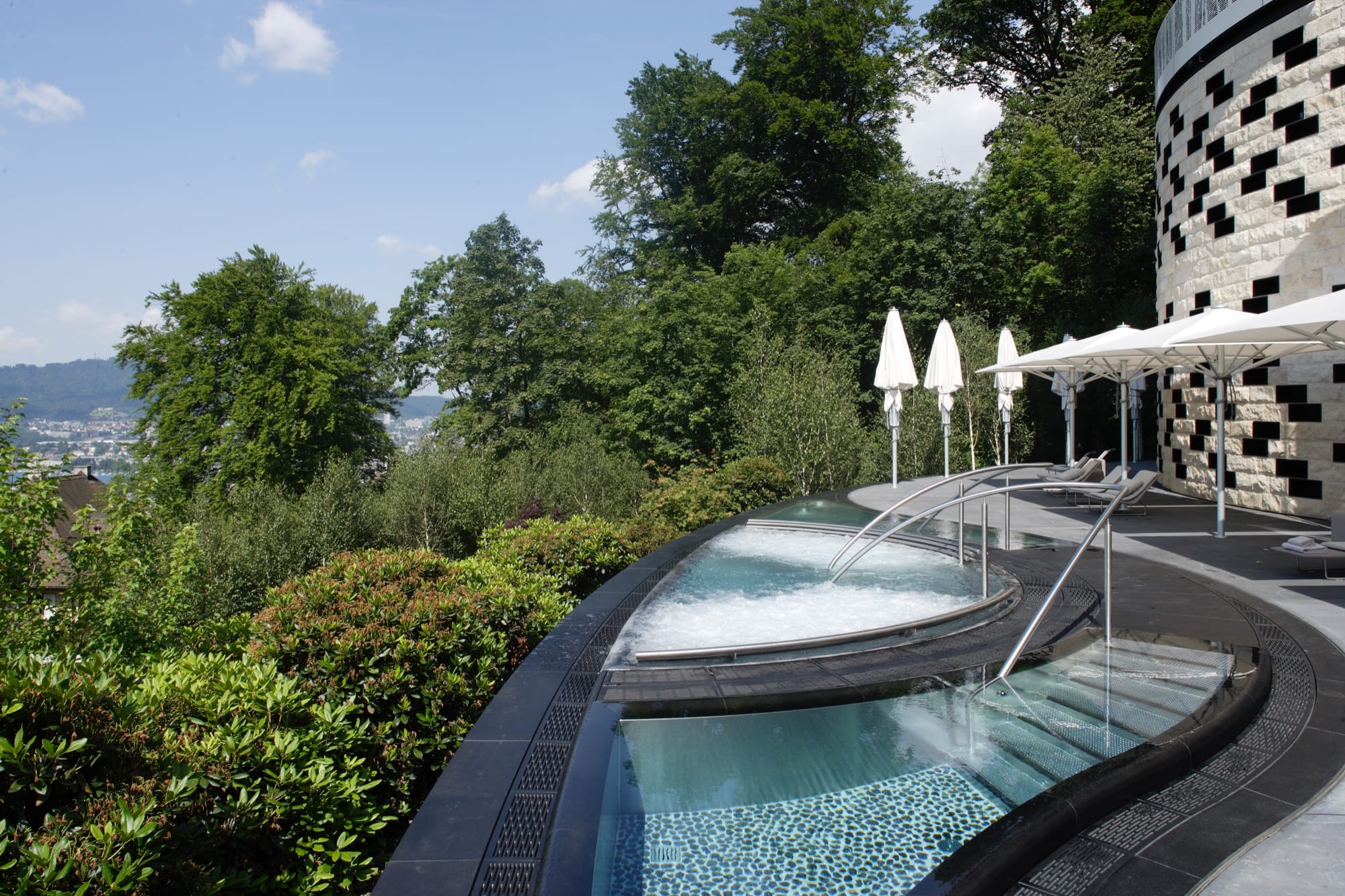
Should you tire of your personal spa bathroom, there is a 4,000 square-metre spa tucked into the Dolderberg hill under the hotel and amazingly this is not a basement at all but a light filled, high ceilinged paradise with rough cut limestone walls and a canyon-like black granite pool that is surrounded by panoramic glass. According to the hotel brochure, there are spa pools on a terrace overlooking the city but with snow outside I gave those a miss.
There is a very comprehensive list of European and Japanese influenced treatments with a few rather unconventional options too, such as Botox and laser treatments. I decided to opt for an ‘Urban man massage by Kerstin Florian’. This involved being completely exfoliated before soaking in a chromatherapy whirlpool for 30 minutes and then massaged for another 45 minutes. I felt as if I had been kneaded, marinated and boiled but I was happy for it. Feeling smoothed and soothed I then relaxed in the waiting room enjoying the solitude with a cup of herb tea as I pondered the angle of my review.
Honestly, the Dolder Grand is an incredible hotel. The beautiful design, the stylish interiors, the fit and finish of the workmanship are all extraordinary. Furthermore the hotel has impeccable service, a stunning spa and an enviable location. I really cannot find any reason to fault the place except for perhaps one thing, its prices. Then again if you want true quality you should be willing to pay for it. So it may be grand but will the steep prices be prohibitive in this economic downturn? I honestly hope not, but only time will tell.
CONTACT
The Dolder Grand
Kurhaustrasse 65, Zürich,
Switzerland
Tel +41 44 456 60 00
www.thedoldergrand.com