A flawless expanse of blue sky is mirrored in the azure tiles lining the bottom of an enormous swimming pool, empty of water. The curving expanse of the hollow basin is surrounded by dry concrete, dust and sand. Behind it, the skeleton of a palatial building, rows of arched windows and doors lining its curvilinear façade, rises from the desert like the fossilised remains of a vanished civilisation. In the distance, a line of arid mountains is just visible, peeking over the top of the building.
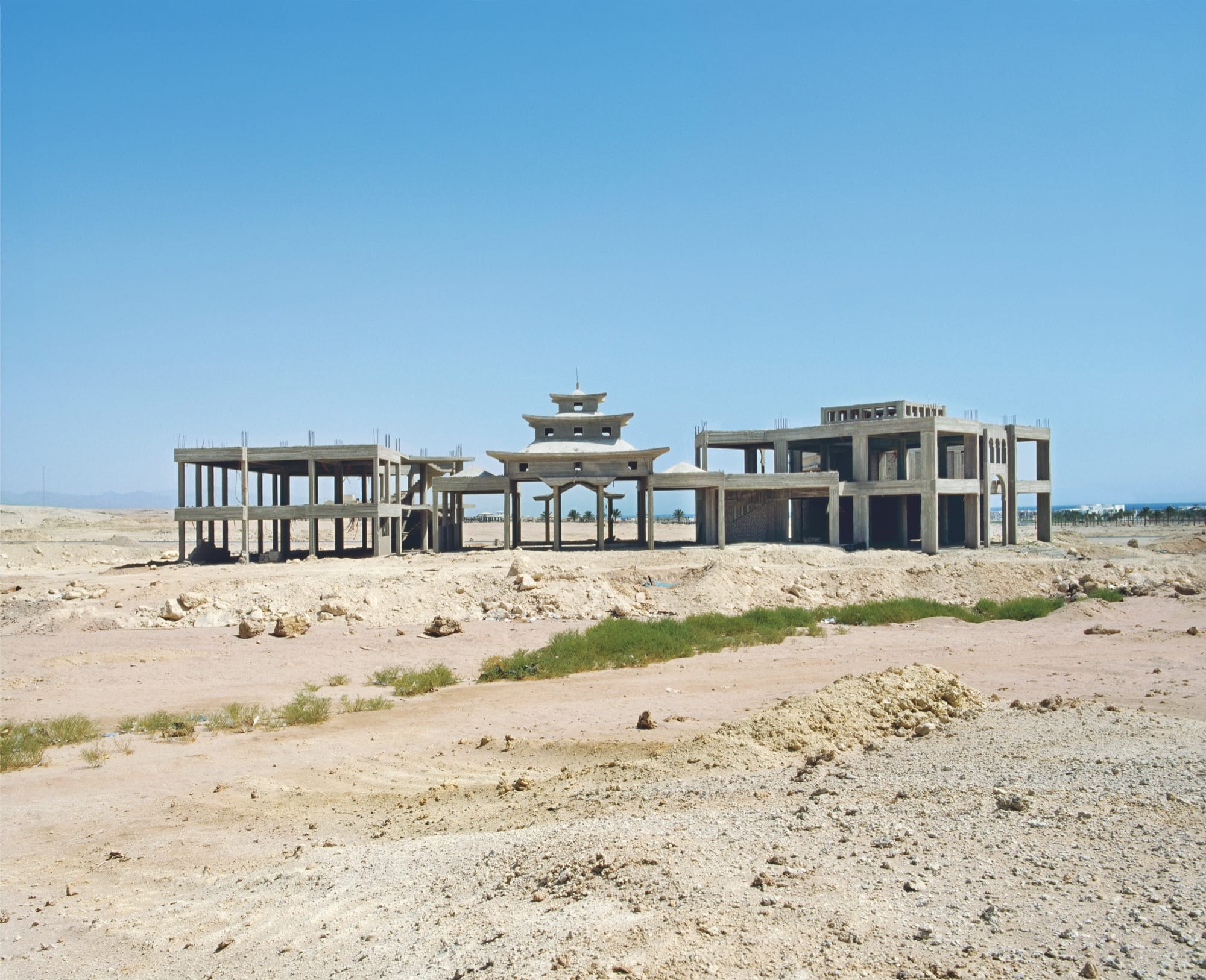
This surreal scene is part of Sinai Hotels (2003-5), a series of stunning, yet haunting photographs by German artists Sabine Haubitz and Stefanie Zoche. The concrete shell is the remnant of an unfinished construction project, one of the dozens of hotels destined to remain in a half-built limbo, casualties of an over-optimistic construction boom in the Egyptian desert.
Haubitz and Zoche captured several of these abandoned, half-finished hotels, creating a series of eerie images that evoke post-apocalyptic landscapes. Although enormously varied in format, their work is tied together by its subject matter, often focusing on architecture and public space or environmental and ecological issues.
Born in 1965 in Munich, Zoche studied at the École des Beaux Arts in Perpignan and at Middlesex Polytechnic in London. She built a successful career as a solo artist until 1998, when she met Haubitz. “We became very close friends and then we often talked about the projects that each of us was doing individually,” she recalls, “and after some time, our comments to each other started to have such an impact that we thought, well, it’s not fair to present the work under one name.”
They decided to abandon their solo careers and work in tandem under the studio name Haubitz + Zoche, until Haubitz passed away in an unfortunate skiing accident last year. During the time they worked together -16 years - the duo’s shared interests in art, architecture and environmental issues such as climate change helped them to come up with projects that are both conceptually and aesthetically powerful. In Sinai Hotels, these threads come together to create a series that combines striking visuals with a reflection on architecture and identity.
The pair first stumbled across one of the unfinished hotels while on holiday in the Sinai Peninsula. “At first we just saw one of those ruins,” Zoche explains, “and we thought it would be interesting to take pictures of the unfinished place and then come back years later and have the same perspective in a finished situation and juxtapose them – but then it was never finished. We ended up finding out that there were quite a few of them, so we went back a couple of times to search for them. Sometimes, we’d go there on motorcycles and then we got drivers and asked them explicitly to show us these places – which they didn’t really understand. They are embarrassed about these concrete skeletons not being finished, so we had to convince them that we really wanted to go there.”
Abandoned and stripped of their purpose, these buildings are testament to a particular period in Egypt’s history. “This area was under Israeli control,” explains Zoche, “and when it became Egyptian again, they started an aggressive development process. They wanted to develop the whole coast within seven years. So it is a sideeffect of a development that was far too quick and not really planned well enough.”
One of the most salient aspects about the photographs is their timelessness. The pair captured the buildings from inside and out, always against the same backdrop of featureless sand and unremitting blue skies. It’s impossible to guess how long they might have stood there, isolated sculptures in the desert, or how long they might continue to stand. “There’s hardly any rain. It rains maybe once or twice a year,” says Zoche. “In Germany or other countries where you have a harsh winter, they’d get destroyed after a few decades, but if you have no rain and no ice then they endure hundreds of years.”
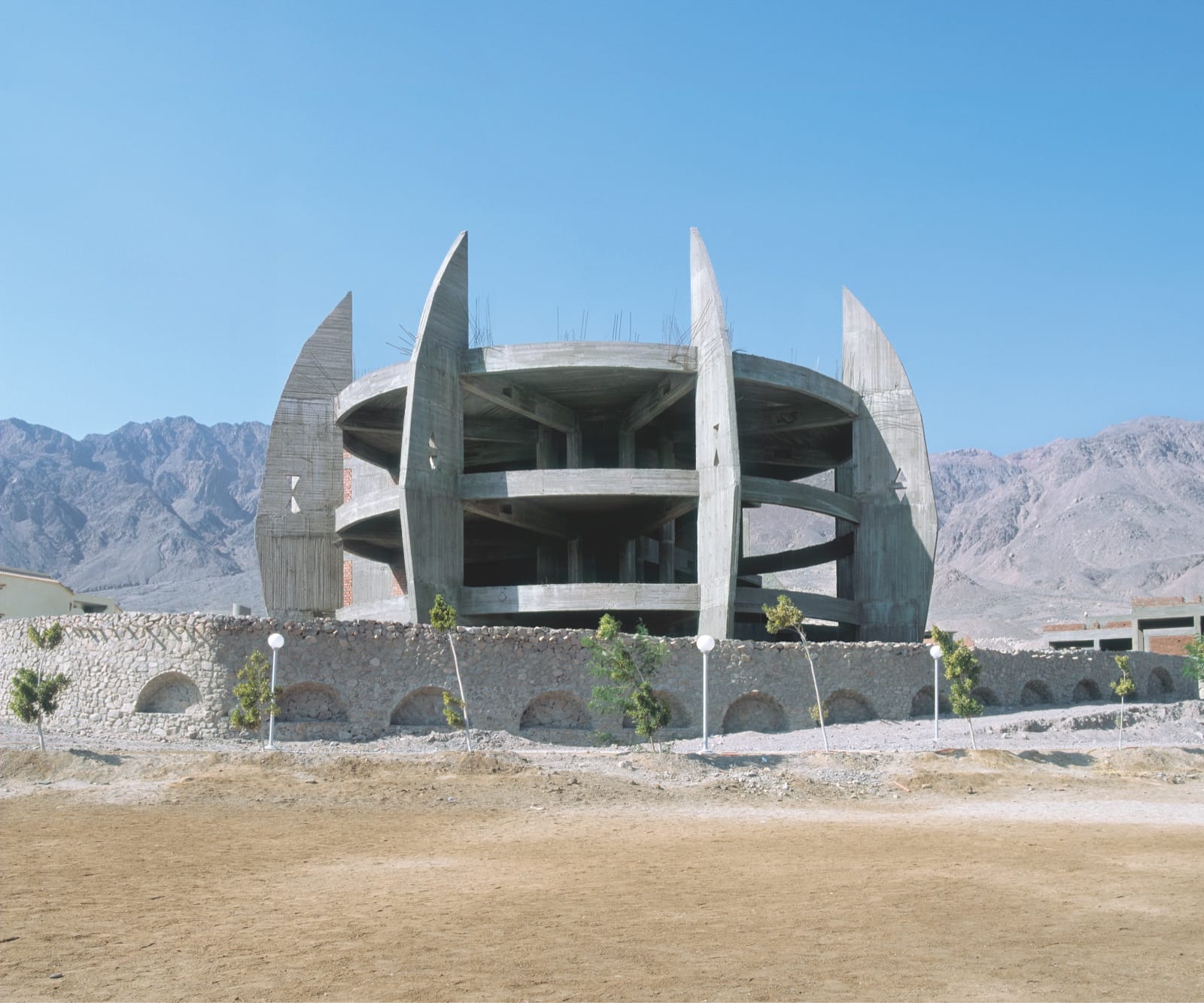
Another facet of this body of work is the sheer range of architectural styles it reveals. Each half-finished hotel is suggestive of a single architect’s unrealised vision. For instance, one particular circular construction resembles a spaceship from a sci-fi movie. Another, photographed from the inside, boasts a lofty domed roof, like the interior of a mosque, supported by a ring of central pillars topped with arches. A third concrete shell juxtaposes a stocky square tower with a shorter round tower, around which a staircase winds before turning back on itself like something from an M. C. Escher sketch.
“They are all in Sinai, but they don’t refer to the architectural style of the area,” says Zoche. “They are just taken from any time in history, and any place. When they’re finished and surrounded by greenery and in a working state, we become so accustomed to these styles that we don’t analyse them. In their unfinished state, the intentions become so much more visible. It also tells us a lot about tourism, where it doesn’t matter if these buildings are in Egypt or in Turkey or in some Asian country, because for the people in these holiday resorts it’s not so important where it is, they just need sun and sand and entertainment. So by using this kind of architecture, these architects are promising a fairytale.”
An exploration of artificially constructed fantasy-scapes recurs in another of the artists’ projects linked to the region. Often exhibited together, the photographs in Ski Dubai and Tropical Island capture a snowy wonderland built in the tiny Gulf state and a resort in Brandenburg that houses a rainforest, a heated sandy beach and a lake for swimming.
“We’re interested in the creation of these artificial worlds and again, there’s the focus on the language of architecture,” says Zoche. “Like in Ski Dubai you have this Swiss mountain hut, and in Tropical Island you have houses from Bali and Indonesia. As in the case of Sinai Hotels, architectural language is used to create a certain atmosphere.”
Sinai Hotels is also reminiscent of another Haubitz + Zoche project, Movie Theatres, in which the duo travelled around South India taking photographs of old cinemas. An extraordinary mixture of Western modernist architecture mingled with Indian influences, and painted in vivid colours, these movie theatres are the microcosms of a cultural heritage. “I think the façade of any building is like the face of a person,” Zoche adds. “It tells you a lot about what lies beneath.”
The vastly different facades of the buildings captured in Sinai Hotels may suggest little about the ‘face’ of Egyptian culture, but they reveal a lot about the utopian fantasy of luxury travel, where resorts are designed to transport visitors away from the reality of their surroundings. In Haubitz + Zoche’s atmospheric scenes, viewers are invited to wander in a wilderness of unrealised ambition, transformed over time into a thing of beauty in its own right, ghostly sculptures frozen in the unchanging desert.