Tunisia is deep in post-revolutionary fever. From the moment you arrive at the airport in Tunis, the excitement of the post-revolution atmosphere is palpable. There’s a buzz about the chaotic crowds in the airport, a hopefulness, but there’s also an urgency. Barely have I touched down before I leave the bustle of Tunis behind for an hour-long flight down to Tozeur, an oasis city deep the southwestern desert. My destination is the village of Nefta, which is about 20 minutes from Tozeur by car. It’s night by the time I arrive and as we drive to Nefta, all I can see apart from the straight, unravelling road and the occasional shrub is sand, sand and more sand. Barely off a plane and I am deep in the heart of the desert.
The night I arrived in Nefta, people were celebrating on the main square. Of course, the party wasn’t for me, nor was it for Matali Crasset’s radical new hotel, Dar HI. It was in fact to mark the one-year anniversary of the ousting of former president Zine El Abidine Ben Ali. As it happened, Dar Hi opened its doors just a month before Mohamed Bouazizi fatefully set himself on fire, sparking the first of the Arab Spring Revolutions. Even sleepy Nefta – still probably best known as the place parts of Star Wars and the English Patient were filmed – was swept up. A hotel neighbouring Dar HI was burned down and Crasset herself explained how the staff protected Dar HI as if it were their own house.
Your first clue that Dar HI is not your standard luxury hotel lies in its location. Nestled discretely down an alley, it’s barely visible from outside. A series of earthy, rectilinear structures huddled together that mimic local architecture. It’s easy to miss the entrance, a large palm wood door bearing the hotel’s name picked out in metal studs. Subtle and rustic, it’s a lovely introduction, and its tinted ochre façade blends perfectly with the surroundings. Step into the Dar, however, and you move firmly into Crasset’s world.
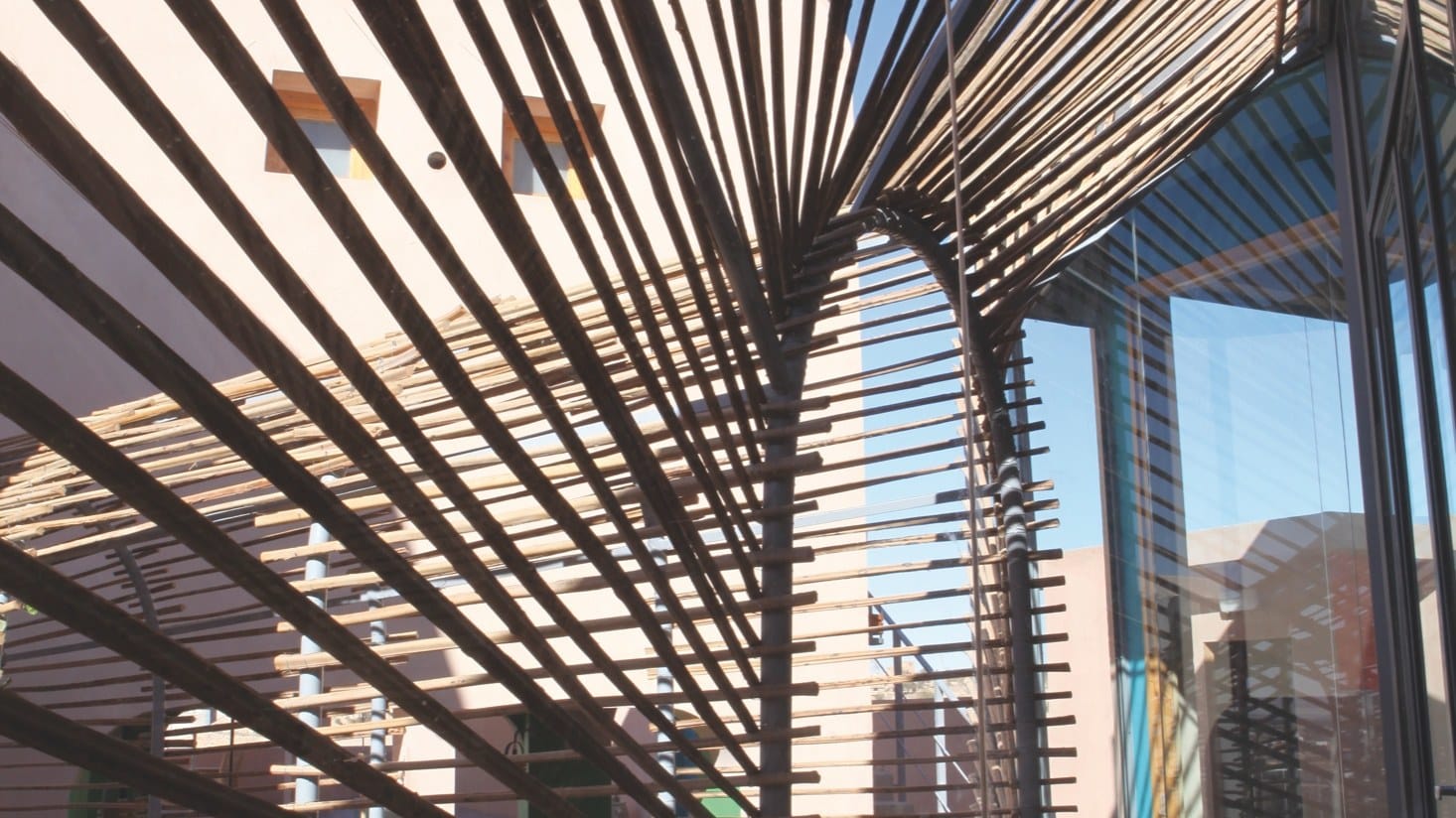
The first thing I notice as I wander into the open living space is a massive, pleated concrete column surrounded by chairs upholstered in bright green. Books with titles like “Who’s afraid of Design?” hang like fruit off the column on wooden lattice-like projections. These lattices are a dominant theme used elsewhere for enclosures, pathways, even chandeliers. A library tucked into one corner holds more books, old photographs of Nefta and pamphlets about building desert-friendly resorts. It reminds me, in a nice way, of school.
To get to your room you must step outside into the crisp, biting desert cold and cross the courtyard. I was staying in one of the Pilotis rooms that rise from the ground on concrete stilts so after I mounted the stairs to enter I was relieved too find a warm and cosy shelter. All bed, with a toilet and open shower on either side, these snug rooms are built for intimacy and come with a hidden indoor terrace, where you can lounge comfortably on plush, flaming orange cushions, that echo the stripes on the off-white, camel-hair bedcover. Enclosed in a bay window, when you lie back against the glass, the view makes you feel as if you are perched on a precipice.
By night, all I could see at first was a plunging cavity of darkness bordered by the lights of the village. The flatness of the land, which stretches interminably in every direction, is overwhelming and gives the Dar the perspective of a fortress and when I awoke the next day, to the sound of bird song, I still had a dizzying sense of being at the very edge of the world. The dark cavity of the night now revealed itself as a lush date-palm grove, above which poked low-lying beige houses in the desert vernacular. Beyond, I could see the misty white rim of the dried-up salt lake on the horizon, Chott el Djerid.
This outside-in and inside-out perspective is not Dar HI’s only characteristic. Everything, from the orange-blossom shower gel to the homegrown food and the architecture style, is strictly local, in keeping with Crasset’s environmentally sustainable approach and the project itself was carried wout with the help of Tunisian architect Mohammad Nasr and his team. Admittedly, there were a few elements that were out of place or didn’t quite work - the straw basket in the shower room was actually a bin and as I walked around barefoot the first morning, the brightly-coloured, lime-plastered floors were stone-cold, solar heating means the hot water flow needs to be constantly maintained and lighting is ’atmospheric’ but in the end, nothing is wasted and it works as a whole. Because even if Dar HI is sometimes rough around the edges and perhaps more of a luxury refuge than a luxury hotel, it actually works.
Though it’s a bit of a maze, Crasset makes navigating easy. Spaces are colour-coded and demarcated according to function. There are no wall partitions in communal areas. The shower room, hammam and open kitchen are painted in turquoise hues, the living spaces in happy tones of orange, yellow and green and the small, glassed-in screening room, in velvet red. More notably, Dar HI is not wired. There are no phones, TVs or internet connections in the rooms, though truthfully, I didn’t notice at first, because I was more eager to look through the handpicked selection of books in my room; ‘L’Impure’ by Guy des Cars and another by Aki Shimazaki.
Despite the clear (and colourful) definition of spaces, Dar HI does have a homey feel. All the staff is from Nefta and appear strongly invested in both the hotel and their community. Service is attentive but not intrusive, the agricultural produce used in the kitchen the water drawn from a communal well. Local cooks serve traditional recipes, albeit with an organic twist and though the menu is set, the choice is always so perfect, you don’t really care. Plus, as the open-plan kitchen is glassed in, you get to see how the food is prepared.
Breakfast, by the way, is always buffet. There are herbal teas, cereals, crepes, a scrumptious sampling of dates, homemade fig, apricot and quince jam, and oven-baked bread sprinkled with barakah seed (black cumin). The area designated for eating overlooks the most magnificent view of La Corbeille, the basin filled with the forest of palms, above which the imposing vestiges of the abandoned Sahara Palace hotel, once favoured by the likes of Brigitte Bardot, can be seen.
Poking around, I discover there’s a children’s library, a small boutique selling Dar HI items like hand-stitched bathrobes, straw hats and cutlery and the intriguing wooden dune-like structure turn out to be an intimate seating area, perfect for curling up with a book. I also discover that the pleated concrete column I’d noticed on my way in the night before, does more than support. It houses a spiral staircase that leads to the roof, where there’s a pool fed by hot springs. The sun was out so I decided to brave the winter chill and took a plunge. A deep, slightly cloudy green, the water was heavenly. Drawn piping hot out of the ground, it is first sent to heat the hotel’s tiled, hand-painted hammam – an essential stop for the fig scrub, algae wrap or the eucalyptus oil massage - and now cooler, is fed into the pool. Later, this water is drawn off to irrigate the palm grove.
Up here, everything shimmered with a vibrant intensity. Even from my elevated platform, the sound of the call to prayer sounded so close, it could have come from within the hotel. Only with the vividly-streaked setting of the sun was I at last ready to descend to the comfort of the fireplace near the library. During dinner, the reflection of lights, floating as if in mid-air and the sound of the fire crackling in the background was bewitching and I savoured every last drop of my pumpkin soup, which came with a firey dollop of harissa. The rest of the meal was equally delectable. There was chakhchouka (chicken on a bed of vegetables and finely-made bread) and couscous with almonds and raisins, followed by tangy fruit-based desserts and the black olives, some of the best I’ve ever tasted, were my constant companions.
While Crasset discovered Nefta through hoteliers Philippe Chapelet and Patrick Elouarghi, who being half-Tunisian, wanted to build a resort in his home country, the project she designed for them is quite remarkable, not only in its concept-driven ethos of redefining traditional luxury, but also within the group of hotels to which it belongs. The Hi Life group - there’s a Hi in Nice and Hi Matic in Paris - are normally on the cutting edge of urban chic and new technology and each offer a wide variety of room types. Simpler, Dar HI seduces not with an extensive menu but by offering three completely different ways of experiencing the hotel. There are three room types, Pilotis, Troglodyte and Dune, each of which live exactly as they sound. Pilotis is an elevated, airy experience. Troglodyte, underground and cave-like, is inspired by underground Berber dwellings, with their shared water fountains and bread ovens. Dunes are warm cocoons built on the sand, angled to imitate the wind-sculpted dunes. Pilotis are rooms for couples. Troglodyte and Dunes are arranged in family suites.
Dar HI embodies a contradiction. It’s the home that isn’t your home. It feels like it could be, though you know you couldn’t be further away. Monastic but with a contemporary touch, Crasset’s approach creates contemplation, both of the outside world as well as introspection of ourselves, or as she puts it when describing what it was that inspired the space, “it is a space of retreat and openness at the same time.”