Although Australia is better known for its stunning beaches, laissez-faire attitudes and vast sections of uninhabited space – well, and Kangaroos – there comes a time when every visitor, migrant or native, has asked why the food is so damn good, especially in Sydney. And it’s not just that the food’s good either, it’s incredibly diverse too.
Let’s start with the coffee. The Australians invented the flat white in the 1970s and while you could well say that this is no big deal given that it’s so similar to the cappuccino, which was created decades earlier, I’d beg to differ. Rumoured to be the result of a peace accord among clashing Italian and Greek cafés, a flat white comprises two parts espresso shots, one part warmed whole milk (à la latte) and one part milk foam (à la cappuccino). It’s a perfectly balanced coffee with a lot of goodness retained in the steamed, and not scalded milk, which is still full of fats and proteins and therefore has a naturally sweeter flavour. In fact, thanks to successive waves of Italians, Greeks and Vietnamese, Sydney-siders are devout about their coffee and drink their espressos standing up by carts on streets. They also finish noodles or dumpling soup with the almost illicitly good cà phê nâu đá (dark roast condensed milk Vietnamese coffee), which brings me to my next point.
This is also a city where Asian food and drink is prepared as much for the resident Australians as for anyone else. Sydney abounds with Japanese, and every other variety of South East and Northern Asian cuisine, evenly made for the recent migrations and for the multicultural Sydney populations.
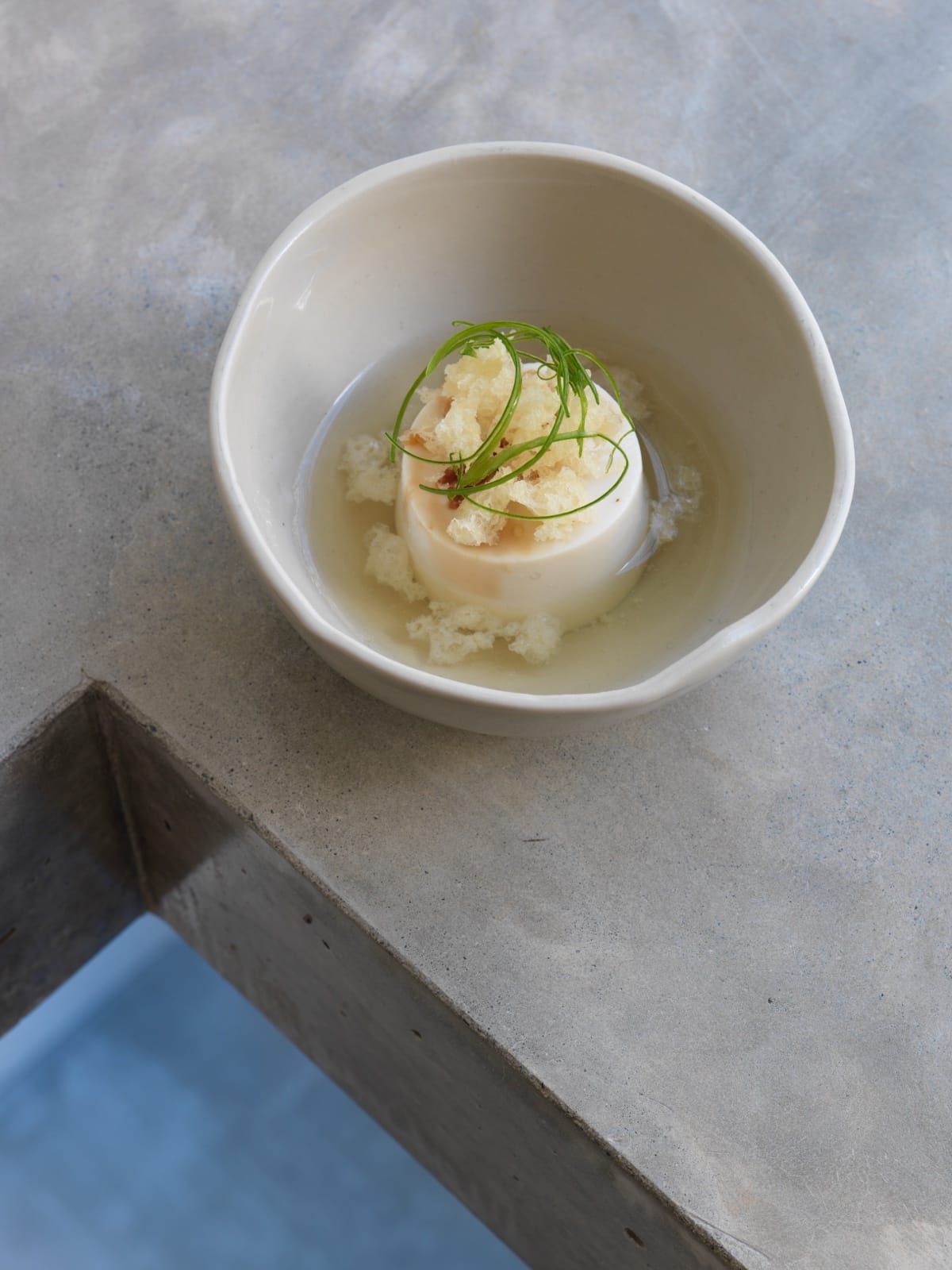
Take Cho Cho San, a recent addition to the inner-Sydney up-and-coming hip area of Potts Point, where the baseline is Japanese food, raw bar, shared portions, delicate grill. The minimalist design of longitudinal bar tables and stools in greys and creams and the exposed, walls in white plaster go well with the attitude and the relaxed setting.
The chef is an Australian-born Chinese-Burmese, which means he is, like the food, Australian. I say Australian because each dish is distinguished by its eclectic richness – and here’s what makes the Sydney dining scene so great – each ingredient adds to the mix. You have a certain adherence to culinary traditions combined with the almost contradictory openness of being a multicultural city – only Sydney could combine almost sushi portions of grilled lamb with tempura eggplant or snow crab omelette with Japanese curry.
In essence, the trick with Sydney is owning it both ways, like the ‘surf and turf’ motif, which is the combination of both seafood and meat – and the best of both, so you’ll have lobster and filet mignon, for instance. So if the Sydney coffee is the flat white, then what is the Sydney dish? Contrary to outdated clichés, real Sydney cuisine is not a BBQ grill but rather the synthesis of Australian produce, both by land and sea.
For this, the Pei Modern in Four Seasons would be a perfect place to sample the ‘local’ cuisine. In the layered burgundies, browns and ochre of the restaurant’s interior, you’ll experience a menu that is the culmination of all that is grown, fished and farmed. You see, a truly Sydney restaurant sees no reason why beef tartare and sea urchin should not be paired; snapper and salmon tail, cooked on the bone, are given equal billing to Australian Wagyu beef or Black Angus. This is the meaning behind surf and turf, and the quintessential Sydney cuisine, which is Asian-influenced with a European twist, all the while combined, shared and open, as is the charming Australian way.
That’s not to say that the original has been supplanted by the combination. Ask a typical Sydneysider for the best brunch around and you’ll get one of two popular but very divergent answers. The first is a café favourite: sunny fresh eggs, salmon, pancakes, flat white and whatever else you could imagine, after a dawn surf. The second is Yum Cha. Inappropriately called Dim Sum elsewhere (which is the Cantonese noun for dumplings, but literally means to ‘touch the heart’ as in how good the taste is), Yum Cha in Sydney is rigorously authentic.
Marigold, in Chinatown, is an institution. The staff, though serving several hundred customers on any given morning are relentlessly dressed in suits and Cheongsums (embroidered tunics for women). The ‘aunties’, as you would call them politely, wheel trolleys calling out their selection and you are as equally likely to see a table fiercely guarded by the early rising Chinese grandmother as you are to see blonde and blue-eyed families at ease with ordering portions in their original Chinese names.
That’s because Sydney is the kind of place where people pay homage to the heritage of the food and save worn-out terms like “fusion” for elsewhere – people would rather be both faithful to the past and adventurous in the present. For example, it is known that Korean is one of the greatest, less renowned, cuisines of the world. That’s why you can find restaurants like Kim, contemporary Korean, in Sydney’s King’s Cross, adding an Australian twist to kim chee (the Korean panacea of pickled vegetables), Bulgogi (marinated roast beef) and Prawn jang.
Coming back to why Sydney’s food is so good. Our Yum Cha host asked himself the very same thing when, 25 years ago, he migrated with his family from Singapore. Why was the Chinese, Malaysian and Indian better in Sydney than that served by the street hawkers of his own culinary giant of a metropolis? The answer was there, laid out across the table for us to see, garbled in the polyglot of our fellow diners. It was the wealth of Australian produce, wealth by land and sea. It was the diversity of the migrant peoples, wedded in their traditions but constantly evolving and open to change. It was in the natural beauty of the land and its bounty, a heterogenous lifestyle. It was Sydney.