A ‘world premier’ may be a scintillating concept but in my experience, the reality rarely delivers. This thought sprung to my mind as I sat in a VIP room in the bowels of Pasha nightclub in Dubai. Journalists, car dealers and sheikhs of all shapes and sizes were assembled for the unveiling of Nissan’s latest venture into the GCC, namely the launch of Nismo, its motorsport and performance brand. The atmosphere was fraught with apprehension as we were promised not only a world premier but an “historical event in the Middle East”.
“Nismo is the ultimate essence of Nissan’s promise to deliver innovation that excites,” began Samir Cherfan, Managing Director of Nissan Middle East. As you’d expect given its name is an abbreviation of Nissan and Motorsport, the subsidiary firm was founded in 1984 with the remit of handling the motorsports and performance interests of its Yokohama-based parent company. Over the years it has demonstrated some truly maverick engineering and they’ve enjoyed notable success in Rally, Super GT, and endurance racing.
But we are gathered here today to bear witness to a new line of road-going sports models, as well as learn about how Nissan is introducing the GT Academy to our region. The latter is a programme run by Nissan and PlayStation to provide an alternative route into mainstream motorsport by giving gamers the chance to go from virtual to reality. With the Middle East becoming an ever more important market for the auto industry, Cherfan cites Nismo as a key element to Nissan’s expansion strategy here.
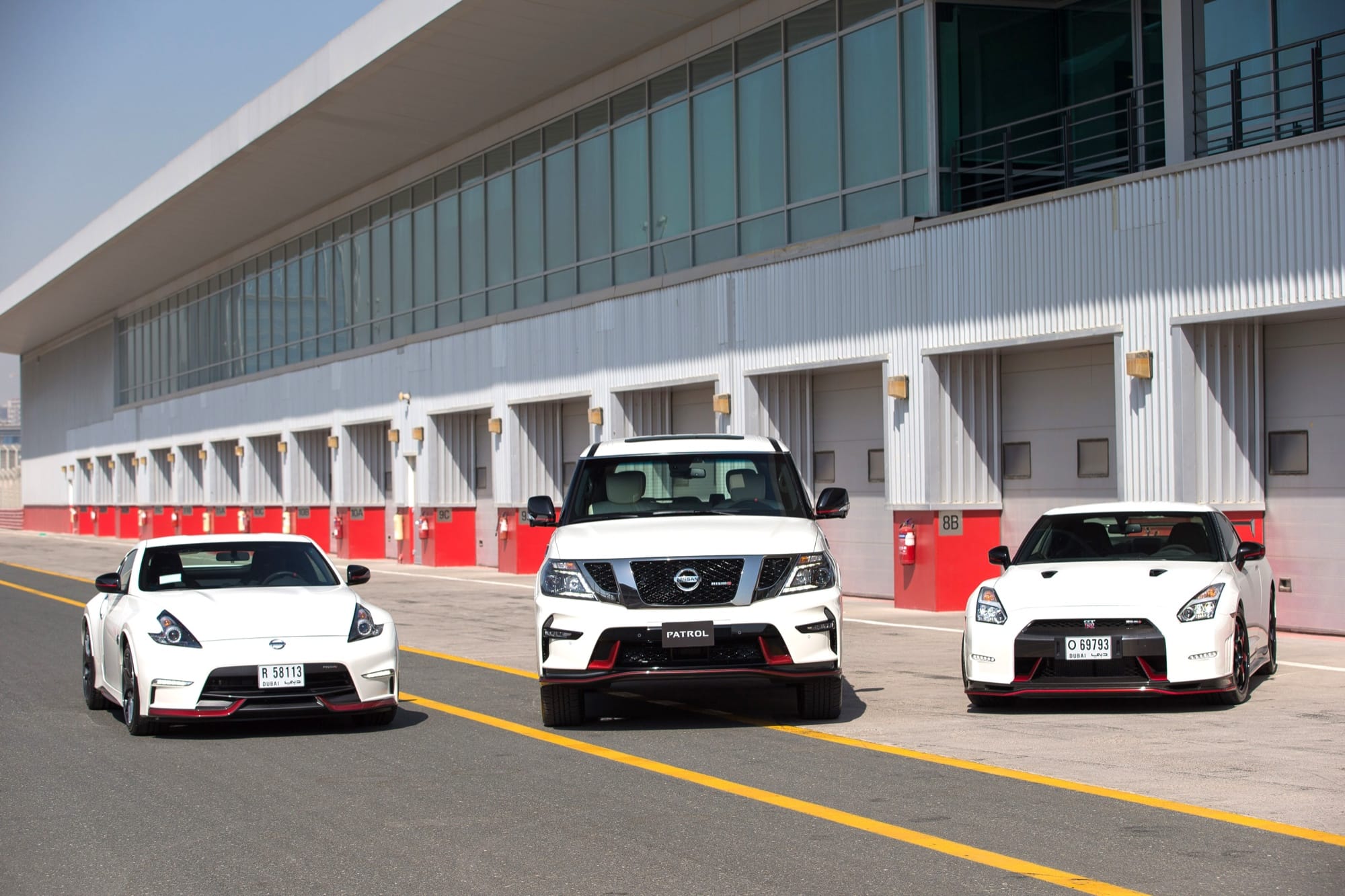
Following some energetic words from CEO Shoichi Miyatani and Chief Product Specialist Hiroshi Tamara, it was finally time for the unveiling of the three covered cars before us. First up was the GT-R Nismo, a race-inspired update of the legendary GT-R with 600bhp, advanced aerodynamics, and a top speed of 300km/h. Next was the revised version of the 370Z Nismo, a coupé with a new, sleeker exterior, a retuned suspension and exclusive Recaro seats. But it was the unveiling of the final car, the SUV Patrol Nismo or rather, as it was introduced, “the hero of all terrains in life” that elicited gasps of wonder and a spontaneous round of applause from the crowd. We were then ushered outside to marvel at this new leviathan.
At first, it wasn’t immediately clear to me quite how this enormous SUV had garnered such a legendary status in this part of the world but, with a little probing, I soon found out. It seems the regular Patrol is, in fact, a multiple record-breaker: not only has it achieved a Guinness World Record by ascending a 100-metre sand dune in just 4.9 seconds but it also displayed immense pulling power when it managed to tow a three-tonne cargo plane. The model has become synonymous with superior performance and luxury, combined with very impressive off-road capabilities and these are of course the right boxes to tick in this part of the world. In fact, in Nissan’s language, the Patrol is “becoming an inseparable part of the social and cultural DNA of the Middle East”, which explains why the Patrol Nismo was actually developed specifically for our region and won’t be available anywhere else.
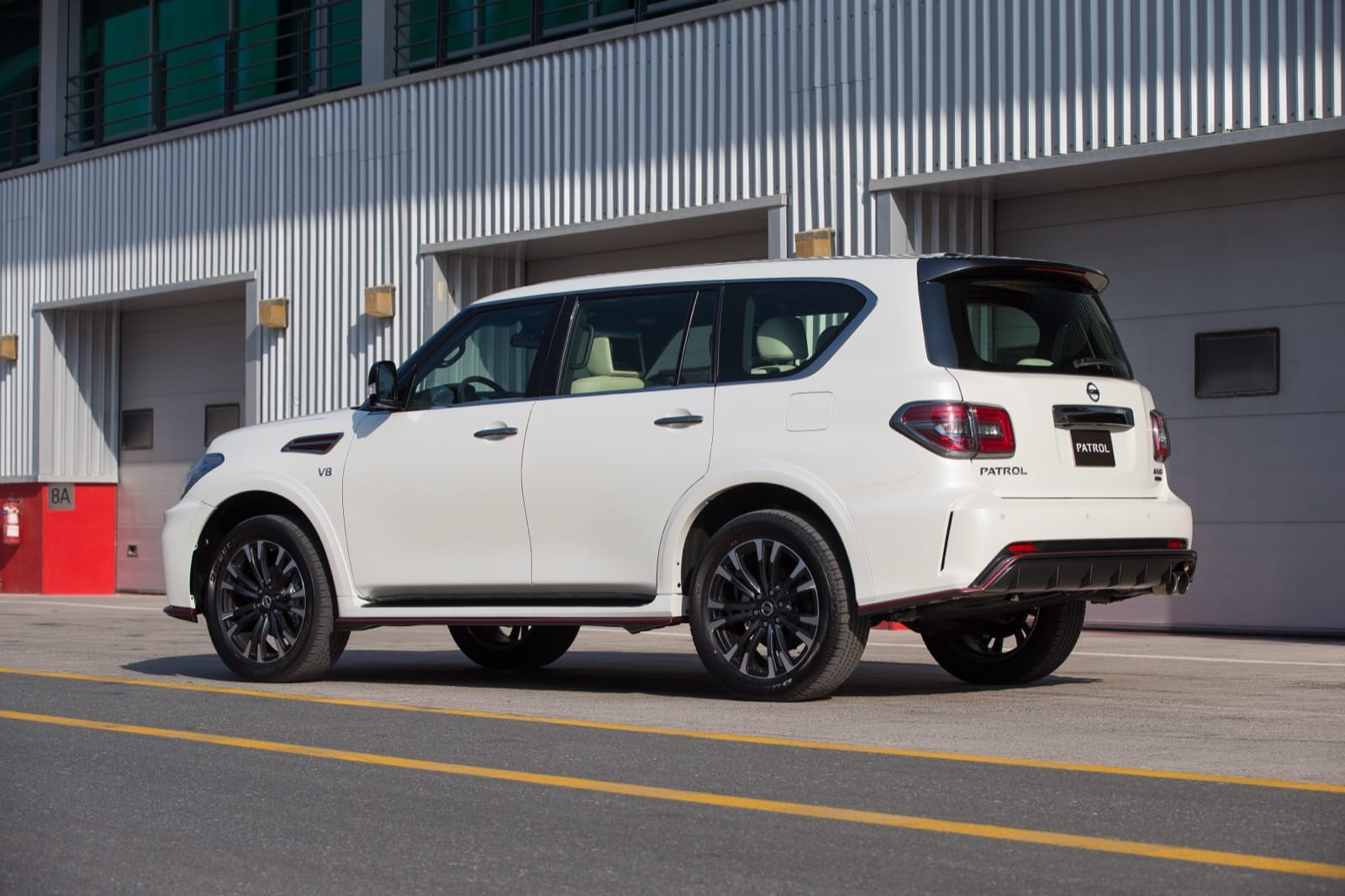
An upgrade on the base model in a number of ways, it still however retains the characteristics that have made it so popular. There’s now a more sporty steering, a zero-lift aerodynamic body kit, a 428bhp engine and a new suspension system which uses Bilstein shock absorbers for improved handling and ride comfort. Although the top half may look similar to the regular Patrol, the redesigned bumpers, side skirts and red accents lend it a distinctive appearance. And if you haven’t noticed its more flashy intentions, then the massive 22-inch Rays alloys and lowered suspension definitely give the game away.
The next day had us at the Dubai Autodrome, a dystopian multi-purpose motorsports facility on the outskirts of the city. The circuit, containing six different configurations, was the location for the test drive of the Patrol Nismo and the GT-R Nismo. Unfortunately, because the Patrol Nismo was still a prototype, we were told that we would be passengers with a driver behind the wheel. Nevertheless, the drive was fast, yet smooth, and each turn felt as level as a straight section.
As for the GT-R, a souped-up, mean-looking, racing beast winking in the desert sun, a professional driver was also assigned to each car but luckily they were seated on the passenger side this time. While ride height hasn’t changed from the previous model, aerodynamic enhancement lowers the centre of gravity, giving more control. Pressing the gas, the Japanese 3.8-litre V6 responds quickly. “Start braking now,” said the driver, a long way from the corner but soon I was in it, tickling the accelerator as I passed through the apex. The road holding was exceptional and the speed through the corners was exhilarating, helped no doubt by bespoke Dunlop tyres. Coming to the straight, it was clear that acceleration is one of this car’s greatest strengths: it does 0-100km/h in 2.7 seconds.
The breathtaking speed and wondrous handling make this the ultimate incarnation of the GT-R. Sadly, the two laps went by in an instant and the next group’s arrival signalled an end to all the fun, and, one of the rare instances where a world premier really delivers.