Possibly the best adjective to describe Matteo Molinari’s style is ‘invigorating’. His penchant for fusing sharp tailoring with offbeat elements like handcrafted crochet is nothing short of cutting edge in a world of menswear dominated by tradition.
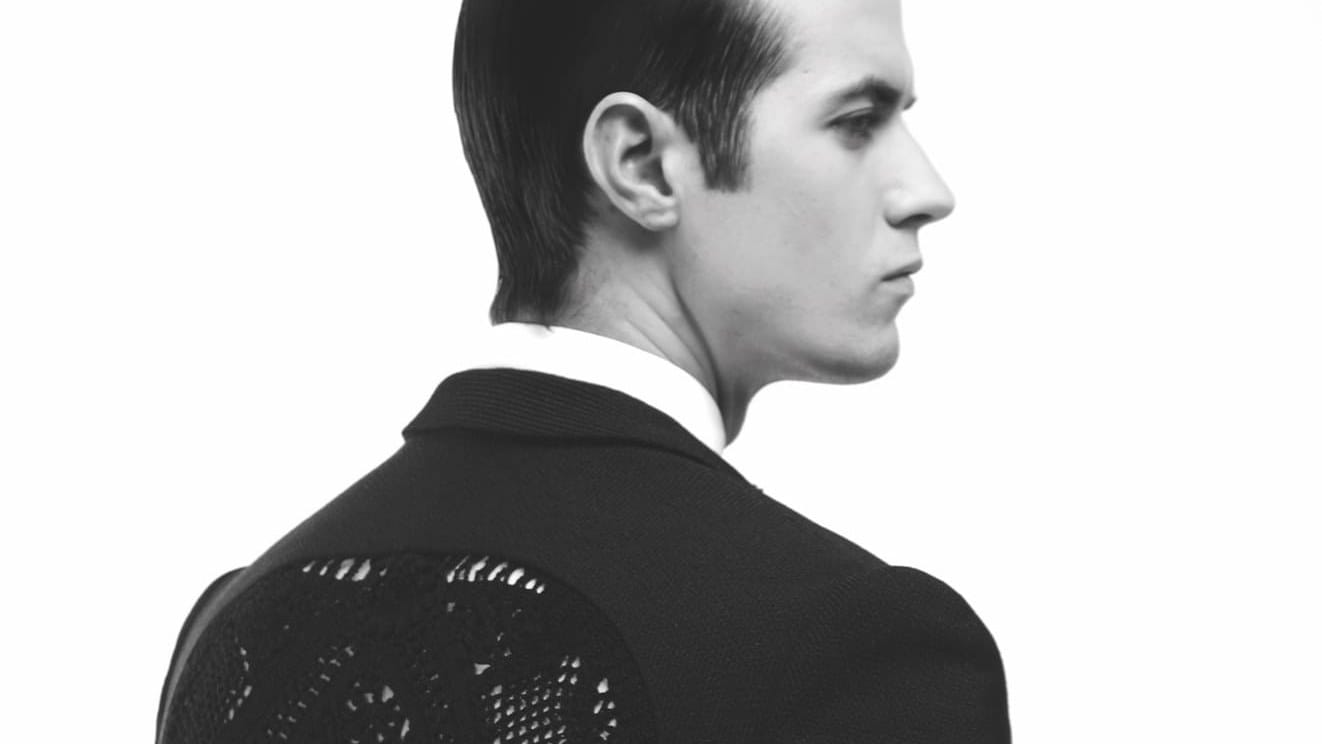
One of fashion’s fastest rising stars, Molinari has little show for himself apart from that first, student collection. But what a sensation it was. Male models swathed in loose-fitting coats with dramatically oversized knitted collars were followed by a batch of sharply-dressed boys in tailored trenchcoats and Bolero jackets with tails, with panels of crochetwork set in their backs, who danced their way down the catwalk.
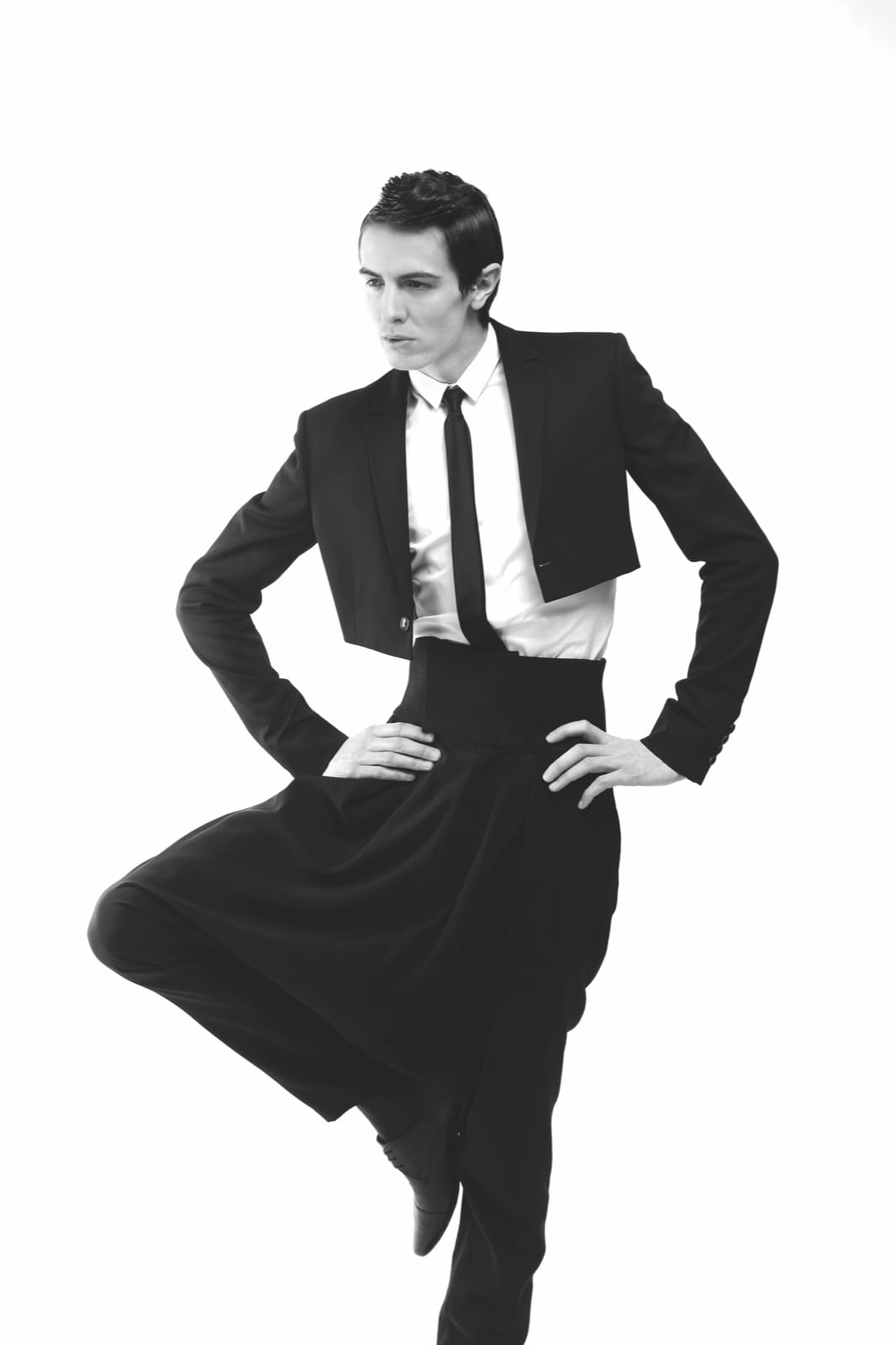
“I changed the proportions of the suits,” he explains with a degree of understatement in the introduction to that collection. “Jackets are cut short, the waist of the trousers is very high, similar to a man’s corset. I adopted the high waist because I found it interesting how it cuts a man’s body optically. The coats have a boxy but structured construction that retain an architectural feel.”
Stunning to look at, these pieces are not for the faint of heart but then the young designer wants to make a difference not only to the way men dress but to the way fashion is perceived in general. The fact that as a woman, I would be happy to wear some of those clothes – especially the Bolero jacket and the low-crotch sherwal-style trousers - might be your first indication that these aren’t clothes for the average man and it’s hard not to admire their daring, which was one of the factors that won him the British Fashion Council’s award for Best Collection of the Year.
Of course, I may be a little biased. In the interests of full transparency, you should know that Matteo is a dear friend and more than that, one of the warmest, most down to earth people I know. A joy to have at the dinner table and surprisingly shy, he’s highbrow and cerebral. Get him talking about fashion, design or, for that matter semiotics, and the effect is hypnotic.
His personal style perfectly illustrates the ethos underpinning his designs. Not that you’ll find him dancing down a catwalk in a pair of low-slung pants but rather that some days, Matteo looks like he runs a hedge fund and on others, he looks like an artist. More often than not, he’s a combination of the two: traditional and bohemian, sharply tailored and quirky. These dual, antagonistic elements are very much a part of his personality and lie at the heart of his signature but still evolving style.
It might all have been so different. Born and bred in Auronzo di Cadore, a small mountain town in the Italian Alps, Matteo experimented with fashion as a child – his first sketches were of jumpers and scarves, inspired by Auronzo’s long, snowy winters, which his mother and aunts eagerly knitted into reality – but when it came time to study, he went in a completely different direction.
His first degree was a Bachelors in Philosophy, which he swiftly followed with a Masters in Semiotics. As a result, he tends to approach fashion from an analytical, almost scientific perspective. In this respect, he’s like a kind of practical, hands-on version of one of his heroes, French literary theorist Roland Barthes, who Molinari says was as among the first to link fashion and popular culture with semiotics.
Upon leaving college, Matteo took a position designing handbags and other accessories for a local company and quickly discovered that he enjoyed the process of research and experimentation and the creation of a finished product as much as he did philosophy and theory. Deciding this was where his future lay, he enrolled for a Master’s at London’s College of Fashion.
His interest in women’s fashion waned and unable to find anything he wanted to wear himself, he turned his attention to menswear instead. “It’s definitely a smaller market but it’s also one that is growing faster,” he says. “Modern men are becoming very aware of their appearance.”
As he did, he began to explore the meaning of the pieces he was designing, the message each pieces was sending out. It was as a result of this and his background in philosophy that led him to work with fabrics and techniques more usually associated with women; crochet, lace and needlework. “Actually I always thought crochet was one of the more tacky things,” he writes in the introduction to his student collection, explaining how it came about. “I was having a lot of trouble trying to find a textile technique that fit the theoretical research and the more conceptual aspects of my project. I was thinking about pleating, smocking and other ways to work on the fabric surface… until I randomly opened a book borrowed from the library called Crochet Workshop by James Walters. I saw a diagram of a mysterious crochet pattern that was a perfect example of Symbolism.”
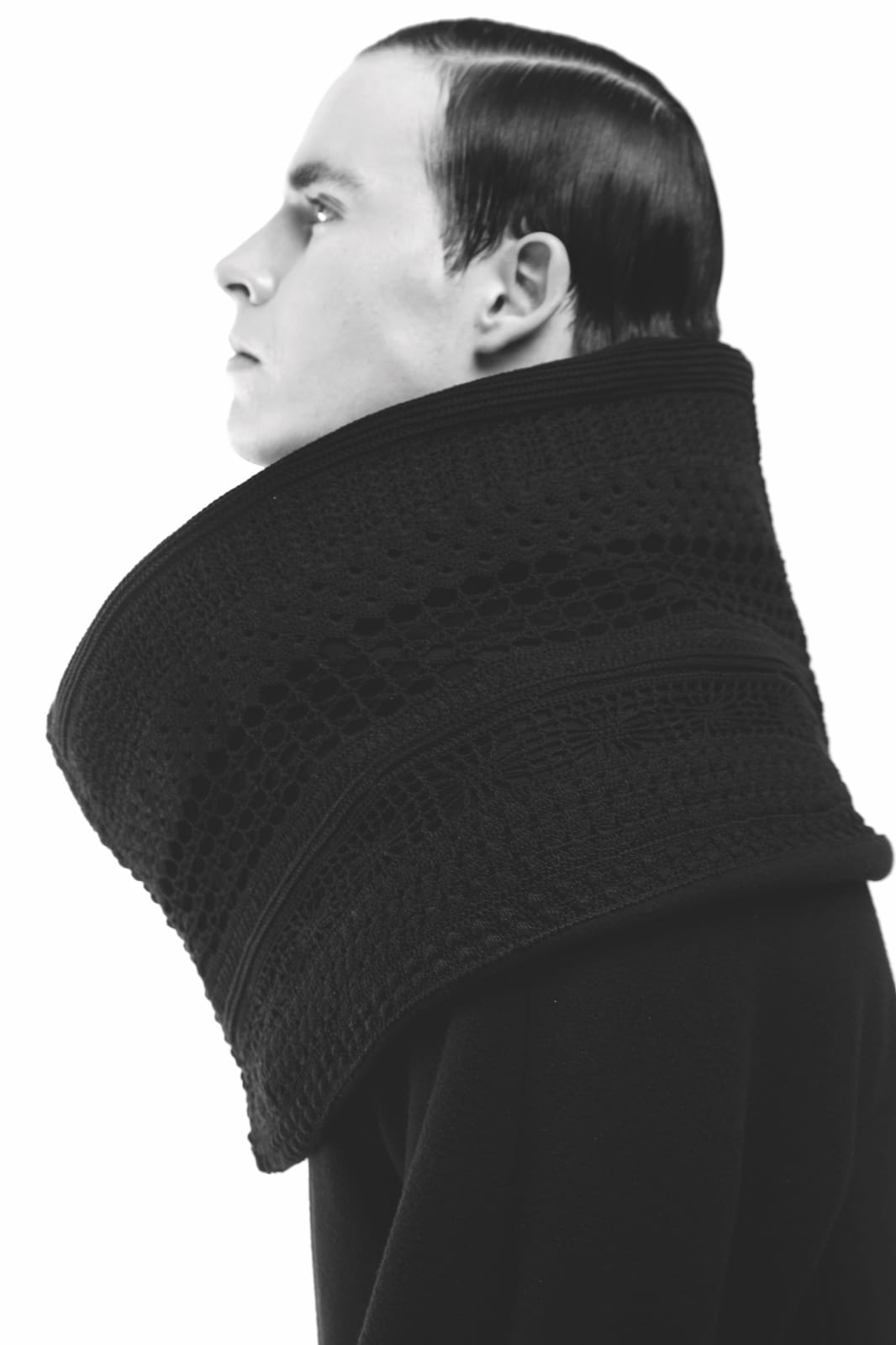
His two worlds met and Molinari became determined to find a way to incorporate the fabric into his designs but knew he would have to find a way to make it work for men. “We developed stitches that were graphic and masculine, working on the texture of the surfaces, creating a thick and textured fabric characterised by the alternation of full and open stitches,” he continues. “The crochet typology is a mixture of free-form crochet and the more traditional and symmetrical crochet. The development of the crochet was quite a long process, because it has a mathematical structure that remains, a kind of fractal geometry.”
Not the kind of rational you read everyday in Vogue but then Matteo isn’t an everyday designer. Currently working on his spring-summer 2013 collection, which he will unveil at London Menswear Week in June, he’s keeping details top secret, though he does reveal that he’s considering supplementing his trademark black and white palette with a little colour and that more handcrafted elements will feature. Whether that will be embroidery, crochet, lace or something else, for now, that will have to remain a surprise.