In recent years, any mention of ‘America’ in the Middle East has often been preceded by the words ‘Death to’. Not getting involved enough in Palestine. Getting too involved elsewhere. Iraq. Afghanistan. Libya. It does sometimes seem that anti-American sentiment is as intrinsic to the Middle East as anti-Middle Eastern sentiment is to America.
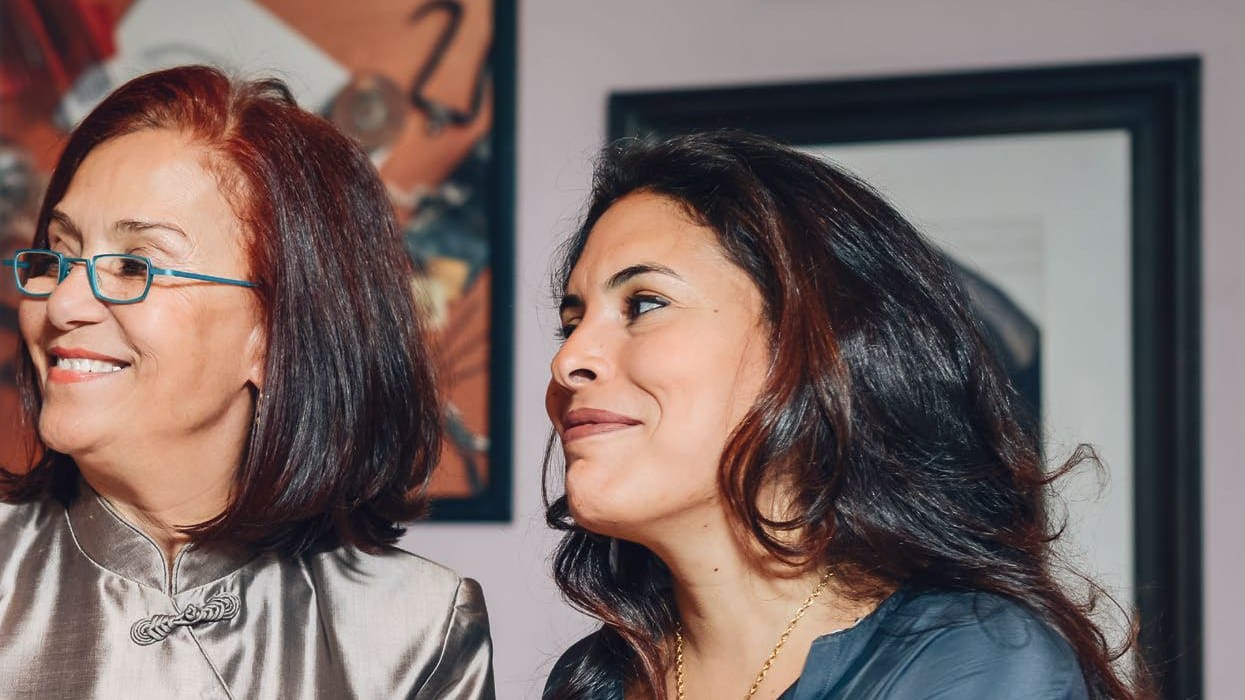
This is one reason then, why the work of Kate Seelye and her sister, Ammanda Salzman-Seelye, is so welcome. Daughters of a diplomat – Talcott Seelye served in various roles, including twice as ambassador, in Jordan, Kuwait, Saudi Arabia, Tunisia, Lebanon and Syria – they grew up between America and the Middle East.
After a career as a journalist for NPR in Beirut, which included a stint as documentary filmmaker for the likes of PBS, Kate has followed her father into politics and is now senior vice president of the Middle East Institute in Washington D.C. For her part, Ammanda has chosen a different path and maintains her connection to the region through art.
“I first developed an interest in art while I was a child in Kuwait in the 1950s,” she explains to me. “My work explores and critiques American encounters with the Arab world through the lens of one family’s history in the region.”
That family, of course, is their own. On both sides. Kate and Ammanda’s mother’s ancestors began working in what is now eastern Turkey, northern Syria and Kurdistan in 1848, as missionaries and later as doctors. The first Seelye to come, Julius Hawley Seelye, a U.S. representative and former president of Amherst College, became a medical missionary in what were then the Ottoman eyalets of Van, Diyarbakir, Erzurum and Mosul in the 1870s.
Two generations later, the Seelyes had left the missionary work behind to concentrate on education. The sisters’ grandfather was a lecturer at the American University of Beirut in the 1920s and it was here that their father, Talcott, was born.
Kate and Ammanda’s journey into their family’s past grew out of an ongoing project Kate began while she was working in Beirut. After re-discovering her grandfather’s grave in a rather neglected cemetery on the opposite side of the expressway that now runs from Ashrafiye up to Hazmieh, she became curious to discover more and began interviewing family members. In the process, she dug up a series of diaries kept by her early ancestors as well as a trove of old photographs, Daguerreotypes and film footage, which she has begun to shape into a family documentary.
For the most part, the photos are family snaps, pictures of wives and children as well as landscapes and trips to famous historical sites but through them, a picture emerges, not just of a long-vanished Middle East (and long-vanished Middle Eastern traditions) but also of the pleasure this very American family clearly had living here.
And so alongside the shots of veiled women carrying water, camels on what would later become Hamra Street, performing bears and visits to Bedouin dignitaries, there are images of ordinary life; a visit to the souks in Jeddah, swimming in the Red Sea, afternoons in Sidi Bou Said, trips up into Mount Lebanon and (pre-1948) images of the drive from Beirut to Jerusalem. In them all, Kate and Ammanda’s relatives, who spoke fluent Arabic and many of whom also spoke Armenian, Turkish, Persian and Kurdish, can be seen looking completely at home.
What the sisters have done with these images is twofold. Ammanda has transformed some through silk printing, adding her own layers to the photos. This can be as simple as deciding to juxtapose scenes of today and yesterday but also includes more thought-provoking visual commentaries. Though she also works with her immediate family photos, her paintings focus more on the lives of her distant ancestors.
“I work on the photographs with paint, collage and silk screen because this allows me to create the layering I need to express my personal narrative and then enlarge them digitally,” Ammanda explains. “By mining the material, I’m able to reveal a complex tableau of American experiences in the Arab world. My intention all along has been to share these images and to be a chronicler of the lost and forgotten worlds of the past. I’m also hoping to show new ways of seeing the Arab world through the arc of time and history and the continuity of our family’s enduring relationship with the region.”
Kate’s contribution to the show is a 10-minute film that permits viewers to take a peek into the life of one (relatively privileged) American family in the Middle East in the 1950s, 60s and 70s.
“There are fabulous images of my mother on a beach in Beirut in the 1950s and of us splashing about in water in Tunisia,” she says, smiling at the memory. “In Saudi Arabia in the 1960s, you’ll see Westerners walking the souks in sleeveless dresses and swimming in bikinis. There were more personal freedoms then than today. It shows a very different Arab world, you get snippets of the secular atmosphere of the times.”
While neither sister was entirely sure how Arab audiences would respond to images of an American family, especially one that had originally come to the region for somewhat controversial reasons, both say that so far, they have been met with warmth and enthusiasm.
“I suppose for Arab audiences, these images represent an easier time and in a time of great upheaval, like today, people take great comfort from their past,” Kate continues. “Remember, the 1950s and 60s were periods of great hope. The region was coming out of colonialism and gaining independence. It was run by a smart technocratic class, who saw the great potential of the Arab world. That potential still has not been realised 40, 50 years later, but then that’s also part of the nostalgia in these photos.”
To date, they have exhibited twice in the region – once in Abu Dhabi and once in Kuwait, where some of Ammanda’s pieces were sold to Sabah family members. They’re keen to exhibit elsewhere in the region – the geographical and historical reach of the collection means that they have photos of almost everywhere – but are even more keen to exhibit in the United States.
“More than showing these images in the Arab world, I think it’s important to show Americans the experiences our family had here. As surprising as some of it might be for the region, it is even more surprising for Americans to see how comfortable and well-integrated Americans were,” Kate says, explaining their interest in exhibiting at home. “Our show tells a very positive story, it tells of connections and of the very human ties between Arabs and Americans over the last 160 years. That’s a story that remains untold in the U.S. and it’s Americans that need to know this story the most.”
“Given the current state of relations between the region and the U.S., people in the States tend to react to my family history with curiosity and even some ignorance,” Ammanda says in agreement. “The Middle East is so rich, so important and so misunderstood. We show a more positive past, when there was a better relationship between Americans and Arabs. If there is one message I hope viewers will take away with them, it is that this past can also be our future.”