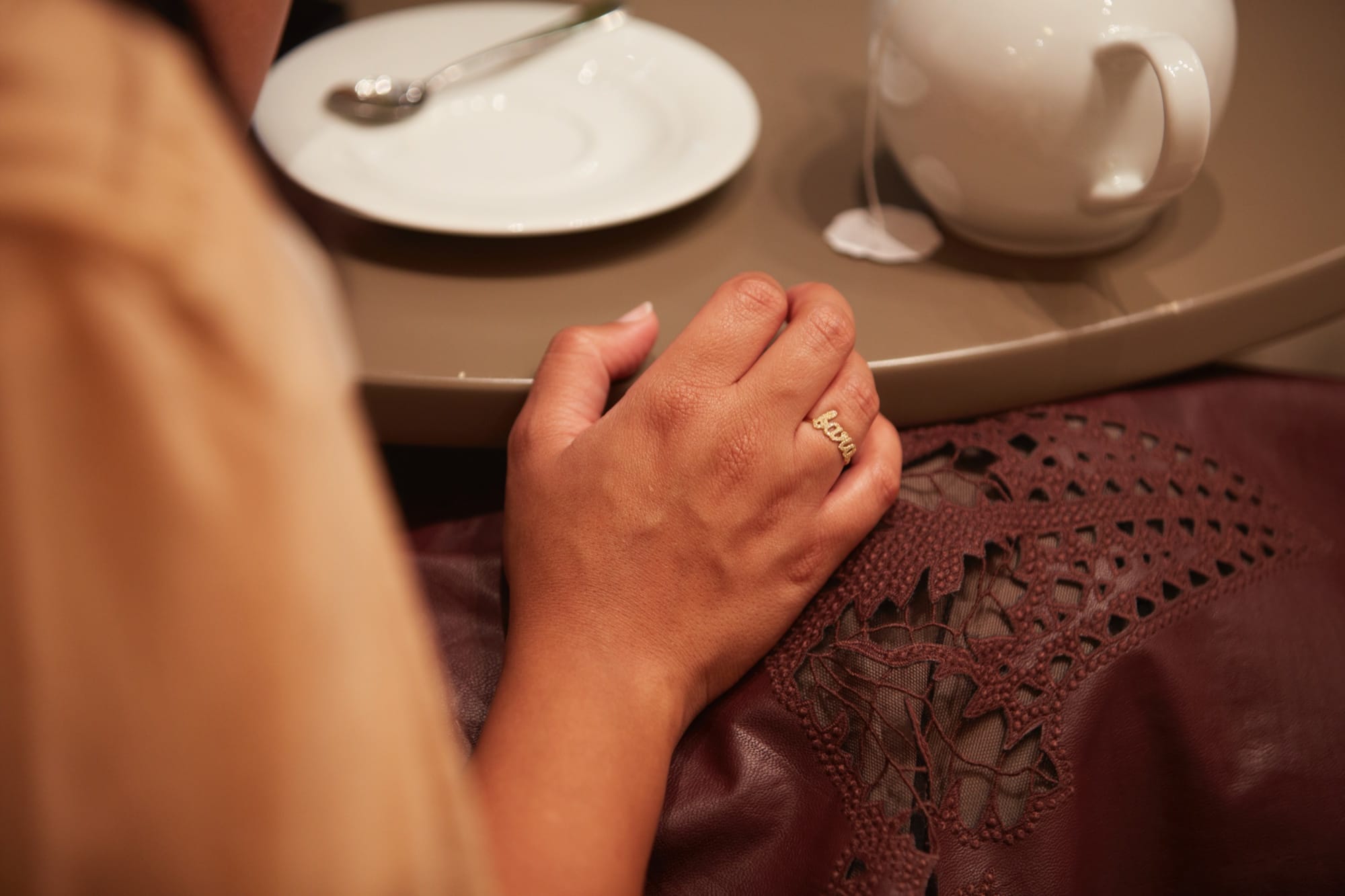
As I speak with HRH Princess Reema Bint Bandar Al Saud, the first thing that comes to mind is “My Life is in This Bag,” an exhibit I saw at the Tod’s factory on a visit last year.
A series of life–sized photos of the bags of six female entrepreneurs, it was a testament to how much the modern woman carries around with her. The contents spilled forth in a creative wash of phones, sunglasses, keys, handwritten crumpled notes, fruit and books. One woman even had a pair of dumbbells in her purse.
Then, I flash on an image of a woman rummaging frantically through her bag to find her keys, pulling out make-up, wallet and other things in the process. This is the picture Al Saud is painting. “It doesn’t look graceful. Your bag becomes a big black hole when you don’t have an appropriate place to reach for or know exactly where everything is,” she tells me as we begin discussing her Baraboux handbags, a project that was born out of this frustration.
“I would use men’s travel accessories to store my cosmetics and keep things apart but they aren’t exactly pretty,” she continues. “Then there’s the problem of being constantly on the move.” Growing up as the daughter of a Saudi diplomat, her family often had to travel at a moment’s notice. From a young age, she learned that she could only take what she needed. “When you travel frequently, the element of luxury disappears. The greatest luxury you can have is time. I would end up with the wrong bag because my business cards were in one, my charger in another and I was in a hurry. I thought to myself, I cannot be the only woman facing these issues. So the idea of Baraboux came from the need to keep the chaos out, have everything in one place, one multifaceted bag for endless destinations.”
If Al Saud seems a little obsessive about details, it has to do with the way she was brought up. “In my family, we’re a bit too rational,” she confides. “There are eight of us, so as children we had to struggle to make our voices heard and come up with strategic proposals to convince our parents. So it makes sense I wanted to create a system that works, not fantasy products.”
Somewhat boxy but still elegant, the Baraboux line is united by a single thread. Less ornate carrying cases than functional designs, they’re clever packing solutions with sliding compartments and transferrable pouches that double as clutches. They can be detached to form smaller purses or attached inside bigger bags with hidden magnets. “Initially,” Al Saud explains, “my pieces looked like orphans, they weren’t linked aesthetically. Creating a coherent collection of tote, evening and travel bags was retro-active.”
Looking at her creations though, you’d think it is the aesthetics that takes precedence. There’s textural contrast through the pairing of leather with transparent vinyl and shiny laser-cut patterns or grainy, exotic skins in a patchwork of colours that morph fluidly. It’s not the smart folds, slip pockets and corner flaps, sections clearly designated and sized to accommodate the phone, lipstick or iPad, that are immediately apparent.
Take her eponymous clutch, Reema. Cylindrical in form, it’s covered in snakeskin that’s antique rose or charcoal black, with a stingray cuff (in grey or yellow) and sports an elongated rhombus at its centre. Despite the glamour, the real treasure is in the cuff, which is a connector that slides so each side can open separately. The reasoning behind this is calculated. “You probably don’t want to keep your phone near your keys, they can scratch it, or expose everything in your bag all at once when your phone rings,” she explains. “I was in Florence, where the manufacture is and where I roll up my sleeves and get dirty. I took a long look at the different shells of bags, wanting to see what would happen if you slid one into another and got rid of the inner wall so they fit together like a puzzle. They told me it wasn’t possible. We worked on it for a year and a half to make it happen.”
Although Al Saud says she is averse to being considered a local designer, because she designs for women everywhere, she admits her inspiration comes from the Bedouins. “They didn’t carry emotional baggage or have time for vanity. Everything had a place and purpose, nothing was superfluous. Time was of the essence, whether you had to pack before a sandstorm came or set up in the desert before night fell. I’d say my guidebook for packing efficiently comes from them. It’s a nomadic trait, not an urban one.”
Her first taste of nomadic culture was through the Bedouin artefacts her mother collected when they were living in Washington D.C., which grew into one of the largest collections of material culture from the Arab world. Al Saud decided to pursue museum studies at university and went on to do an internship at L’Institut du Monde Arabe in Paris. “I thought it was my calling and I’d end my days in museum archives. But then I got pregnant. I loved being a stay-at-home mum and I became far removed from the world of historic preservation,” Al Saud continues. “When we moved back to Saudi Arabia after 23 years in the U.S., the environment at the National Museum wasn’t woman-friendly. We didn’t want to give away my mother’s collection so we combined it with my grandmother’s private foundation to form the Art of Heritage, which now reproduces Bedouin products, designed by Saudi women. Rather then being locked into boxes, they’re living pieces.”
A solid businesswoman Al Saud may be but as our conversation deepens, it becomes clear she is also someone who wants to improve the conditions for women in her home country. To do so, she wears many hats. As CEO of Alfa International, the holding company for the Harvey Nichols branch in Riyadh, she’s involved women in the workplace. She’s also been recently appointed Saudi Arabia’s Committee Mentor for the Advancement of Women’s Leadership in the Middle East and North Africa.
When you consider what she did for the Zahra Breast Cancer Association, of which she is founding member, that recognition is no surprise. “In 2010, I wanted to spark dialogue in a society where men are suspicious of women touching themselves to look for lumps. The lack of awareness as to how treatable breast cancer is, was demoralising. I needed to think big, I immediately went to Guinness. We used to watch the show and go through the Book of World Records when growing up, that’s the kind of family we are, I thought, why don’t we break a record? We can’t do the most mammograms because we don’t have the greatest incidence of cancer. I saw that Germany had made the largest pink ribbon of almost 3,000 people. I’ve seen more than 3,000 women at a single wedding.” And so her idea was born. Gathering 3,952 women together in a Jeddah stadium, Saudi Arabia broke the German record.
“I began thinking about how the treatment is more debilitating than the disease itself and how altitude sickness is similar to chemotherapy symptoms,” she says, explaining the thinking that led to her next consciousness-raising initiative, a trek, in 2012, as part of the first Saudi Arabian female team to reach the Everest Base Camp.
Sensing we’ve digressed, Al Saud slowly brings the conversation back to Barboux. “We went through the most varied terrains I’ve seen in my life, from the driest areas to green valleys and stark blue mountain tops, snowy and frozen. It was one of the most isolating journeys for me. We walked in a single file, avoiding animals. The air was thin and the last thing you’re in the mood for is chatting. I realised I don’t ever want to spend that much time by myself again but the natural beauty I saw influenced my first collection.”
The Everest Collection came out last year and is a vibrant and moody winter collection of electric blues, brick reds and acid yellows. This year’s spring/summer collection is even bolder, inspired by the flamboyance of florist Rambert Rigaud, former studio director for Yves Saint Laurent and Dior. Al Saud tells me that her use of colour starkly contrasts with her first pieces, all of which were neutral in tone.
At the time, she was still developing her latticework-like logo. “If you look at it in quarters, you’ll see it’s a feather. I was thinking of freedom and lightness. I like things that are balanced and symmetrical, that can be put together to form one piece and yet also function independently.” And that, it seems to me, neatly encapsulates the ethos behind this brand.