Ara Starck first came to realise just how famous her father was when she was taken to meet the President of France at the time, François Mitterrand. Philippe Starck had been asked to redecorate the President’s office and had taken his daughter with him to meet the man himself. When President Mitterrand turned to Ara, then a small eight-year-old girl, she was overwhelmed and promptly fainted. Being the daughter of one of the most famous designers in the world might make the idea of going into the same arena somewhat overwhelming. Surely any attempt at making the name Starck a reference for something other than Philippe’s work, would be a fruitless task. Yet Ara Starck was not put off. The challenge to create her own space is one that she appears to be rising to rather than eluding and at the age of thirty, Starck is now emerging as a serious artist in her own right.
Ara Starck’s first major breakthrough came with the huge piece of work that adorns the ceiling of the Dali Room in the luxury hotel Le Meurice, Paris. Le Meurice requested that Philippe Starck give the hotel a makeover and he chose his daughter’s submission, despite stiff competition. Even though the painting is in a room dedicated to Salvador Dali, Ara insists that the painting is not a surrealist piece, “I did not know that it was going to be called the Dali Room,” she says. Instead, Starck stated that she wanted a picture that reflected the space, “What happens in this hotel is often very dramatic on a personal scale - couples getting married or celebrations - so I wanted to reflect the theatrical aspect of this space”. Theatrical it certainly is. “It took me five months to do the painting and the piece was 145m²,” Starck explained. The piece was so large in fact that there were times that, Ara said, “I lost the composition of the piece. I had to use a crane to get the full perspective .” To get an idea of the scale, consider that it took ten people 16 hours to haul the painting up to the ceiling. The final result is an array of gold, pink and mauve with shadowy figures that appear to dance or fall across the giant canvas and a work of art that is certainly confrontational.
The Meurice artwork is part of Ara Stacks dedication to creating large works to be displayed in communal spaces rather than in the confines of galleries. “The confrontation that art can give on a large scale is very interesting and I am passionate about this idea. To be able to show this in a public space allows you to start a conversation where it is not expected,” Starck explained. “In a gallery people are going specifically for stimulation whereas at the Dali Room people are confronted by the painting; it is about keeping people stimulated.” Keeping people stimulated and interested is something that Ara Starck appears to have a natural flair for. While painting the piece for the Le Meurice she walked about the exclusive hotel in a tutu and fairey wings. Likewise, when her father got married for the fourth time, to Jasmine Abdellatif in 2007, Ara was the witness and attended the wedding in one of her famous tutus.
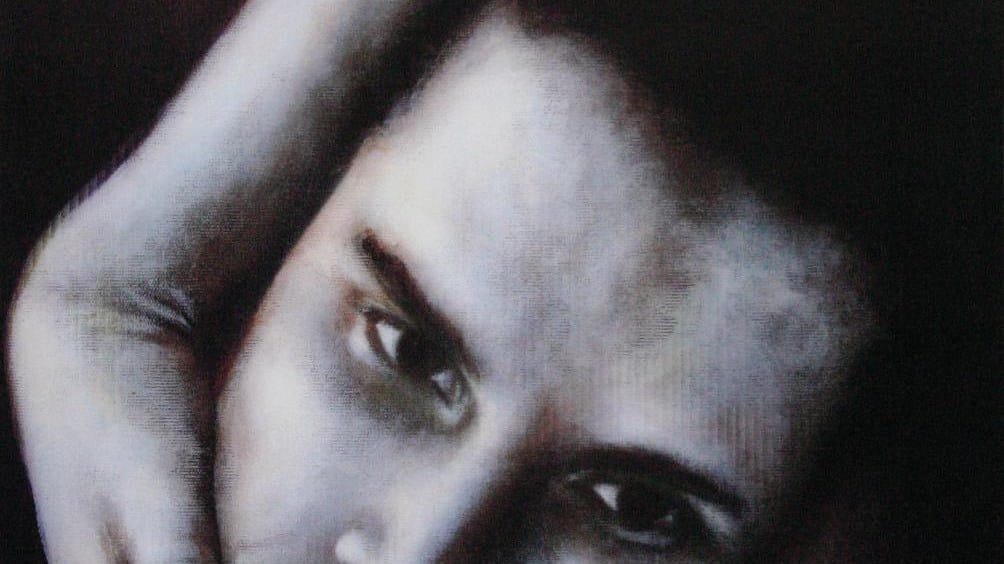
Tutus are often most associated with ballerinas yet the floating motion, the idea of fantasy or other worldliness, is something that Ara Starck’s work is very much concerned with. The first major exhibition that won her many plaudits was at Artegalore, Alter Familia, and it consisted of a series of portraits of circus performers. Here Ara connects the bizarre world of the circus with the very intimate world of the family. The portraits focused on the idea of being able to create another kind of family, “one that was not based on blood or DNA… I thought that this was a very modern way of looking at the family,” Starck explained. The circus performers are each painted individually, “the title of the pieces is the way you know that they are circus performers but you can see that they are a team,” Starck said. Each portrait has a story and sometimes Starck has to write 10 pages about the portrait before she can paint. However, with ‘The Contortionist’ it was different. “The Contortionist was a banker and he had a very poetic face. There is always one in the family who is a contortionist,” Starck said. ‘The Contortionist’ shows most poignantly the power that Starck has as a painter. The monotone palette creates a bold image and the wondering look of the subject gives a thought-provoking posture. All the portraits contain the essence of a contortionist, that there just might be something remarkable that these paintings can transform into if you look long and hard enough.
Contortion of the image is something that Starck is actively pursuing in her current exhibition at Artegalore using a cutting-edge technique called Lenticular printing. This is a technology that is used to produce images with an illusion of depth, or the ability to move as the image is viewed from different angles. There are only a few companies in the world that are able to manipulate this technique. When Ara Starck came up with the idea to use Lenticular techniques in her work the few that were able to use the technique shut the door in her face. “But then I found the crazy one who said ‘OK let’s do it’,” Starck said. The idea of Lenticular printing is that images are layered on top of one another through a complex printing technique, creating a sense of movement or depth. “This technique opens new space in your brain…it creates the space that I need by adding layers,” Starck explained. The result is unique paintings that appear to change as the viewer alters his or her position.
The creation of space has appeared to be a challenge that was laid out to Ara Starck at birth and one that she has taken up with verve. Starck’s next project is a ceiling at an opera house in Belgium that will be, “twice as big as Le Maurice,” she excitedly claimed. Further to this, Starck is working on creating yet more epic paintings and working with charcoal for an exhibition in Los Angeles. Ara Starck has created her own space and now she intends to fill it as much as possible.