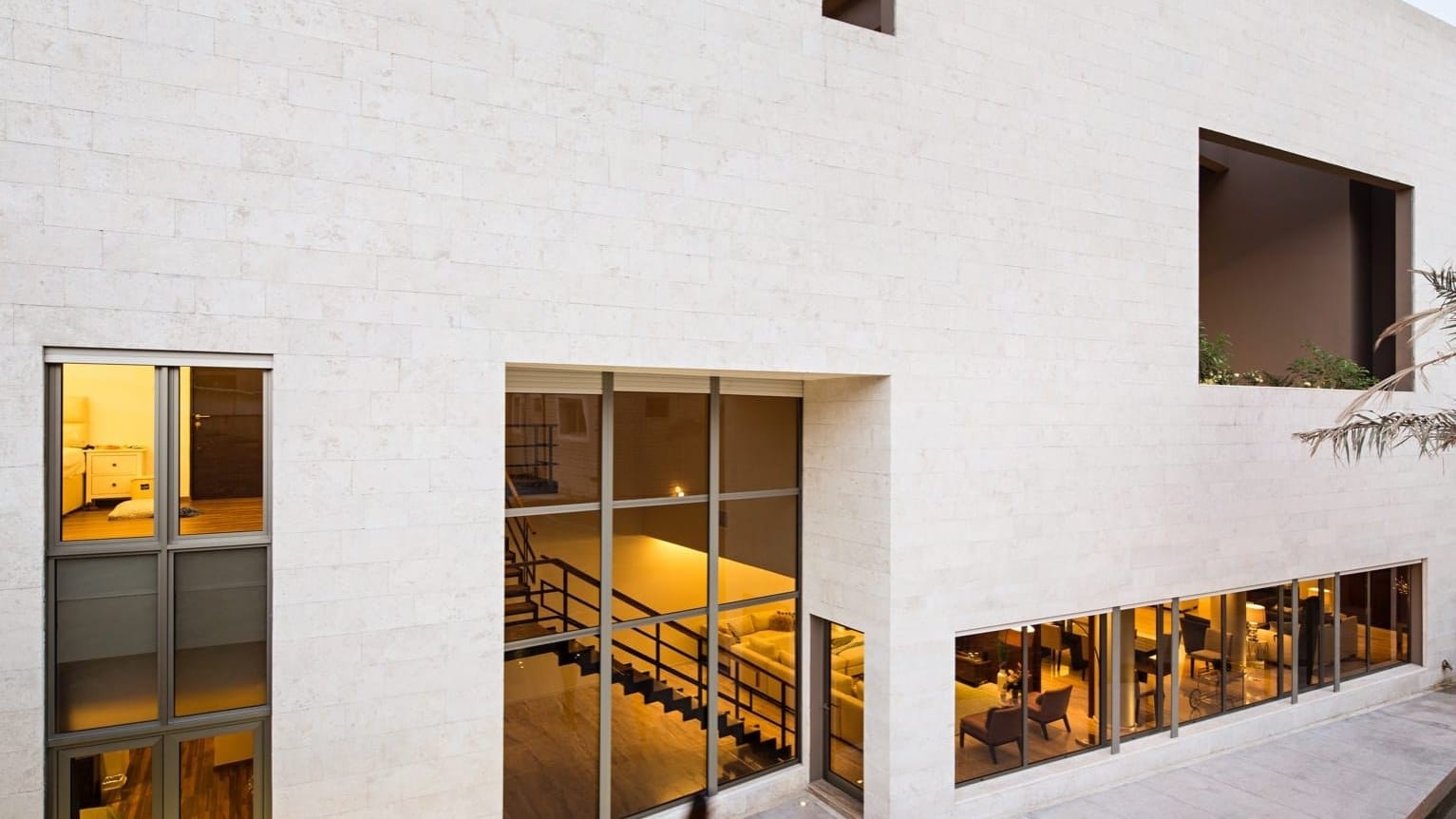
Box House is in fact not a box at all. Rather, it is an L-shaped apartment building that contains three family dwellings. More remarkable still, judging from its lean aesthetics, is that each of these three residences is uniquely shaped with their own private courtyards. The clever structure, designed by Kuwaiti architects Massive Order, disguises the complexity of its interior behind a composed and simple appearance. But, as the name implies, its form does indeed appear to be little more than an understated box when first approached.
The minimalist structure is set in Al-Rawda, in the centre of Kuwait City. Clad in a flush façade of pale beige stone, this imaginative adaptation of communal living looks at once soft and severe, reflecting its bridge between contemporary creativity and conventional family structures. Inside, the striking angles and modernist geometry that dominate the design are occasionally tempered by a surprising diagonal here or a pleasing curve there. The inward-facing exterior walls are darker brown, and reflect a soft, warm light onto the terraces and walkways. Large sliding doors and full windows bring luminous rectangles of sunlight into the building, having a transformative affect, as is the tradition in Modernist residences.
Although only just completed last year, the project was conceived seven years ago by Muhannad Albaqshi, principal architect at Massive Order and head of Interior Architecture at Kuwait’s College of Architecture. Speaking over Skype, he recalls that the owner of Box House had his own concept in mind when he initially asked Massive Order to design a large house for his family that could later function as three distinct homes once his two sons become adults with children of their own. Happily, however, the client was receptive to the architect’s more radical idea of subdividing a single box into three unique composite geometrical forms that would serve the same purpose.
Albaqshi remembers how his client made a bold move by committing to this design, still considered avant-garde compared to the majority of residential architecture. “He faced much criticism from family and friends, which often happens here in Kuwait, and which tends to keep many new architectural commissions looking quite conservative”, he explains – adding that his client is an art teacher who is in tune with contemporary design and already open to novel ideas. Referring the Gulf’s sudden hyper-modernisation in recent decades, Albaqshi describes how, “In Kuwait there is a clear cut line between primitive and modern. There was never a gradual change, so innovative people don’t really like to look back to traditional techniques”.
From an outsider’s perspective, however, the building retains certain key conventions that are important in the clan-centric culture that still pervades in the Gulf. The exterior has very little outward facing window space, with most of the openings turning in towards the centre of the building, as is usually the case in Gulf Arab housing that emphasises privacy and family entertaining. Equally, that each of the three homes has been allocated a sheltered courtyard reflects the customary importance of having an enclosed outdoor space that functions as a focal point in the home, more like an open air room than a garden, which would be a more Occidental approach.
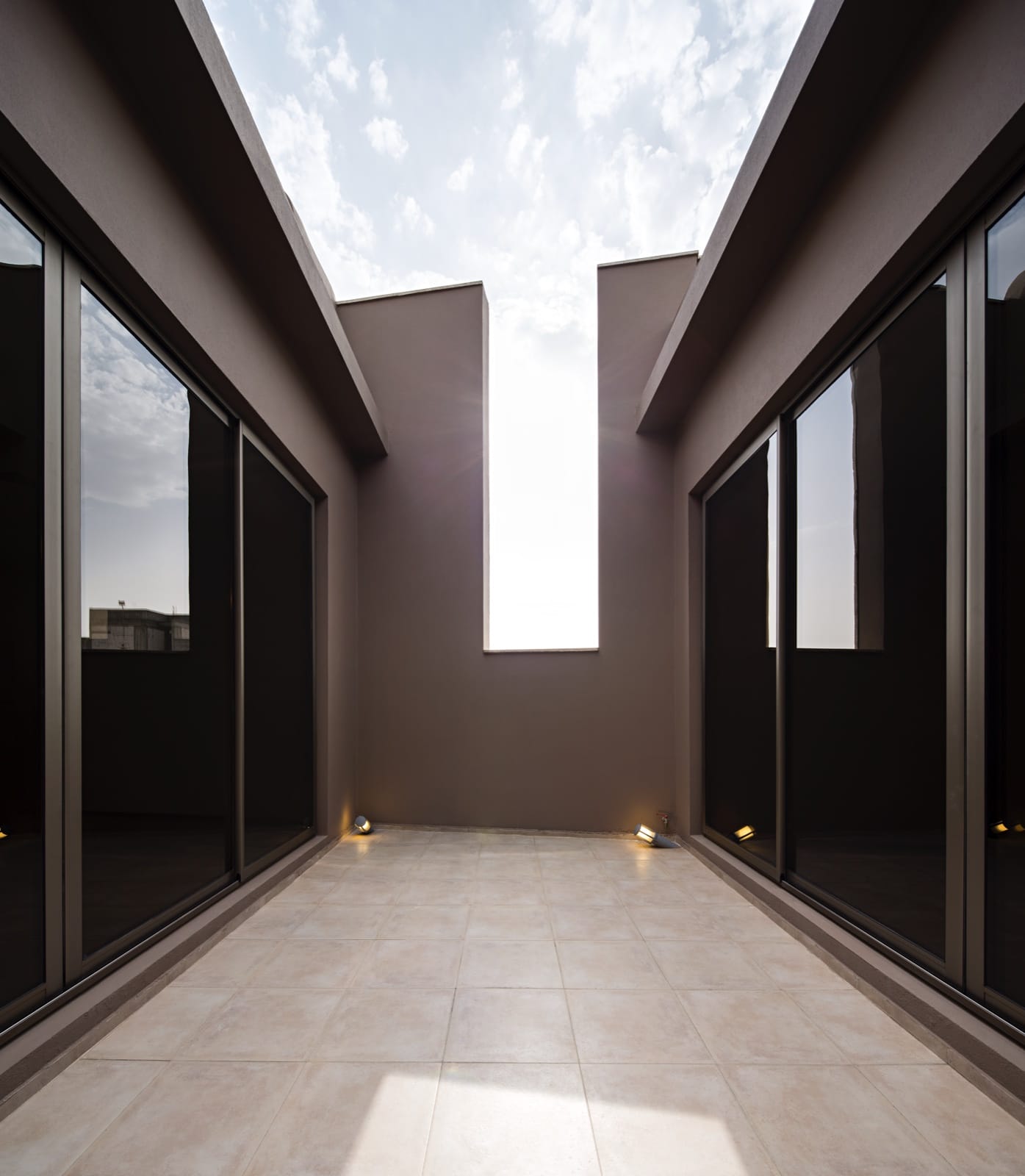
For the architect, what really distinguishes his design can be found in the details of its functionality. “Subtle things can make a huge difference to how a building is experienced by its user”, he rightly says. “So here, the access for the two apartments on the first and second floors are on the street, so the user can enter without encountering anyone else – this is in contrast to the habit of locating the access point at the middle of the lot”. In addition, setting the staff quarters in private rooms outside the apartments is particularly unusual.
Albaqshi values making such defining design decisions on a project-by-project basis; he says he never repeats architectural formulae to create cookie-cutter buildings. Massive Order oversaw the construction and interior architecture themselves so they could manage the execution of every detail, which shows through in features like the shading, ventilation and finish of the floors, doors and lighting. “This was one of the earliest projects I began working on and now it’s become typical of my signature style”, he says. Today he is working on new buildings outside the region. He has recently returned from a project in Singapore, which he says impressed him with the scale of its outdoor designs; “I like the landscape architecture and gardens they have over there”.
Taking inspiration from the work of Steven Holl (for his use of light and detailing) and Álvaro Siza Vieira (for his eye for simplicity and clarity of form), Albaqshi brings a pared-back, recto-linear style to Kuwait. In an architectural landscape dominated by large engineering firms, boutique practices such as Massive Order have an important impact on introduction variety and distinction to the fast-changing urban environment here. Although only a handful of these small firms exist, they continue to build reputations based on personal recommendations, gradually improving their position to colour the city more and more. He explains, “When we started practicing ten years ago there were only around five small architectural studios like ours. Thankfully today it’s really happening for more experimental firms as people become more aware of design and more willing to take risks”.
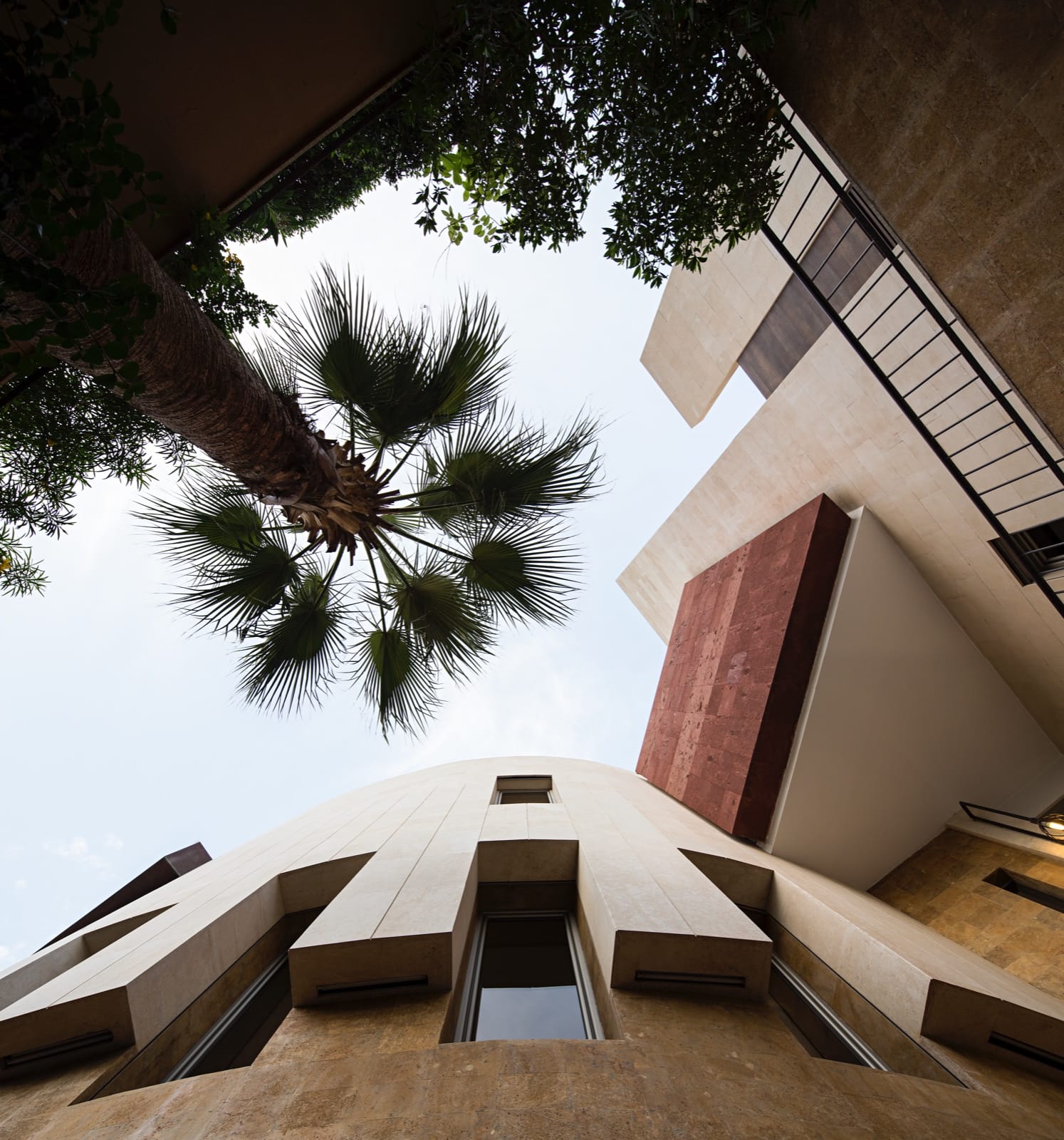
While his own style isn’t overly conservative, Albaqshi remains true to his location and context; he says that at Massive Order they would never let their work be influenced formally by historical architecture from other parts of the world, found in buildings from Ancient Rome or the Far East for example. “I have nothing against traditional ways from anywhere”, he clarifies, “But as I am a contemporary architect, I prefer the trend for modern lines”. His designs are created for their local environment, aesthetically, socially, and geographically. As with his elegant Box House, his work is radical yet discreet – and covertly more complex that its simple lines would suggest.