It won’t surprise anyone who has been paying attention that Hasselblad has a long association with space. The first one, a 500 C was taken into space in 1962 and since then, they have accompanied NASA flights and Apollo moon landings. Armstrong and Aldrin, for example, captured the first images of the Moon with specially-modified Hasselblad cameras, several of which are still there today, left behind to save weight for the return trip.
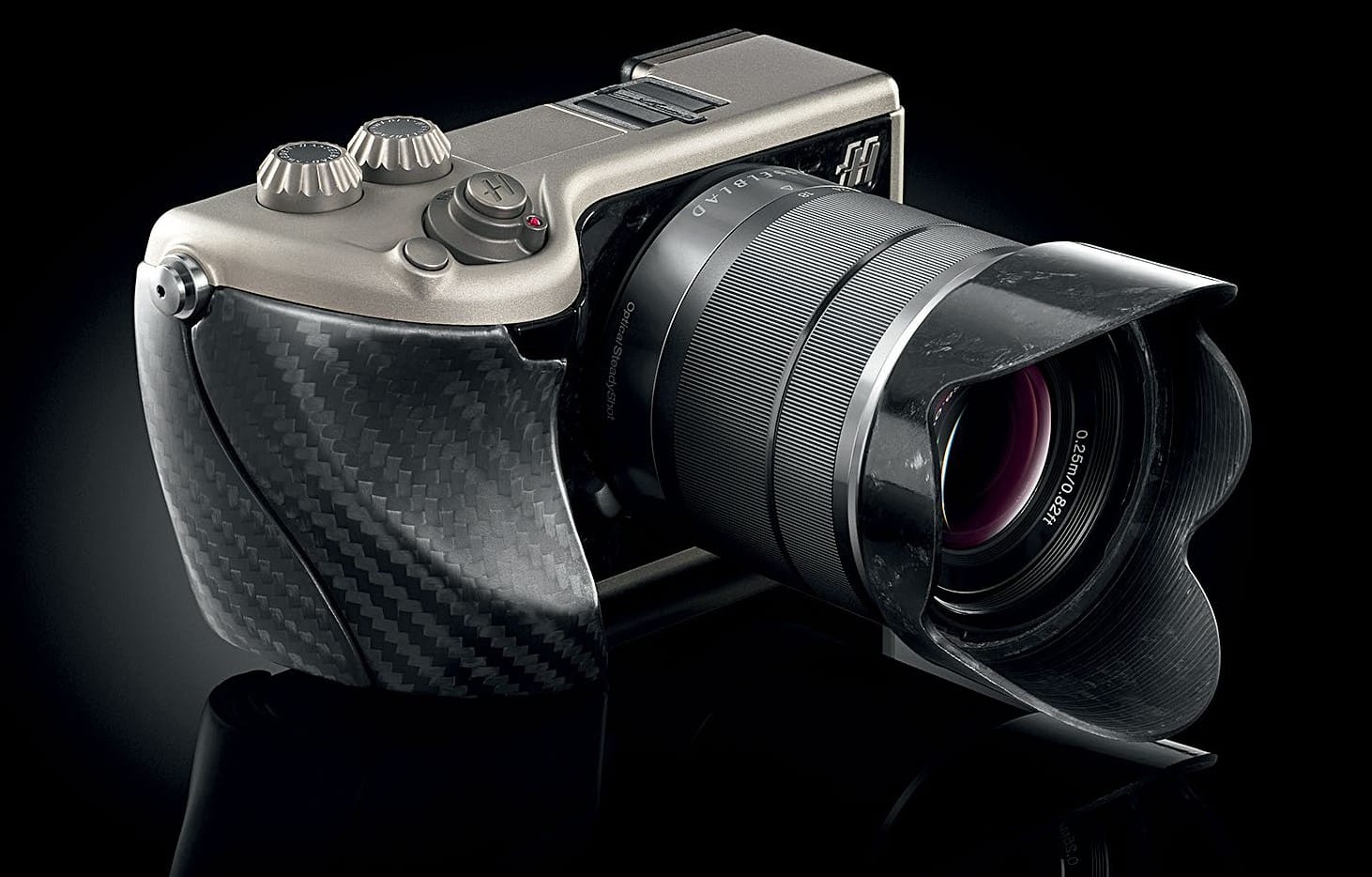
This year, the Swedish manufacturer is paying tribute to their first space-faring camera with the Lunar. Vintage look aside, it’s state-of-the-art, with a 24.3 megapixel APS-C digital sensor (at 23.5 x 25.6mm, the largest in compact cameras) instead of film. One thing hasn’t changed. The price. At 7,000 USD, the Lunar is astronomical.
And controversial. The Lunar may look and feel like a Hasselblad – especially with its wonderfully sculpted grip but on the inside, critics claim it’s just a rebranded 1,000 USD Sony Nex 7. Certainly Hasselblad has used Sony parts, including the sensor and the same E-Mount lenses and electronic viewfinder as the Nex. It also packs the same impressive ISO range of 100-16,000, making it ideal for low-light and night conditions, uses Sony’s TriNavi navigation mode and 25-point contrast detection autofocus system.
“What we’re doing is buying different components from the best suppliers, and applying our knowledge and expertise to create a different camera,” Luca Alessandrini, Hasselblad’s business development manager told the British Journal of Photography. “This is not a NEX 7 camera, just because we are buying components from Sony. The hardware is just a small part of the whole.”
The question though has to be why would anyone pay this much for a camera that has similar capabilities to one that’s a fraction of the price? In its defence, not only is the Lunar beautiful to look at, an embodiment of history and luxury, it also does its job expertly, on Earth or off. It has a higher resolution than most DLSR cameras and can shoot 10 frames a second with real-time image processing. This means it can take high-quality action shots and advanced image stabilization produces clearer images in situations that normally require a tripod.
“You look at antique cars that are one hundred years old, they still run and the leather is perfect,” CEO Larry Hansen put it, explaining that in the long-run, 7,000 USD was value for money. “That’s what we’re trying to do. The frame on the Lunar is made from carbon fibre, which has never been used in a camera before.”
Add to that a titanium top deck, ruby buttons and a customisable grip available in everything from mahogany to richly-veined olive wood, leather (brown Tuscan for a classic look or black for something bolder) and even carbon fibre for Minimalist chic.
So yes, it’s going to cost you the Earth to own but the Lunar isn’t just an impressive camera. Like Hassleblads before, it’s a collectible and that places its value out of this world.
WHAT Hasselblad Lunar camera
PRICE USD 7,000
FACT Victor Hasselblad began developing aerial cameras for the Swedish military in 1940.
WHY Sourcing a lot of its components from proven top-notch suppliers, Hasselblad has expertly produced a beautiful and collectible camera that is a leader of its kind, at least for now.