After an overnight flight to Bologna via Paris, I quickly forget my fatigue and arrive in Maranello full of anticipation. This is a special day, for I’ve had the good fortune to be invited on a tour of the Ferrari factory. Sure, anyone can drive through the Prancing Horse’s hometown but that cannot compare to getting inside access to its world-famous factory. Passing beyond that legendary red brick arch means you’re more than just a customer, a supplier or media representative; you’ve become a respected member of the Ferrari club.
A self-congratulatory pat on the back later and it’s time to check in. We’re warmly welcomed, presented with badges (mine might as well read “Hi! I’m Nicolas and I’m a Ferrariholic”) and into the land of the worthy we go. The factory is larger than I imagined, 45 buildings and 250,000 square metres in all. Then again, as a manufacturer, Ferrari is bigger than even it ever imagined. Only a decade ago, management vowed the company would make no more than 5,000 cars a year but there they were in 2011 selling just over 7,000, with an impressive 15.8 per cent return on sales. Apparently, recession is not a word much used in Maranello.
Most remarkably, though, Enzo Ferrari never intended to produce passenger cars when he split from Alfa Romeo to form his own company in the late 1930s. That he did so, and somewhat reluctantly was in order to fund his primary passion; racing. It’s fitting then that all the internal factory roads are named after former Scuderia Ferrari (the marque’s racing team) drivers. There’s Via Juan Manuel Fangio, Via Niki Lauda, Via Gilles Villeneuve, Via Michael Schumacher and so on. Naturally, for a manufacturer that has won more races, more drivers' and more constructors' world championships than any other, it’s only the Scuderia’s winners that are immortalised this way, so don’t go looking for a Via Luca Badoer.
Back to the factory itself. There’s something surreal about the fact that while its history is palpable, it’s unapologetically 21st century. Apparently, 200 million Euros were spent renovating the facilities over the last 15 years and it shows; 3,000 people may work here but they’re supported by hundreds of robots handling many key tasks. Our tour first takes us through the mechanical machining area, where not just the Ferrari, but also the Maserati engines get made. Then we’re taken to see the impressive assembly line for the V8-engined cars.
Ferrari has embraced the zeitgeist of the modern luxury brand for it now permits customers to specify every last detail of their car. Apparently, there are so many ways to spec a modern Ferrari that each vehicle on the assembly line has its own trolley-full of parts specific only to it, where you’ll find everything from the steering wheel rim to the door-trim pieces. The workers then follow each car’s unique specification sheet indicating the colour of the leather, its style (stretched taut or gathered more loosely), the kind and colour of stitching and lastly any customised pieces, like carbon-fibre or aluminium inserts.
Sadly, the one part of the factory that I am not permitted to see is the Formula One department. Rumour has it this is the most technically-advanced section of all, which makes complete sense when you consider that Ferrari uses Formula One as a test bed for research, the results of which then get transferred to passenger cars. Still, I did get to see the whopping great F1 wind tunnel, from the outside at least. Designed by Renzo Piano, it reminded me of Ski Dubai but instead of a piste and a ski lift, the tunnel is a closed loop, shooting air down its barrels at speeds of up to 80m/s. That’s almost 290 km/h. Likewise, architectural enthusiasts may be interested to know that Ferrari also employed the services of Jean Nouvel (he redesigned the assembly lines) and Marco Visconti & Partners (who overhauled the employees’ canteen).
One of the most unexpected aspects of the tour is a trip to the Classiche division, hidden within the old foundry. This is the department that specialises in servicing and restoring old Ferraris. Central to doing so is the division’s access to all available original parts and their ability to reproduce any unavailable ones according to original blueprints. Proof of just how much pride these guys take in their work is the concours-winning condition in which they return your prized vintage automobile.
We end with lunch at Ristorante Cavallino, where the late Mr. Ferrari would conduct his most delicate negotiations. Just across the road from the main factory entrance, it’s still the restaurant of choice for Ferrari executives.
The FF: First Impressions
Fully-fuelled by my delicious lunch, I am handed the keys to a Pozzi Blue Ferrari FF. This car, possibly the most revolutionary product to come out of Maranello, is to be my steed for the next couple of days on a drive that would take me to Siena and Florence before ending in Mugello. I am raring to go.
The first thing to do when experiencing the FF is to let go of all your preconceptions about Ferraris. Why? Because despite the fact it has the largest capacity engine Maranello has ever produced (a naturally aspirated 6.3-litre direct injected V12 unit that can churn out an epic 660 bhp), the FF is actually a four-wheel drive, four-seater hatchback.
Bestowed with abilities previous Ferraris could only have dreamed of, alas, the FF is not a looker. Frankly, I’m still puzzled by its styling. This is, after all, the most expensive car the company currently makes and it plans to sell a 1,000 a year. As a Ferrari, it’s likely the FF would sell even if it had been styled on a Zimmer frame, but the question is, did it have to be so provocative? My theory is that perhaps the fact that the FF is so technologically advanced spurred the designers over at Pininfarina in Cambiano to make a giant, two-fingered salute at the past. Alternatively, it may just be that the design house has always secretly admired the BMW Z3M.
Whatever the reason, four-seater Ferraris are nothing new. They’ve been building them since the 166 Inter in the late 1940s. Then there was the ghastly 330 GT by Vignale and the unloved 400 Automatic but let’s not forget the gorgeous 456 from the 1990s, and more recently, the 612 Scaglietti, which the FF is replacing. Admittedly, if you were to compare the FF to the 330 GT Vignale, it’s practically a beauty, but I still firmly believe that Ferrari could have done better. It’s not like they don’t know how to make sexy station wagons. Just think back to the fabulous 456 GT Venice cars, custom-designed by Pininfarina for the Sultan of Brunei.
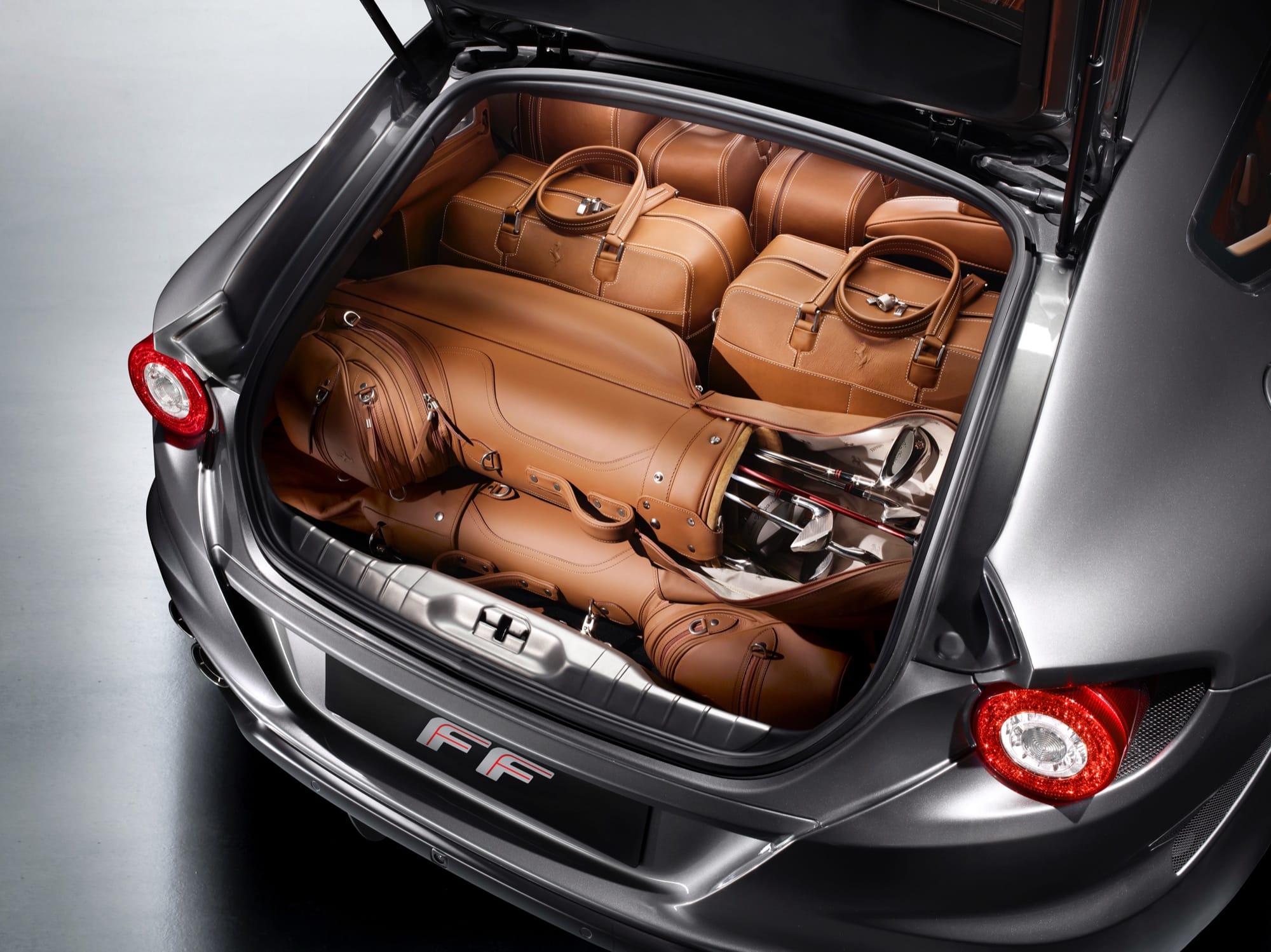
Still, I’m not about to let style undermine substance, especially when this is the world’s fastest four-seater, so I stop critiquing the exterior, load my luggage into the boot and attempt to close the lid with the power tailgate switch. Only there isn’t one. Apparently, Ferrari hadn’t thought about one until I mentioned it to them. Okay, it isn’t the end of the world but you’d think that given the stratospheric price it commands, a car of this calibre would come with all the bells and whistles. And then some.
The FF: Behind the Wheel
Firstly, and for context, I am driving in Tuscany in incessant torrential rain. It’s one of the worst storms in recent history. And it’s brutal. Despite this, the FF is unfazed and the traction remains phenomenal. In fact, I’d say that this clever four-wheel drive system is the FF’s greatest attribute. It allows you to utilise all of the car’s power, at any time and in any situation.
Ferrari definitely thought outside the box on this one. Rather than whacking a centre differential into the FF, thereby mechanically linking the front and rear axle (which Ferrari insist would have added too much weight), the four-wheel drive is controlled by electronics and a set of clutches in front of the engine. Most of the time, you’ll be driving with 100 per cent rear-wheel drive, but the car’s brain is constantly monitoring wheel slip, speed, yaw and steering angles. The electronic monitoring is so exacting that it can predict wheel spin before it happens, in which case it’ll activate the forward clutches to direct drive torque to a particular front wheel, keeping forward momentum.
I can tell you that even off-road – yes that’s right, I really did power an almost 400,000 USD Ferrari along a rutted dirt track or two – you cannot kick the tail out too far. It’s incredible stuff and I imagine FF owners will relish in this sense of security as they drive up icy roads to their mountain chalets, kids in tow.
Though not as dynamic as the 458’s, the steering is incredibly precise. The standard carbon-ceramic brakes are fantastic. The electromagnetic dampers provide a civilised ride and the new multi-link suspension has definitely lessened road noise compared to its predecessor, the 612 Scaglietti. But, if I must find fault, I’d say that there should have been one more setting on the manettino that allowed for an even more supple ride. When I told Ferrari so, they replied that they’d rather be accused of making a hard car than a soft one. The Ferrari legacy weighs heavy.
The FF: verdict
The FF may not be endowed with the looks or the on-the-limit prowess of its stable mates, the 458 and 599, but that’s actually not its USP.
The FF is a unique all-rounder. Sitting inside this car is a wonderful place to be, irrespective of what seat you’re in. Incredibly, there’s much more space here than in the four-door Aston Martin Rapide and I’m sure Gaydon is a little embarrassed by that. Though the rear seats could never be compared to those of, let’s say an S-Class, they’re still perfectly comfortable and sufficiently spacious for a tall adult. Even at 1m95, I managed to sit in the back for almost an hour and though my knees were enveloping either side of the front seat, both my companion (in front of me) and I, were perfectly content.
All things considered, what’s truly unique about the FF is its ability to tackle any road surface and weather condition you throw it at. Not only that but it’ll still feel like a Ferrari while doing so and that’s an incredible feat. Granted they didn’t wrap all that magical engineering in the most alluring of bodies but the FF is still a thrilling car. Can you imagine what kind of pedestal we’d have put it on if it had been prettier?
Specs
Model Ferrari FF
Price 360,000 USD
Engine 6.26-litre V12
Power 660bhp
Transmission 7-speed dual clutch
Kerb weight 1,880 kg
Top speed 335 km/h
0-100km/h 3.7 seconds