Take the escalator straight up to the massive, central atrium of the Conrad in New York City and you’ll be forgiven for thinking that you’re in a museum, instead of a hotel. It’s not your typical five-star - it doesn’t have a spa - but there’s art in every corner and every room. You can even ask for your own guided tour, complete with a detailed catalogue. With monumental works bearing names like Loopy Doopy and Topsy Turvy, there’s a lot more here than meets the eye.
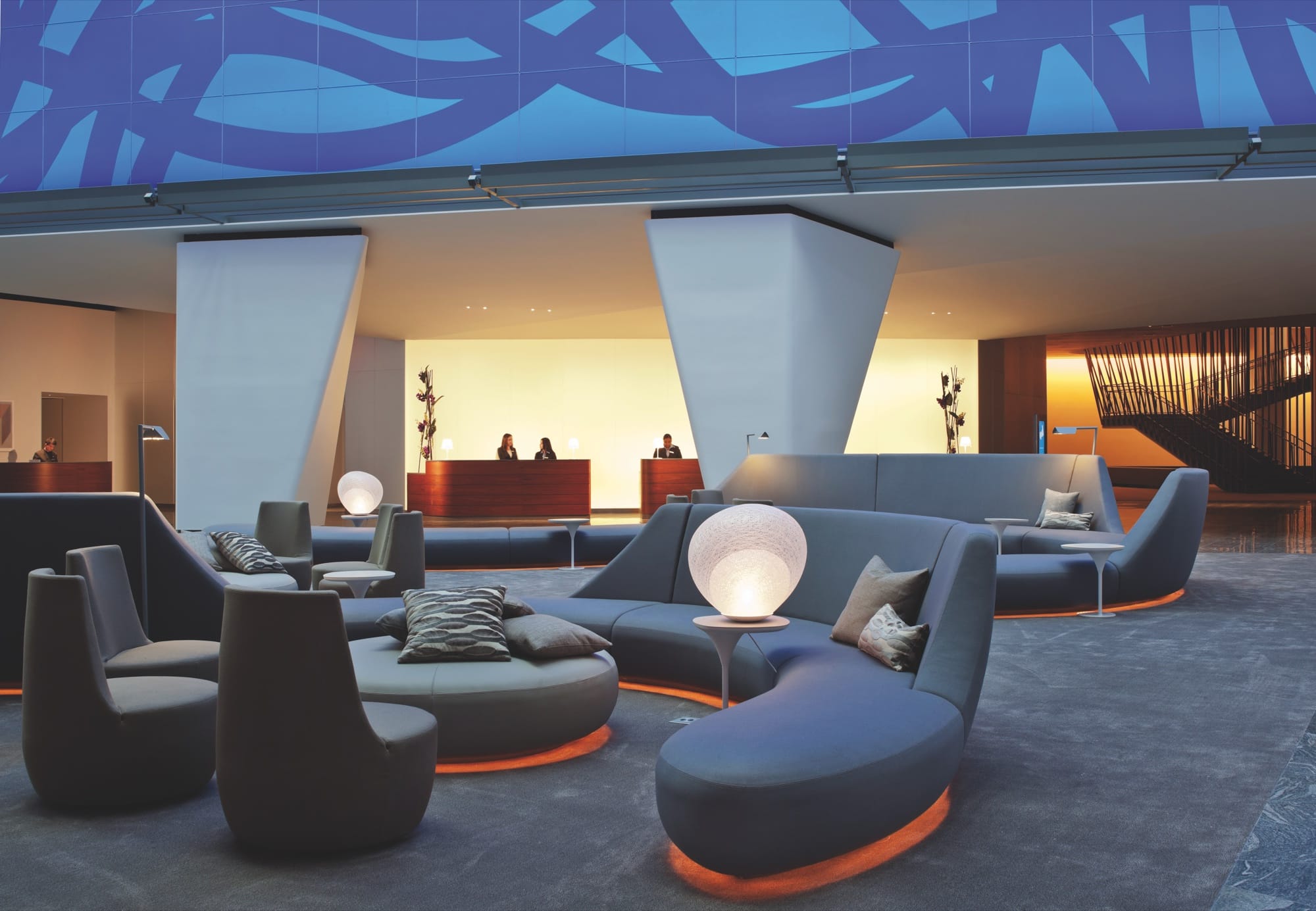
From the moment I enter the Conrad’s airy lobby, I find that my eyes are compelled upwards. A giant mural soars dramatically up to the skylit ceiling, spanning all 13 floors above the reception area. With undulating streaks of blue and purple, it’s visually arresting. And it’s called Loopy Doopy.
Created by the late Sol LeWitt, who is regarded as one of the founders of the conceptual art movement, I soon discovered how this mural can be experienced differently when you take the glass-covered elevator up to the rooftop bar (which is named after the mural). As you rise, you are first confronted by the gaping maw of the Conrad’s atrium and the supporting, parallel bands of metal wrapped around each floor. Then you start to notice the tiles making up the mural. Each is a boldly and formidably painted. There are hundreds of them. The mural is largest work LeWitt ever created and the whole thing measures 30 x 24 metres. It took more than 100 gallons of paint and 3,000 hours of work in an immense warehouse in Brooklyn’s Navy Yard before they were ready to be installed.
But the mural’s not the only thing you see. Suspended from the ceiling in a symphony of twisting and turning tubular structures made of white steel is another behemoth creation by Venezuelan-born architect, Monica Ponce de Leon. Impressive and intimidating, her ‘Veils’ hang in theatrical fashion from octagonal pylons, as if on threads. I almost cringed at the thought of them crashing down on our heads.
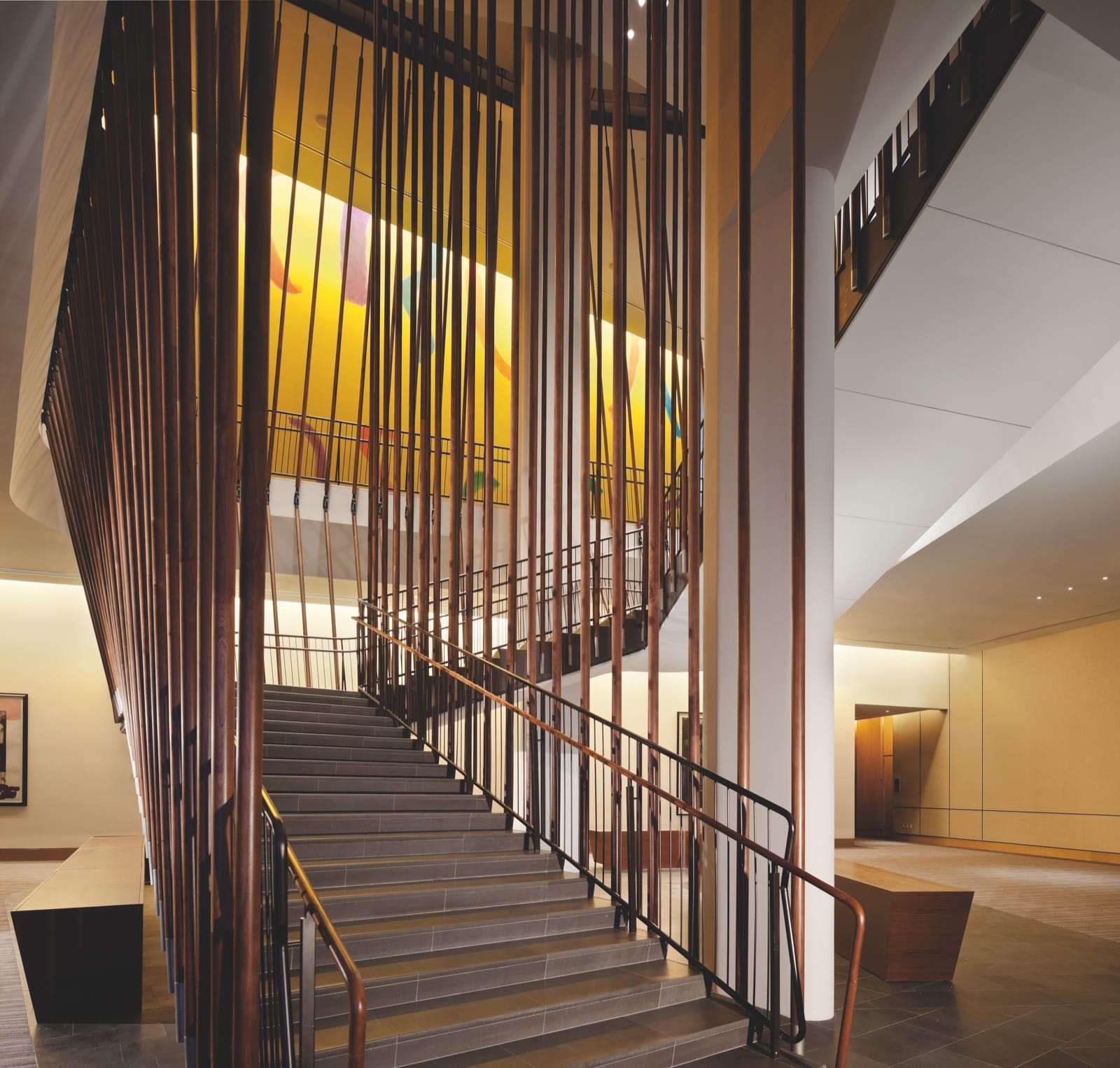
Everywhere you look in the Conrad, there’s a vast universe of art in motion. On one end, you’ll see Imi Knoebel’s ‘Mennige (Polygon)’ where the German abstractionist outlined red rectangular forms in industrial anti-rust paint (‘mennige’ in German). They look like they are toppling over. American abstract expressionist Pat Steir’s Topsy Turvy is also clearly visible, on the landing of the staircase near the ballroom. Her painting is large and playful, ribbons of different colours curl and seemingly trickle down from both edges against a bright yellow background.
Even the waiting room for the cinema functions as a gallery, with paintings and lithographs exhibited on the walls and circular ottomans, for you to better contemplate the artworks, perhaps. There, through the floor-to-ceiling window, you can catch a glimpse of the infamous “Mural,” an immense painting by the Ethiopian-American abstract artist Julie Mehretu, intricate and geometric, which is sprawled across the entrance of the facing Goldman Sachs building. Which brings me neatly to where we are.
The Conrad is smack in the middle of Lower Manhattan’s financial district. Streets swarm with business types scurrying about and slightly stiff in their suits, supposedly directed by the soulless machinations of Wall Street. From the outside, the hotel could be mistaken for another corporate façade but it actually used to be the Embassy Suites Hotel, before a 75 million USD makeover gutted its interior and rebranded it as a Conrad, the luxury wing of Hilton Worldwide.
“Not a single wall was torn down,” Mark Ricci, Hilton Worldwide’s director of corporate communications explains to me. “Architecturally, it reminds me a little of JFK Airport’s 1961 hangar. The essential issue facing architects Kohn Pederson Fox and Monica Ponce de Leon, who was responsible for the interior lobby and restaurant, was how to take a building based on an atrium structure and make it contemporary.”
De Leon’s choice of serpentine grey couches and ottomans, lined with orange lights at the base and mesh lamps on the side tables are almost post-contemporary. From the bird’s-eye view, they look like elongated and winding forms that fit together much as the pieces of a mosaic would, in S-shapes and large connecting dots. The lights, designed by Herve Descottes’ internationally-acclaimed lighting design firm, L’Observatoire, correspond to the futuristic chic mood,
As the lights subtly morph from purple to orange and blue hues, I seek the quieter haven, with its earthy palette of rich browns and creams, that is my room. Here is a more temperate zone of tangible things, where the only movement comes from the skyscraper lights flickering over the Hudson River, offering an enchanting respite from the city that never sleeps.
All the Conrad’s 463 rooms are double suites, with separate living rooms, hidden bars and city or river views. In keeping with the chain’s ethos of “smart luxury”, there are buttons for everything: privacy requirements, room service, there’s even a virtual concierge who can attend to your dining needs, reservations or any other request via TV, smartphone or touchpad. And the luxury suites must be really popular since none were available for showing at the time I was visiting. “Every room has a different piece of art that you can take home with you,” Mr. Ricci later tells me. It’s true. Stashed surreptitiously in a corner of my room is a miniature version of one of the tiles from DeWitt’s mural – fragments of which also adorn the inside of the labels on the bottles of water. Of course, these mini-pieces are for sale.
In contrast to the grandiosity of the hotel and its art is the cocoon-like ambiance of Atrio, the Conrad’s main restaurant, with its low-lying ridged roof in plaster and stucco. Based on an open kitchen concept, it is run by Lebanese-Italian chef Anthony Zamora, who has concocted a delightful menu using fresh, local ingredients. I began by tasting the shrimp saltimbocca with crusty pancetta, sage and sweet tomato juice. There’s a lot of the Mediterranean in Zamora’s creations, from the charred Brussel sprouts with parmesan and pine nuts, the spicy, creamy harissa roasted cauliflower with pickled fennel and mint to the arancini Bolognese. After gorging on the creminelli truffle salami, the whipped mortadella with Sicilian pistachio crostini and the pasta with crumbly duck sausage, escarole and cannellini beans, I was too full to move. Obviously, there was only one way to end the night, so I headed up to the Loopy Doopy Bar, which boasts as the distinction of being the only bar in Manhattan with Prosecco on tap. With a view of the Jersey City skyline at one end and the new One World Trade Centre going up at the other, I thought to myself that there was nowhere else I’d rather be, than on top of this particular world. Though that might have been the Prosecco-dipped popsicles talking.
Over breakfast the next day, Chef Zamora and I discussed plans to develop a green private roof where he can grow his own herbs and vegetables, whilst revelling in divine bruschetta eggs with pesto and the ricotta hotcakes with lemon curd and fresh raspberries.
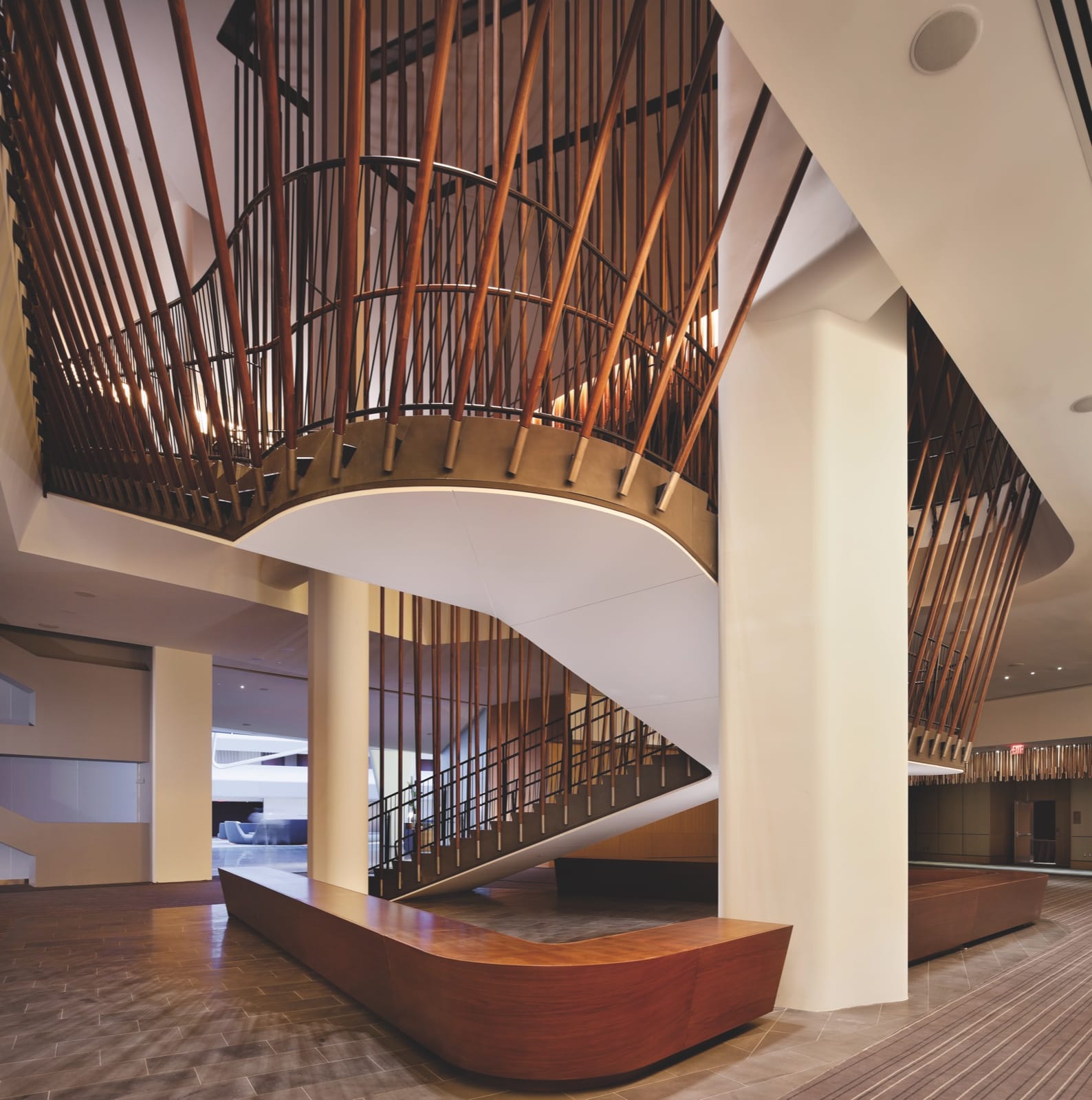
Sad that it was time to leave, I descended the marble stairway, noticing that the huge columns at reception, upon which LeWitt’s mural rested, were similarly sculptural, amorphous and at oblique angles, just like the staircase treads. Once outside, I was simultaneously confronted by the Irish Hunger Memorial, a landscaped slab of rock and grass brought from Ireland and consecrated to the victims of Irish Famine and a very Parisian-looking café by the Hudson River. I found myself thinking that what you see is very much a matter of where you are standing. It’s all a matter of perspective.