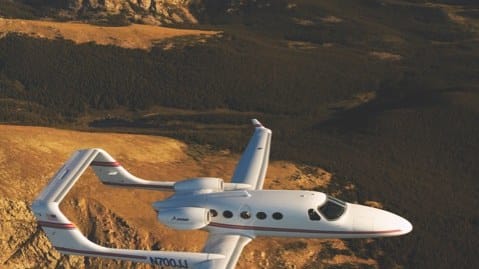
In ‘plane’ speaking terms Adam Aircraft is a new kid on the block. Set up by George F. (Rick) Adam, Jr. in 1998, it designs and manufactures a host of innovative general aviation aircrafts, including the centreline thrust twin-engine A500 and the A700 twin-engine AdamJet. By fusing modern technologies, rapid deployment processes with innovative engineering, Adam Aircraft’s high-performance creations are immediately recognizable for their design, quality and value.
An Adams aircraft is no ordinary plane, inside or out. For instance, its most singular exterior characteristics are the placement of the engines on the centreline and the striking boom tail. According to Adam himself, “Traditional twin-engine planes, the ones with one engine on each wing, have fatality rates four times higher than single-engine planes. This is because once you lose an engine; they are very hard to control. Our breakthrough is that for the first time, you have the redundancy and safety benefits of two engines, but if one engine fails, the airplane is very safe.” In addition to these safety benefits, the aircraft delivers superior range and speed in the pressurized comfort of a roomy interior that can seat up to six on the A500 and eight on the A700.
Adam’s winning formula was to harness the advantages carbon fibre technology can offer and launch new cost-effective alternatives to flight travel. Carbon fibre is a material pioneered in bicycle frames and tennis rackets but also used extensively in Formula 1. The weight-saving realized by using carbon fibre as opposed to conventional aluminium is also a blessing in the construction phase as the latter has 25,000 parts; while, for instance the company’s A700 aircraft only has 3,400 parts.
Another benefit of a lightweight aircraft is that the plane can be powered by smaller and lighter engines, further cutting costs. With such advances the price for an Adam Aircraft aeroplane is very reasonable. Expect to pay around 1.2 million USD for the propeller driven A500 and 2.5 million USD for the jet powered A700. The amount by which they have undercut their competition is most evident when you look at other jet- powered planes. Previously the least expensive jet available was the 4.1 million USD Cessna Citation CJ-1 which means by choosing the AdamJet you save 1.6 million dollars. And of course Adam’s aeroplane is pocket change compared to the less comparable and much larger 45 million USD Gulfstream G550.
The AdamJet A700 is due to get its FAA production certificate very soon and when it does it will deliver jet performance and reliability at a fraction of the cost of today's business jets. With an advanced carbon composite airframe design and highly-efficient Williams FJ33 turbofan engines, the A700 is a collaboration of industry leading technologies. Low operating costs, comfortable seating for seven or eight depending on whether you choose to have an aft lavatory, and state-of-the-art avionics make the A700 a natural choice for customers considering jet ownership.
The love for flight is an Adam family trait. Rick Adam’s father was a US Air Force officer who piloted a B-29 Superfortress bomber over Texas for atomic bomb flight tests during World War II. Rick’s mother was a civilian pilot. He graduated in computer engineering from the United States Military Academy in 1968 before going on to write programmes for the Apollo Missions 8 through 14 which ensured that straying rockets could be detonated remotely. His civilian posts also included a stint at IBM and a career-boosting post at investment bank behemoth Goldman Sachs where he successfully turned-around its IT operations, reducing costs by using technology as a medium for profit. As the former owner of New Era Networks, a firm that helps businesses link together incompatible software packages, he managed to grow the business to revenues of 150 million USD before selling it to Sybase.
According to Adam, the future includes air taxi services which could replace commercial services, beginning with America. “The US has managed to maintain about 5,000 airports in suburban and rural areas that are big enough to support an air taxi industry,” he explains. “NASA has run studies on this, and 85 per cent of the country is within a 30-minute drive of one of these airports.” With major airports ever more congested and hassle-filled, it seems a no-brainer that business travellers will jump on the idea once prices reach a reasonable level.
In the US at least, the numbers make sense. “Coach airfare is 50 cents to a dollar per passenger mile. If you chartered a jet today, the lowest price you’d get is 10 USD per mile. The air taxi guys think they can get the cost down to 4 USD or 5 USD a mile. If you put two or three people on the plane, you’re down to 1 USD or 2 USD a passenger mile. There are a tremendous amount of people who will pay that.” With runways in place, the missing element for air taxis is a lower-priced aircraft but now that too has been taken care of. So is the future easily under Adam Aircraft’s wings? We can only wait and see.
Contact:
Adam Aircraft
Colorado, USA
Tel + 1 303 4065900
HYPERLINK "http://www.adamaircraft.com" www.adamaircraft.com