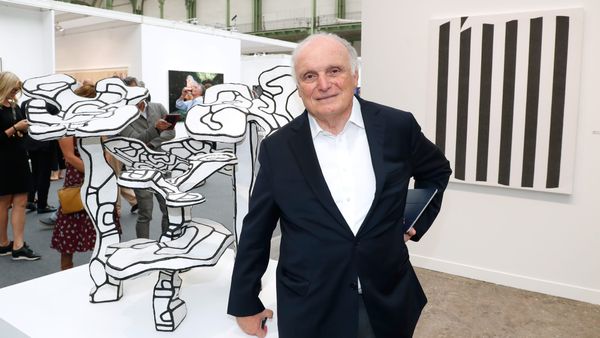
The CollectorWinner of Bespoke’s Connoisseur Award and custodian of the largest private collection of Islamic art in the world, Professor Nasser David Khalili shares how he amassed his incredible collection and why he’s merely managing it for future generations.
In 1958, when he was 13 years of age, Nasser David Khalili, accompanied his father to the home of an important minister in the Shah’s government in Tehran. An art dealer, Khalili’s father was friends with the minister who collected, amongst other items, lacquered pen boxes – these were portable penholders made from varnished pasteboard or papier-mâché that had been fashionable in the Muslim world for centuries. While the pair discussed the affairs of the day, the boy looked around with youthful curiosity until his eyes settled on one such pen box. After some time the minister, who had noticed the boy’s interest, asked him why he was looking so intently at the piece. The boy without pause answered that there were 750 individual faces depicted in the battle scene on the box and each one was different. The minister was stunned. “You’ve counted them all…? I have never noticed before. They are so small.” he said. “What is incredible,” continued the boy, “is the skill involved in this painting. Because it is such a tiny space it is far more elaborate and difficult to create than a painting on a large canvas, fitting the maximum of figures into an extremely confined space. That is why it is so magnificent.” So amazed was the minister that he told the boy’s father that his son would go places and gave him the pen box.
Nasser David Khalili still possesses that lacquered pen box. It became the first piece in what is today the finest single private collection of Islamic art in the world, numbering over 20,000 items from the 7th to the early 20th centuries, from China to Spain and from the Central Asian steppes to North Africa. Gathered over 40 years, the collection includes priceless copies of the Qur’an, religious manuscripts, miniature paintings, calligraphy, ceramics, jewellery, coins, scientific instruments and more.
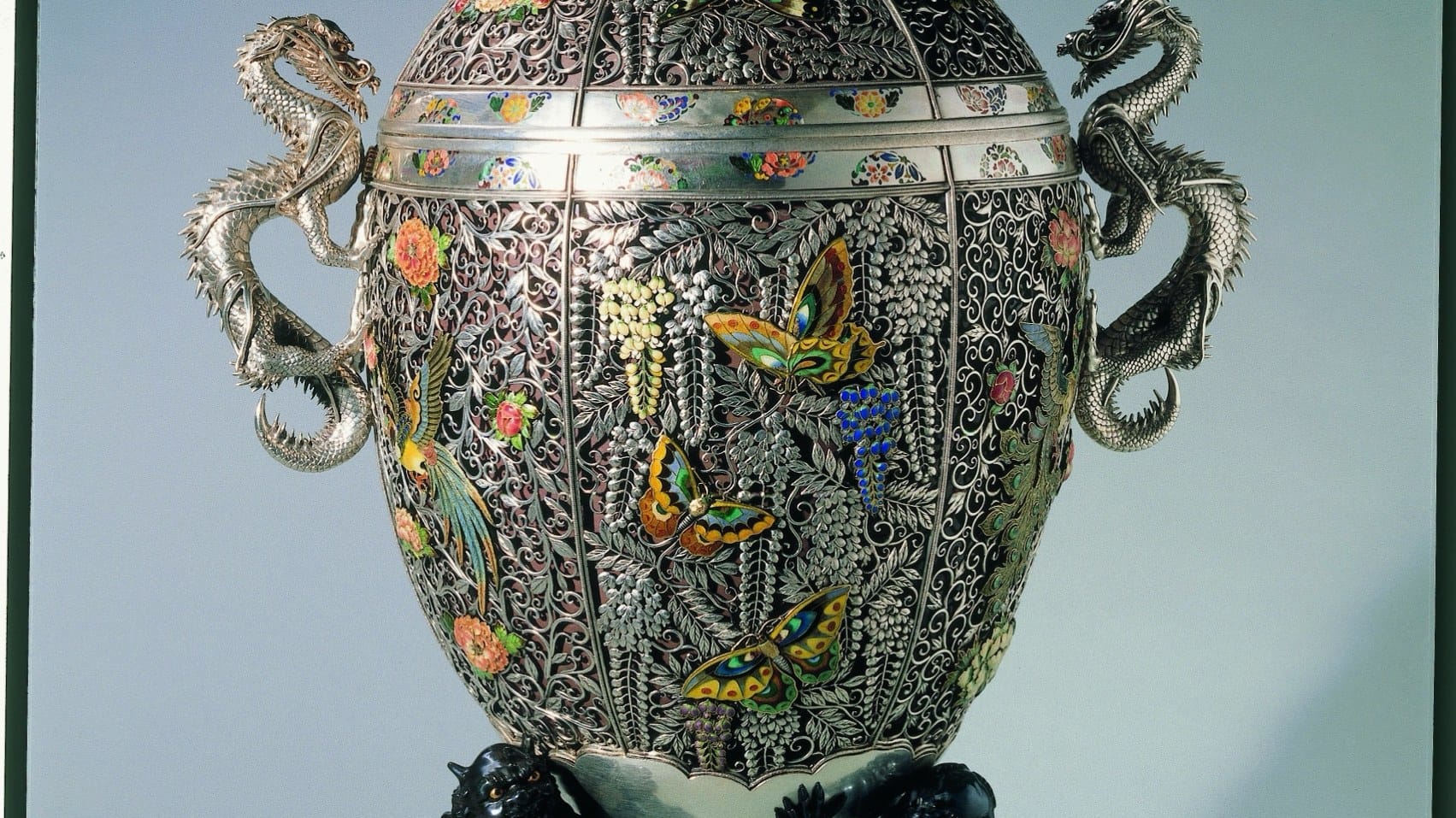
And their owner is truly an extraordinary man. At, his offices in London’s Mayfair, the eyes of this billionaire art collector, PhD, lecturer, benefactor and real estate investor, sparkle with excitement as he talks of his youth, his life and his passion for art. Not only is he a collector of all things Islamic but his collections include a mix of 2,000 pieces of Japanese decorative art from the Meiji period (1868-1912), 1,200 pieces of enamel work from all over the world between 1700-2000, a Spanish collection of some 100 pieces of late 19th and early 20th century damascened metalwork, and 100 pieces of Swedish textiles from the late 17th to mid-19th centuries. Each of these collections is pre-eminent in its field.
He has been called the “guardian of history,” the “ambassador of culture” and “a cultural ambassador of Islam,” for his work in the domain of Islamic art and not one of these titles is an exaggeration.
Khalili relishes the praise given for the souls of the artists that produced these objects. There are rich men who collect for personal pleasure, then there are the Gettys or Gulbenkians of this world who collect for the benefit of others. Khalili falls into the latter category, except the difference is that Khalili is both a collector and a scholar who has sought out and purchased all the items in the five collections himself. It is his deep knowledge which sets him apart from the rest, that and his aim to further understanding of the East in the West through art.
“The definition of a collector for me,” says Khalili, as he sips from his honey and lemon tea, “is someone who collects, conserves, researches, publishes and exhibits because by doing that, you are sharing the knowledge of the past with the people who are not aware of that knowledge. These five criteria give you the right to call yourself a collector.
“If you are buying and selecting paintings in an auction because you are successful and you take them home and display them in your dining room to show to people who come over, you are not a collector. You are selecting for your own joy and pleasure and you are not making any contribution to the world so you are merely an admirer or selector but not a collector. The collector has the responsibility of safeguarding and being the custodian of culture for the benefit of future generations.”
Indeed over the years Khalili has exhibited his collections around the world from Australia to the United States to Japan, across Europe from Sweden to London and most recently at the start of 2008 in Abu Dhabi with a show called ‘The Arts of Islam’ – incredibly enough the first major comprehensive display of Islamic art ever seen in the Middle East, as well as the largest Islamic show staged anywhere.
When it comes to researching and publishing the collections, up to now 17 out of a projected 27 Islamic volumes have been completed by a team of international scholars. The publication of the five collections will number 50 volumes in total, all published by the Khalili Family Trust at a cost of roughly £8 million, making it the largest art publication of one collector in the world. And in terms of spreading the knowledge and beauty of Islamic art Khalili has endowed a chair in Islamic Art and Architecture at the School of Oriental and African Studies at the University of London, as well as the Khalili Research Centre for the Art and Material Culture of the Middle East at Oxford University.
This is a man who doesn’t just talk the talk, he walks the walk. By travelling the world lecturing and holding symposia, Khalili’s purpose has been to create a momentum of understanding and admiration for this incredible art because in his words “If you don’t talk about it and tell people what you are doing and why, then what is the point?”
“I believe,” Khalili says, “as (world-famous American investor) Warren Buffet said, ‘the reason we are sitting in the shade is because somebody put a seed in the ground’ and this is what true collectors do. We create shade for people to sit in using the healing power of art.
“But of course we could not do that without the brilliance and skill of the artists who made these objects in the first place.”
Take for example the incredible Jami’ al-Tawarikh, or Compendium of Chronicles, a written history of the world by Rashid al-Din from the 14th century, commissioned by a Mongolian khan. Stunning in its calligraphy and design, Khalili bought it at a Sotheby’s auction 18 years ago for 12 million USD, but today it is priceless. that’s just one item. The value of all five collections today is virtually inestimable as in their depth and breadth they are almost without parallel either in museums or on the market.
Khalili talks of his collections as he does of his wife and three sons – with unbounded passion: “Collecting over the last 40 years has brought me boundless personal pleasure. If by showing it to the world I have brought a smile to people’s faces, roused their interest in these arts and in the artists who otherwise might have been forgotten and spread understanding of all these cultures, then I consider myself successful and privileged.”
But where did his passion come from and how exactly has he done it? An inquisitive child with a photographic memory, Khalili was born into a Jewish family of art dealers in Iran in 1945 and accompanied his father on buying expeditions. At 7 he was trading stamps and banknotes and by 13 collecting himself. In 1967 he moved to New York and travelled to Europe often and everywhere he went he would spend hours in museums studying art including Islamic, at a time when dealers and collectors in the West seemingly couldn’t care less, for example, about Islamic cast metalwork or Qur’anic calligraphy. “Until about 25 years ago,” explains Khalili, “Islamic art was considered a minor art and it was my collecting that changed this perception.” This meant it was relatively inexpensive and he had few competitors. Dealing seriously in the early days – “I would buy 50 pieces for 100,000 USD, keep the five best and sell the rest for 500,000 USD,” he says – Khalili made money and began building his collections, not knowing exactly where it was going but knowing which pieces would fit in the collection.
“Collecting is like giving birth to a child – you don’t fully control them and, once she or he is born, they take on a life of their own,” he says. “But if you have a pure philosophy and iman (faith) in what you do you can achieve anything. If you have that passion everything else falls into place.”
In 1978 he moved to London, married and channelled his profits into property with his company Favermead, making millions of pounds perhaps partly as a result of his business acumen in buying art. He completed a doctorate in Islamic lacquer ware from the University of London and kept buying, often by the 1990s using agents anonymously as by this time his presence at an auction would drive prices through the roof. But he bought using his vast knowledge and understanding and always seemed ahead of the rest of the field because of it.
“It was partly that I was in the right place at the right time and made the right decisions and made some money that I was able to put into collecting,” Khalili says. “You know it’s like an ocean, collecting. An ocean is made up of billions of drops. You start with drops and it becomes an ocean, but it is the knowledge that makes the difference and that is what I tell people when they ask me how to become collectors. Know your field better than anyone else, so that you can become the master of your own destiny.”
Khalili is a man fond of metaphors (“I began by planting a few seeds hoping for a pleasant garden. But I could not have imagined the forest they grew into.”). His philosophy is simple – “know your aims in life, make them solid and make them for the benefit of others and the Almighty will help you too.” He sincerely believes that he is merely the temporary custodian of his collections and that it is the artists, the creators of the objects that should be praised and remembered. “Ownership means absolutely nothing to me because at the end of the day shrouds have no pockets. Like the brilliant artists who made the works, every one of us can make a contribution, every one of us can be a small light in a dark room in our own way.”
I wonder then, how important Khalili’s Islamic collection is to contemporary artists from the Middle East today. He is certain that it helps inspire upcoming artists to new heights, that they come to see his exhibitions, hear his lectures and are inspired: “There is no reason why we can’t have a Picasso or Brancusi or Monet or Cézanne coming out of the Middle East in the next 20 to 40 years. The Middle East is not short of talent. It is not short of money. And it is not short of visionaries. And you know I see that as my collections represent the great brilliance of artists and craftsman of the past, that there is a wealth of young talent that will be seen in the future, artists that can stand side by side in their talent with contemporary artists of the West.”
“The great strength of Islamic art and culture is its diversity,” Khalili continues. But you know I didn’t collect Islamic art because it was Islamic. I collected it because it was beautiful.” And indeed of his collection and Islamic art in general, 90 per cent is secular in nature and a mere 10 per cent religious. Contrast that with Western Christian art Khalili explains, where 5 per cent is secular and 95 per cent religious.
Is it an addiction? “Absolutely, but it’s an addiction that adds value to one’s soul, gives you a lease of life, helps you, but doesn’t hinder you.”
How does he manage to find time to do it all, manage the collections, run the property business, and write and lecture and have a family life too?
“Since I was about seven, I have been very fortunate to need only four hours sleep a night and I am big believer in making the best use of my time. Time for me is the most expensive commodity in the world, a commodity that should be cherished. I work from 5.30am to 8.30am on my writing and editing work, I manage my company during normal working hours, and spend time with my family in the evenings and weekends. Finally I do some more reading and working on the collections from 9 or 10pm for another three hours or so,” Khalili says.
In 1957 that minister in Tehran prophesied that the young Nasser David Khalili would go places. He could never have imagined how far that 13-year-old boy would travel.
The Arts of Islam: Treasures from the Nasser D. Khalili Collection is at the Institute de Monde Arabe in Paris from October 2009 until March 2010..
Enamels of the World 1700 -2000 will be is at The State Hermitage Museum, St Petersburg, , from 8 December 2009 until 24 March 201009.
For more information on The Khalili Collections, Nasser David Khalili and Tthe Khalili Family Trust go to www.khalili.org