Hiam Abbass probably isn’t the most obvious choice as director of a film for Miu Miu, Miuccia Prada’s other fashion label, which is a younger, more playful version of the mother brand. Not that such a collaboration would be demeaning but what connection an Arab director and actress known for playing strong female characters - from struggling widow to proud mother of an illegal immigrant - could have with fashion isn’t immediately obvious.
Abbass, too wasn’t entirely sure why she’d been approached either. It seems, in the end, to have been the result of a felicitous conjunction. “Madame Prada,” she explains succinctly, as we chat in the cosy interior of her Parisian apartment, “is a good friend of the Venice Days festival director and they were looking for women to work on the sixth Miu Miu short film.”
We are sitting on the sofa. Abbass asks me if she can smoke. Although she’s dressed simply in jeans and a sweatshirt, she has this poise about her, a refinement in the way she carries herself, right down to the way she holds her cigarette.
To meet her here in person, confined to everyday dimensions, is something of a shock - at least of a visual nature - it makes me feel as if something’s wrong with my eyesight. You see, for the past 10 years, Abbass has not only loomed large on the silver screen, she’s loomed large in my cinematic imagination, too.
From as early as I can remember, she has played mature roles that required resilience, characters who persevered after being broken by life. I’m thinking here of when she played the mother of one of the suicide bombers in Hany Abu-Assad’s ‘Paradise Now’ or her starring role in ‘Miral’, where she plays the remarkable Hind Husseini, a visionary teacher who sheltered homeless Palestinian children in an orphanage she founded in 1948. Abbass says one of the most difficult acting roles she ever undertook was for the 2002 Tunisian film ‘Satin Rouge’, in which she plays a widow who re-discovers life through belly dancing in a cabaret. “It took a lot of courage,” she tells me. “This was the beginning of my career and I had to deal with baring my body on stage, facing my own self-judgment and my family’s reactions.”
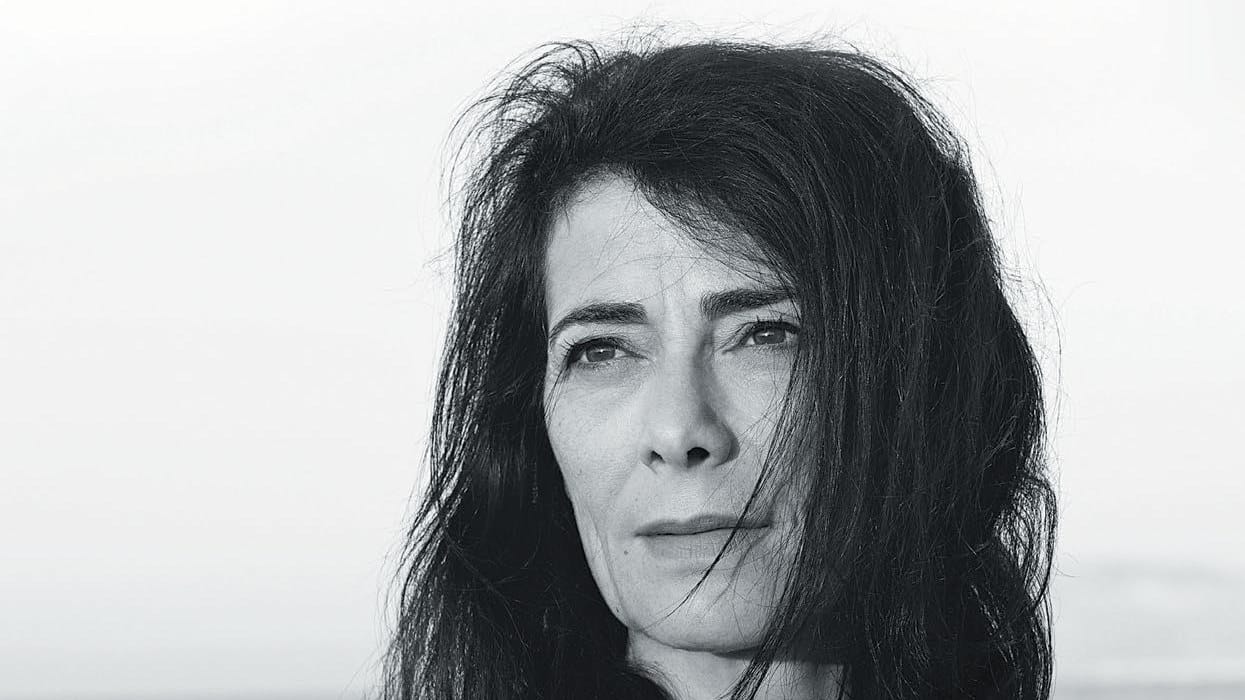
In person, Abbass exudes the same sobering rawness I remember from her films. Her striking dark eyes often seem deep in reflection and the lines on her face fluctuate between laughter and pensive frowns.
But back to that collaboration. The story goes that Miuccia Prada attended the premiere of ‘Inheritance’ at the 2012 Venice film festival. Abbass’ first feature-length film as a director, it is about a wedding in Galilee, set against the backdrop of a war raging between Lebanon and Israel. How that led to Prada thinking Abbass should direct a Miu Miu film still isn’t entirely clear but Abbass doesn’t dwell on whys, explaining simply that she received a phone call asking her to be the next director of Miu Miu Women’s Tales, and that was that.
A series of short films directed by international filmmakers, the Women’s Tales initiative began in 2012. The first in the series, ‘The Powder Room’ by Zoe Cassavetes, takes place in Claridge’s and explores the private world of the intimate yet public space where women go ‘to powder their noses,’ appraising others and themselves. The second and third films, ‘Muta’ by Lucrecia Martel and ‘The Woman Dress’ by Giada Colagrande are more surreal and cryptic and feature metamorphing creatures aboard a boat and chanting, witchlike women in ghostly dresses, respectively. The next two shorts, as one would expect from a sponsor such as Miu Miu, are similarly about the transformative power of clothing and femininity.
Returning to that phone call, Abbass says, “I first thought to myself, ‘what on earth am I going to do in fashion?’ But then I thought that if Madame Prada chose me, there’s something to it. I wanted to try and overcome my fear of what I didn’t know about the fashion world.”
The way she expresses her determination evokes a sense of how defiant she must have been when she was young and still dabbling with photography as a teenager. “People in our village told my parents there was a young woman taking pictures like a man,” she continues, a hint of laughter in her voice, adding that while she acted in school, the idea of being an actress didn’t occur to her until much later, when after a stint with the Hakawati Theatre Group, she was fortunate to work on a film by Michel Khleifi, the acclaimed Palestinian director. “They needed people in the production team and so I took time off from Hakawati and learned how to make a movie. After that, I found myself looking for something else.”
If it was a chance encounter with Khleifi that got her into film, I wonder it was a similar coincidence that led her to Miu Miu. Abbass disagrees, philosophically. “Nothing’s a coincidence. I believe that things happen because we have to go through them. Like a painter who begins from nothing, it’s not just about the final masterpiece or work but the process that’s legitimate in it’s own right.”
“I happened to be visiting Palermo at the time of Miu Miu’s proposal and I simply fell in love with it. I remember thinking how wonderful the city would be as the set for a film, the ancient energy from the market, the Vucciria, that you feel everywhere, the sense of a Mediterranean city and the way it is built around the sea, the perspective, I related to it instantly.”
In ‘Le Donne della Vucciria’, Abbass depicts the Sicilian capital in a festive light. To a score of elegiac traditional Italian music, which drifts into a dressmaker’s workshop in the beginning of the film, where an older couple are busy stitching together a collection of costumes for wooden marionettes. With a subtlety that you might not at first notice, it is the same pastel-coloured, polka-dotted satin dresses with their smart collars, zippers and tunics in which the marionettes are dressed that you next see adorning the spirited women, dancing, singing and clapping outside in the square. The main actress, Belgian-Moroccan Lubna Azabal, who also appeared in ‘Paradise Now’ and Dennis Villeneuve’s ‘Incendies’, gives a sensual, high-pitched performance, accompanied by a violinist.
As the women stamp their feet in a flurry of movement and colour, the singing reaches a crescendo and at this point you notice their metallic suede heels and quirky, striped socks in a close up, which are recognisable to anyone familiar with the Miu Miu vernacular. Gradually, the scene fades to the blurry, intersecting dots of the streetlights. “I wanted to see the fashion become part of the street,” Abbass says.
There’s a vision that Miu Miu has of femininity that is fluid and uncontrived, enlivened by clashing and mismatching styles, that is both sensual and rebellious, a state of continuity and constant change that it quickly becomes evident Abbass shares.
By the end of our interview, with any lingering ambiguity eliminated, I ask Abbass what she’s doing next. “I’m working with Ridley Scott in London on a film,” she says, unwilling to explain except to add that like so much else in her vibrant career, this is another challenge to which she couldn’t say no.
WHO Hiam Abbas & Miu Miu
FROM Palestine & Italy
WHAT The short film ‘Le Donne della Vucciria’
WHY This collaboration with Miu Miu for their Women’s Tales initiative, the sixth in the series, is an explosion of colour, song and almost bucolic outfits that not only tell a wonderful story but also showcase the label’s direction of producing clothing that is both feminine and experimental.