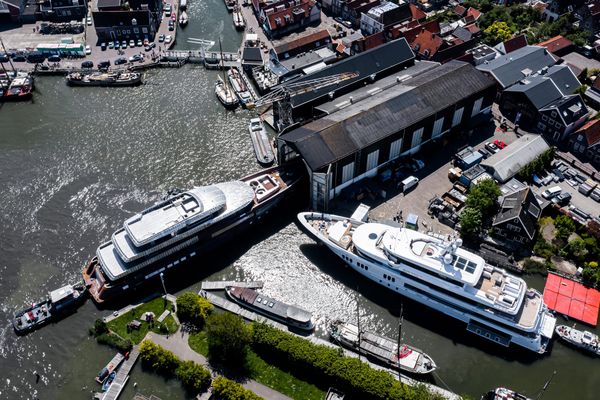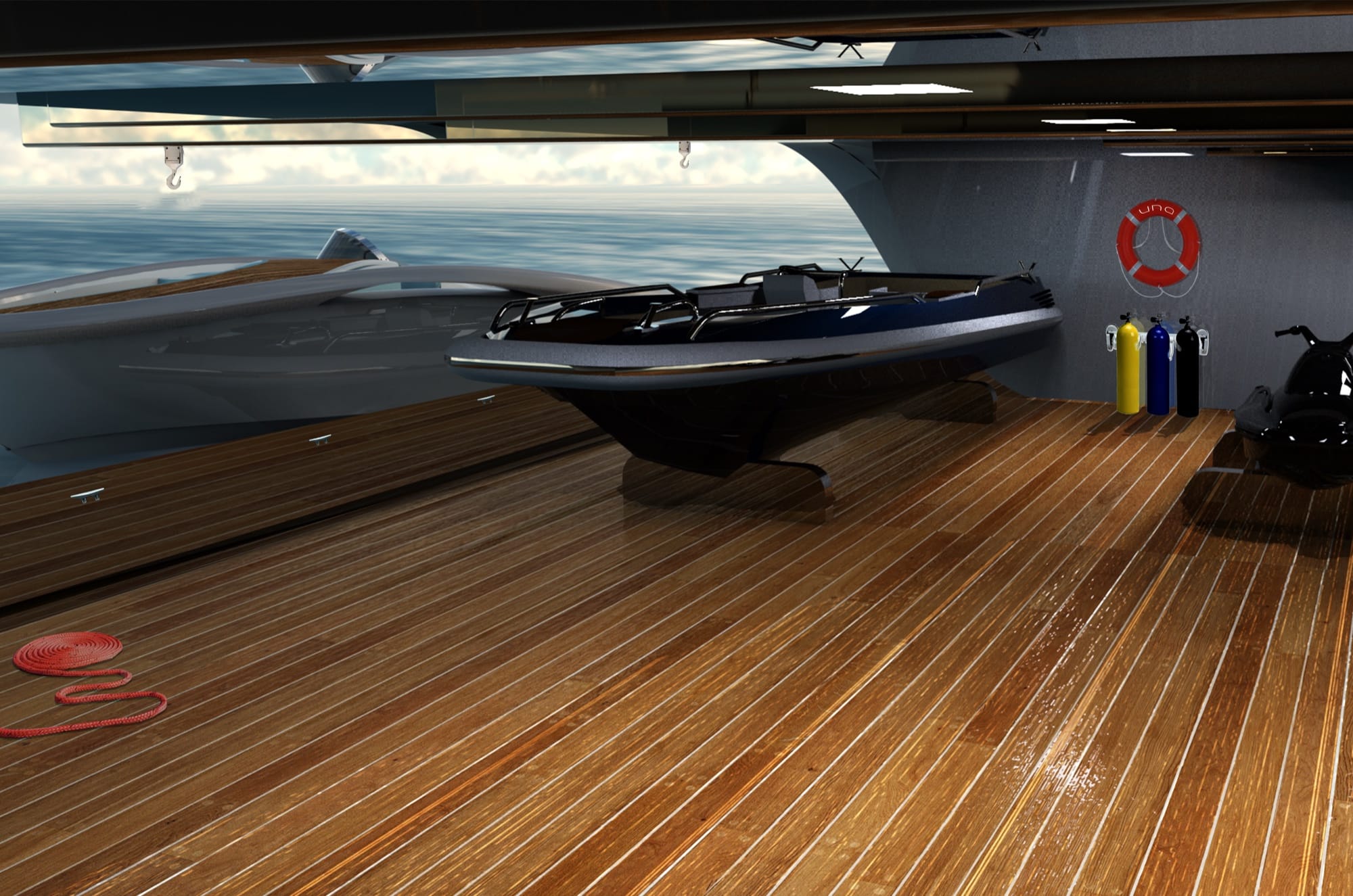
To many, superyachts represent a sense of freedom and adventure, a floating island from which to explore the great blue yonder and appreciate the natural world’s wonders. Yet as the average volume of the world’s biggest and most luxurious floating homes has grown exponentially over the last few decades and the onboard systems have become ever more complex, so have the dependencies on both the fuel to power them and the support systems ashore to keep them going.
Concerned by the limitations presented by such dependencies and with a strong sense of ecological responsibility, budding designer Graham Kuklis was moved to create the UNA, a true floating island. one no longer shackled to the shore for support and fuel to the same degree as her predecessors. The technologically advanced 91-metre motoryacht will use a combination of solar and hydrogen power to provide all the propulsion and electricity needs on board, removing dependence on traditional fuels to make it less environmentally harmful and allow for unlimited cruising ranges.
Having grown up in Florida, the foremost yachting state of the United States, Kuklis recently completed his studies at the Savannah Design School in Georgia, where his final year thesis on UNA was received with high praise. Though young, this designer’s love of design and yachts stretches back almost two decades already.
“I’ve been interested in yachting since childhood and started designing boats when I was eight. At the time, I had no idea that I would end up pursuing marine design but it was just something that I was passionate about,” explains Kuklis. “Over the last few years. I’ve designed a 45m fast motoryacht and a tender and recently, I completed a concept for a 47m fast cruising sloop sailing yacht that’s in a more traditional style than I would class UNA. But my real passion is to explore the concept of UNA further at the moment. My initial inspiration was seeing a need for a paradigm shift in yachting, trying to draw us back from our dependency on fossil fuels, something we’re seeing everywhere else in the design world but not quite so much in yachting.”
The concept has been designed to be as self-sufficient as possible by turning to technology not usually used in the yachting realm. “In recent times, I had switched over to focusing on sailing yacht design, which is clearly a more sustainable method of yachting,” he continues. “So when returning to motoryachts, I wanted to carry over some aspect of that sustainability.”
Kuklis delved into cutting-edge technologies and materials to find the most efficient and feasible methods for producing hydrogen and capturing solar power. The latter has become commonplace in the 21st century and has been applied to a marine setting multiple times, the Swiss-designed 31m Turanor, for example, which in 2012 became the largest boat of its kind to circumnavigate the globe powered by solar energy alone. But hydrogen production as a means of generating power is seen by many as a less practical and efficient technology that still has some time to mature before it can be effectively used at sea.
Kuklis is more confident that there are practical applications that can be used now and his research explored a number of different avenues of hydrogen production. “I found the most promising possibility was photo electrochemical. A semiconductor is immersed in water and light is focused on it, which splits the water molecule and creates hydrogen, which is what makes the energy. The only byproduct is water. Hydrogen storage is currently difficult but we’re finding cheaper ways to produce semiconductors now. Recently, one scientist started using rust as a semiconductor, so instead of using really valuable metals, they’re finding more accessible methods.”
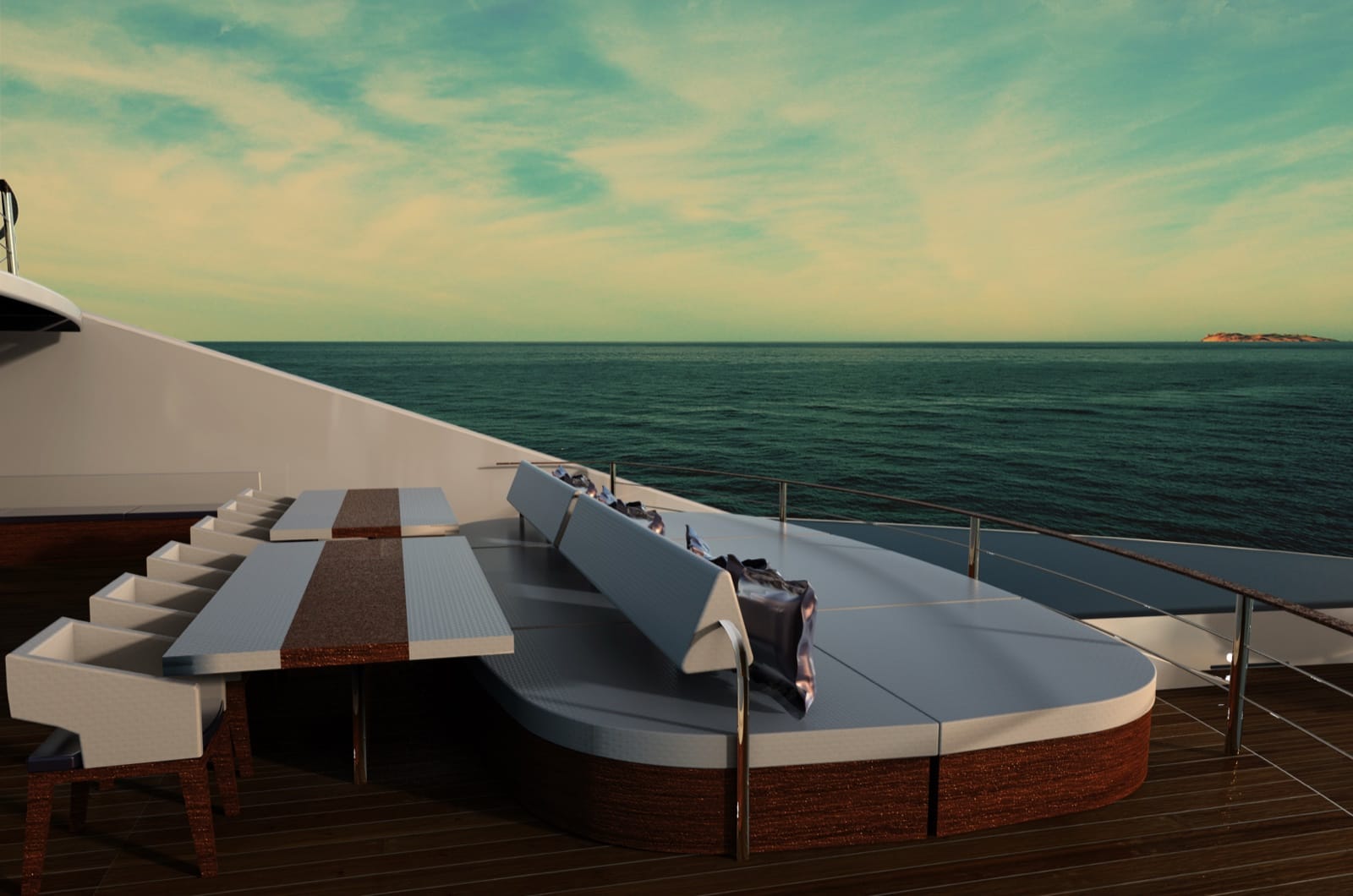
Although solar panels have previously been integrated into concepts for yachts - whether through a simple covering of flat panels or in some cases a rotating ‘sail’ - what is most striking about the UNA concept is that the solar surface adds to the design of the vessel and enhances its aesthetic.
“I wanted the solar arrays to integrate into the design rather than appear to be an afterthought,” explains Kuklis. “I have been very interested in bio mimicry recently and I try to reflect nature with my designs, keeping to simplistic curves and things of that nature.”
His concept had more of the energy production coming from hydrogen but Kuklis’ research into developments in solar films presented him with the opportunity to put flexible photovoltaic material over the entire yacht, specifically the superstructure. He now expects that the ratio of solar to hydrogen power will be closer to 60:40.
One of the central concepts behind UNA’s sustainability is that not only will the yacht use a more environmentally-friendly means of propulsion but her lack of dependence on fossil fuels means her range will become limitless. The owner will be able to explore cruising grounds prohibitively far from traditional fuel sources - to be more adventurous. To complement this, Kuklis has added a hydroponic wall for growing vegetables onboard , making it the centrepiece of the central atrium around which a large spiral staircase runs, encased in glass.
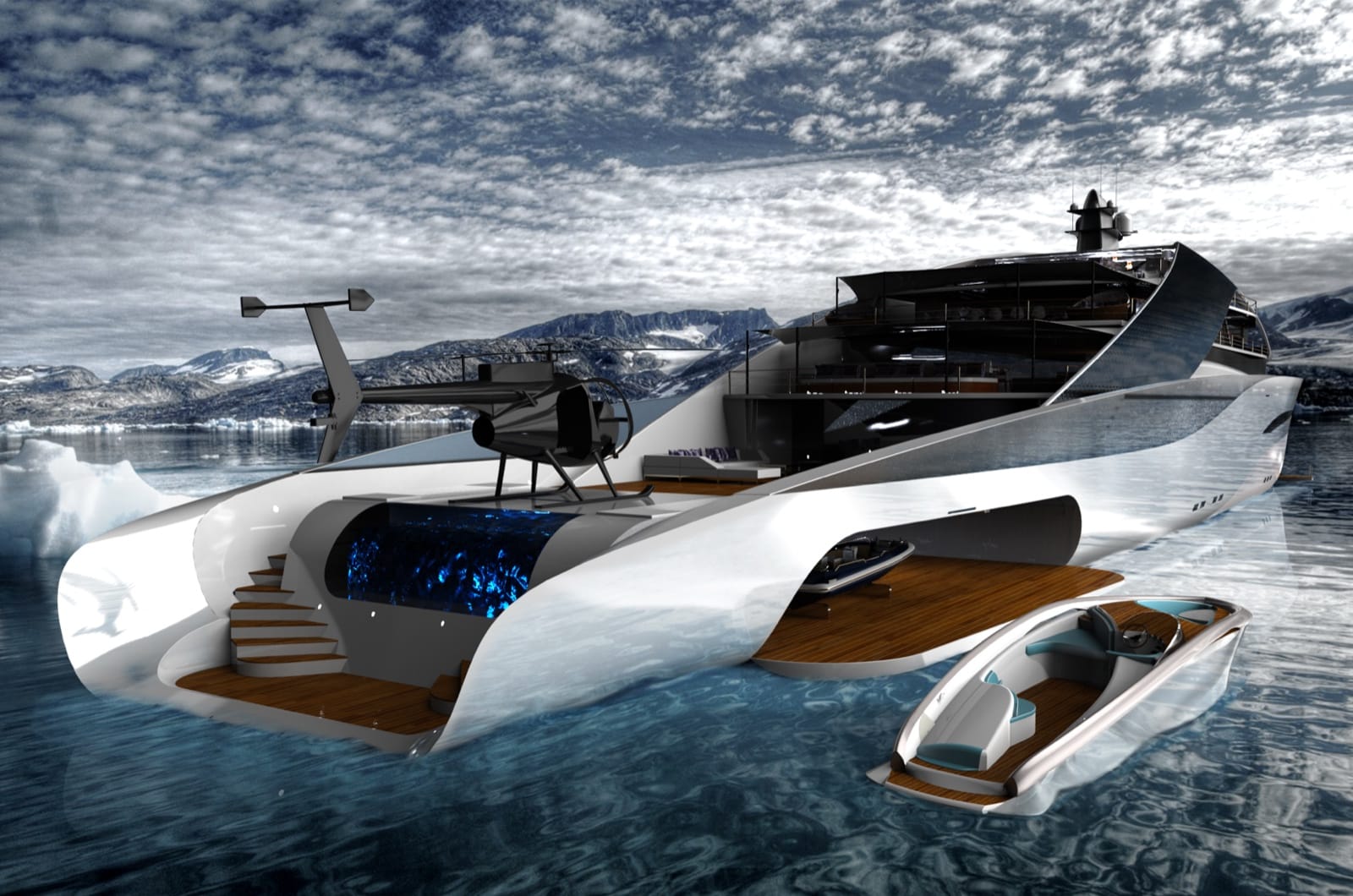
“The idea of growing food on board was very important. I’m currently researching a lot of methods for reusing wastewater on the boat and finding different ways for UNA to sustain itself and be autonomous on the water. We may not be able to provide all the food for everyone on the yacht all the time, but given the right conditions you could have an endless supply of food for a small group of people and assuming you are able to either recharge the yacht while it’s sitting, or fill your hydrogen tanks, you could have a way of sustaining the fuel source as well.”
Yacht designers will often create concepts with a certain owner in mind. Who, I wondered, did Kuklis have in mind with his design? “To me, this would definitely be a yacht design for an innovator. I see it as being an opportunity to showcase new technologies around the world, almost as an investment to get the word out to people. It would be an ideal vessel for a technology guru, someone younger who is open-minded. Someone who is ready for the future.”