
Second-guessing Amazon is a fool’s game. No one will spill the magic beans. But there is one thing that we can predict. Amazon, already nicknamed “the everything store”, is fast becoming the “everything, everywhere, every time store”. It’s growing so fast that it’s now the world’s third-largest tech company by revenue, on course to generate sales of 200 billion USD this year. That’s 547 million USD a day. Analysts expect sales to reach 350 billion USD by the end of 2020 and to surpass the 500 billion USD mark by 2023.
Its shares are soaring at such a clip – up more than 50 per cent this year – that it is expected to pip Apple to become the world’s first trillion dollar listed company. Last week it became only the second company, after Apple, to pass the 900 billion USD market-value milestone. That made the firm’s founder, Jeff Bezos, 54, the wealthiest man in modern history, worth 150 billion USD, according to Bloomberg. That’s enough to cover many countries’ budget deficits.
What makes a simple shop so irresistible that even those of us who are critical still use it to buy most of the stuff we need, read novels on Kindle, watch TV and now wake up with Alexa? Can it continue to escape the scrutiny and public disgust hammering the other tech giants, notably Facebook? Amazon has grown so big, so fast and been largely ignored by regulators because it is different. Not necessarily better than its West Coast US rivals, but different. To find out how, you have to go to 2117-2127, 7th Avenue, Seattle.
The first distinction is as clear as the summer sky around the company’s head office the day I arrive. Amazon is not, like its biggest tech competitors, in Silicon Valley. Nor does it look like anything in “the Valley”. Its 45,000 Seattle-based staff do not work in a perfectly formed bubble, unencumbered by the awkward intrusion of reality. Amazon’s 4 billion USD mothership is spread over 3 million square metres in more than 40 buildings downtown. That helps Amazon never to lose sight of its customers. “It inspires us to invent for them every day,” says Sam Kennedy, from Nashville, the first Amazonian I meet.
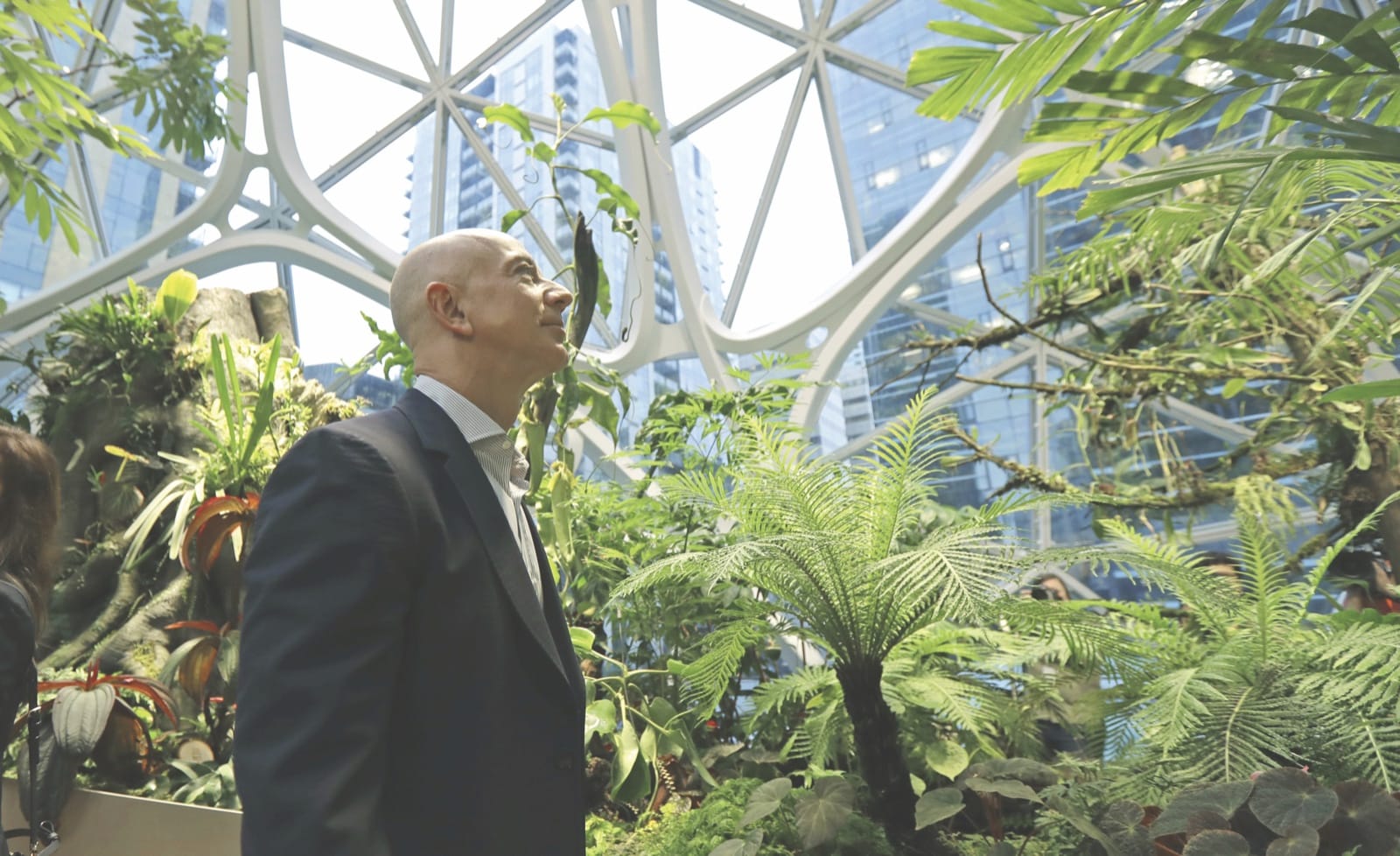
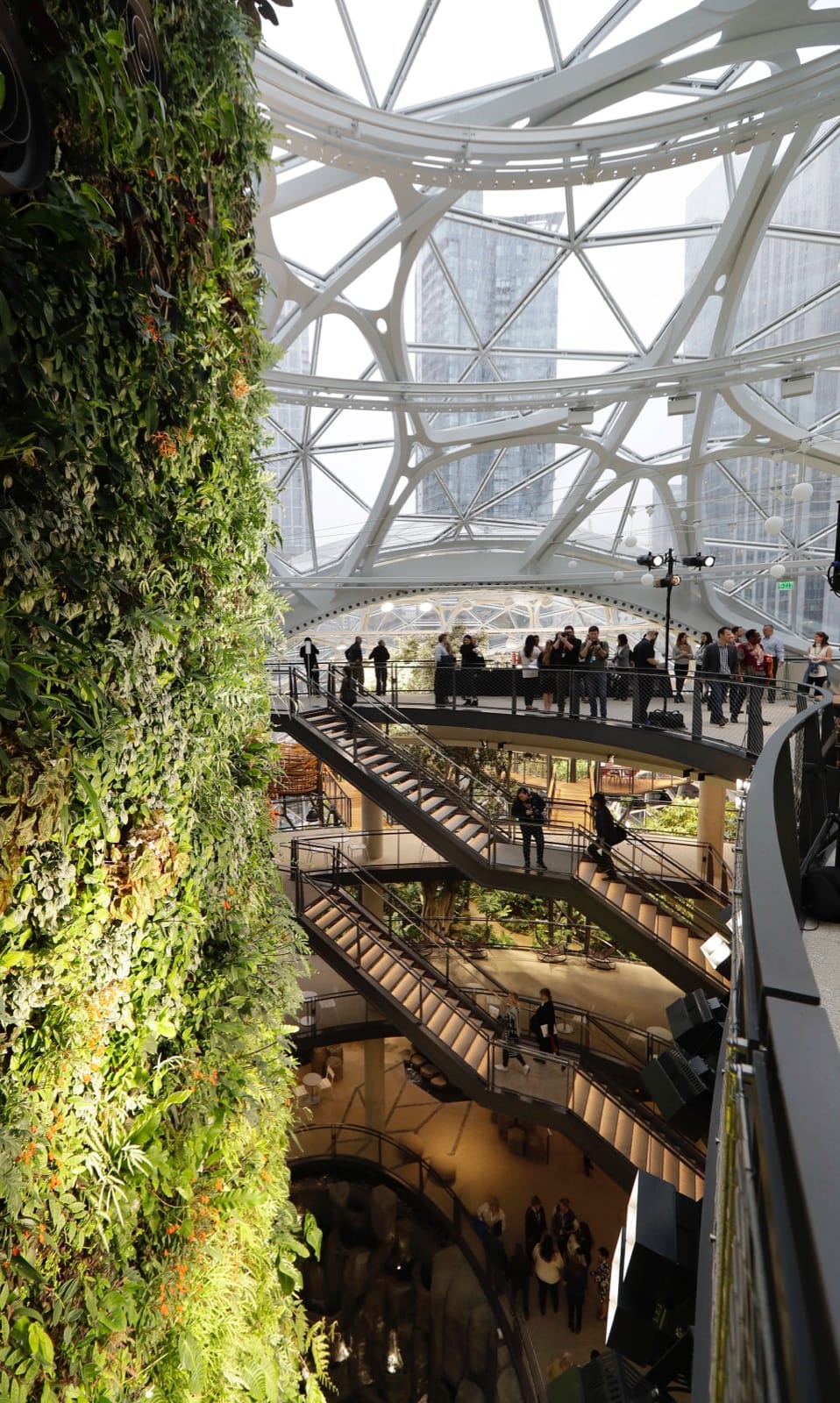
Customers never lose sight of Amazon, either. The entrance to Amageddon is marked by glass domes. The Spheres – to Amazon, or “Jeff Bezos’s balls” to everyone else – are 27 metres high and 40 metre wide, and filled with 40,000 plants. Modelled on the greenhouses at Kew Gardens, they are a place for employees “to feel differently, to think differently”, Amazon says. (Not for too long, though. Bezos monitors the time his employees spend there). Their main role is to demonstrate transparency. They practically scream: “Look inside. We’ve nothing to hide. We’re not Facebook!”
All the tech behemoths like to think they are take-no-prisoners innovators, but Bezos raises the bar. He reminds his human drones to push harder every day by calling the main 37-storey tower of his HQ “Day 1” because “every day is day one at Amazon”. If they forget the firm’s scrappy start-up culture, what will follow is “painful decline. Followed by death.” The company’s values, pasted on walls everywhere, increase the pressure. “Have Backbone! Bias for action!”, the signs scream.
It’s tough all right, but also a refreshing change from the platitudes beloved of most west coast US firms – “Don’t be evil” (Google) or “Connect the world” (Facebook). But do the people who work at a firm that is almost 25 years old and set to become the most valuable in the history of modern capitalism really buy such motivational woo-woo?
They do. Really. “I love waking up every day worried about my customers,” Prentis Wilson, who heads up Amazon’s business services, tells me –with one of his trademark awkward corporate smiles that seems to mimic Amazon’s logo. Stephenie Landry, who pioneered the Prime Now service that offers delivery in cities in a couple of hours, may dress like a hippie but she describes gleefully how “ruthless prototypation” and long, long days enabled her to set up Prime Now in New York in just 111 days. That’s not moving fast and breaking things. That’s being on tech crack.
Perhaps that’s why Amazonians don’t mind doing without the perks enjoyed by staff at Google and Facebook. Another of Amazon’s core values posted on every noticeboard is “Frugality!” There’s no free food and staff travel economy class – all except Bezos, who has a private jet and a spaceship, New Shepard, in case he can’t find anywhere on earth he wants to fly to.
But perhaps the biggest difference between Amazon and its Silicon Valley peers is its attitude to making money. Most big tech outfits like to charge a lot for the gadgets they create and rack up vast profits. Amazon, by contrast, does not seek to make much money at all from its devices. “We break even,” says David Limp, head of devices, whose haircut is so neat and whose clothes are so crisp he looks rather like a device himself. He’s not kidding. A Kindle e-reader starts at around 80 USD, compared to 400 USD for an Apple iPad Mini, and an Alexa ‘Echo’ Dot can be yours for 40 USD, almost 9 times less than Apple’s rival HomePod.
Amazon can do this because it subsidises devices and its retail arm with the vast profit its makes from Amazon Web Services (AWS), its cloud-computing arm. AWS sells pay-as-you-go computing power, data storage and content delivery to everyone from the smallest start-up to the CIA, raking in 20 billion USD a year. It’s the little-known power behind Bezos’s empire and even if you want to escape it, you can’t. Like Netflix? You’re swelling Amazon’s coffers. The streaming giant depends on AWS.
It’s certainly tempting to paint Bezos as a 21st century version of the robber barons of the oil or railways age. It’s also hard to disagree that Amazon and other online retailers are hollowing out town and city centres and malls. One lunchtime in Seattle I walk the few blocks from Amazon’s HQ to Macy’s department store on Pine Street. It’s so quiet inside that shopping is like intruding on private grief. Or it would be, if there were anything to buy: the shelves are a jumble of outdated styles. Last year was a record year for store closures in America, with nearly 8,000 shutting and only 3,000 opening.
But Amazon thinks it has a trump card. By delivering ever-lower prices, it argues it is the opposite of a greedy monopolist. “I wake up every day thinking customers are better off than they were 10 years ago,” says Greg Greeley, former head of Amazon Prime, when I pose the question everyone always wants to ask Amazon: do you wake up worrying about putting yet another bricks-and-mortar store out of business? Amazon executives add that while it may dominate certain markets, notably online books, when you take into account the total retail market, it is only a small fraction – 4 per cent in the US. As for pressuring smaller rivals, they point out that 2 million small- and medium-sized businesses around the world rely on Amazon to fulfil their orders. Last year, for the first time, independent companies’ orders fulfilled by Amazon exceeded sales by Amazon itself.
But what about all the jobs that are disappearing from the high street? Surely Russ Grandinetti, a man-mountain of a hometown boy who runs Amazon’s international business, feels a little guilty about what his firm has wrought? “The building we’re in now didn’t exist three years ago. I see a building going up over there that we are constructing. What we’ve done for this town, for the country, for the world is productive,” he insists as he gestures out of his many office windows. “We create lots of jobs not only in the company – 100,000 in the US last year alone – but also in the suppliers we serve.” He adds that the firm is set to open a new 5 billion USD campus in North America, creating up to 50,000 jobs.
Grandinetti does concede that there are losers in the e-commerce revolution and helping them is “important”. But “where that nets out I don’t really think is ours to tally. Companies have often invented technologies that have then required us to figure out how to reinvest the productivity improvements in new jobs and new ways. That’s an important societal thing to do, an important governmental thing to do. I don’t think it’s our job to do anything but try to be really good at what we do.” Shareholders will cheer his relentless focus on the bottom line. Critics will respond that he is turning a blind eye to the disruption Amazon causes.
If Amazon has an Achilles heel, it is in its comically named fulfilment centres – its giant warehouses. They are anything but fulfilling for the people who work there. Scarcely a month goes by without a newspaper sending an undercover reporter to record how staff work crippling shifts. To meet performance targets, insiders say pickers must collect as many as 1,000 items and walk up to 15 miles in a single shift. Timers count the seconds needed to retrieve each item, with penalties for those who are too sluggish. Pressure to hit targets means there is scant time for lavatory breaks or lunch, workers claim. James Bloodworth, who got a job at Amazon’s warehouse in Rugeley in Staffordshire, revealed in a recent book that workers who have a day off sick – even with a doctor’s note – get a disciplinary point against their name. Amazon has since ended this practice. Wages, however, remain low. Amazon disclosed in April its workers’ median annual salary is 28,446 USD, which means a typical employee would have to work more than 5 million years to rack up Bezos’s current net worth. Thousands of workers at Amazon’s warehouses in Germany went on strike earlier this month to demand better working conditions, joining colleagues in Spain and Poland. Germany’s Verdi services union accused the company of getting rich by “saving money on the health of its workers”.
Can anything stop the world’s biggest data-driven instant-gratification company? On my final afternoon in Seattle, I ask Gur Kimchi, the scientist who oversees Amazon’s tech centre in Cambridge and has already test-flown the first local delivery – a bag of popcorn. We debate the rights and wrongs of big tech but he’s heard it all before and it has turned his hair salt’n’pepper. He wants to move on. “Let me leave you with a parting thought,” he says. “If you think drones are exciting, think about the other 50 projects – bonkers, crazy projects – we can’t tell you about.” Alexa-enabled spectacles? Not weird enough. An Alexa implant so she can tell us what to do, not the other way around?
Like Hardcastle, Kimchi is not giving anything away, but his parting message is clear: the online mega mall that sells soap powder and makes soap operas, online marketplace, music box, online advertiser, cloud-computer services provider, bank, audible-books player, supermarket chain, food-delivery service, e-reader manufacturer, always-on home help, CIA’s little helper, online car dashboard, drone squadron, pharmacy chain, creator of warehouses where Dickens meets robots and much, much else – is only just getting started.