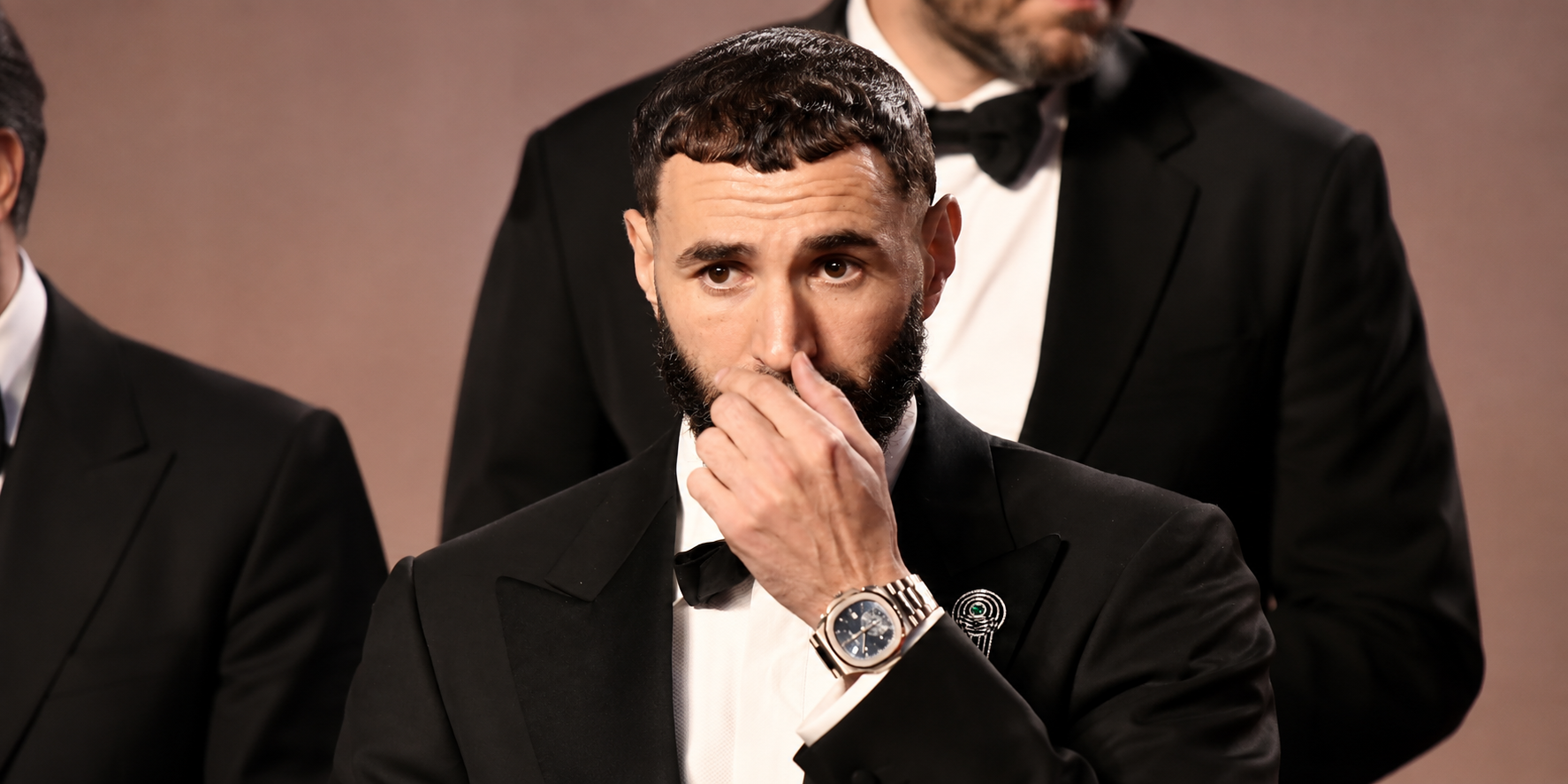
After completing a mid-season transfer in February to only the fourth club of his career, Benzema looks fitter and leaner than ever. He recently turned 38, but the years seem to have done little more than sharpen his obsession with staying at the very top.
Settled in Saudi Arabia, and having signed a contract that extends his stay through to 2027, the former Ballon d’Or winner remains closely plugged into European football, unafraid of strong opinions and still utterly convinced of his own destiny. That much is obvious from the hour he spends talking to us – no glances at the clock, no rehearsed lines, no hedging.
Determined not to relight the fuse on his long-running stand-off with France manager Didier Deschamps, he handles the subject of World Cup selections with restraint, refusing to attack. Yet he still applies a certain pressure: making it clear he would have been willing to return for another World Cup tilt – one of the few trophies missing from his CV. It’s not a formal plea, but surely enough to get Deschamps thinking.
You’ve been in Saudi Arabia for almost three years now, initially at Al-Ittihad, and now at Al-Hilal. How do you judge the experience so far?
Very positively. For me it was a global project. I was there right at the beginning of the Saudi football project, to help build something. At first it was hard, because it was a radical change: a different kind of football, a different mentality. It felt like starting again from zero. But with all my years in Europe, things improved step by step. In my first season (2023–24), my level was average. Very average. But I always look at things in terms of progression – that’s my mentality, that’s what motivates me. I always need something to chase. The second season was very, very good. I got my sensations back. Good team, very good players, goals, trophies.
Has the Saudi Pro League proved its legitimacy in terms of quality and intensity?
For me, in three years the football here has evolved a lot. It’s more physical, it’s quicker and it’s only going to keep moving. At the Club World Cup we saw Al-Hilal draw with Real Madrid and knock out Manchester City; so don’t imagine it’s easy here. It’s not at Europe’s level yet, but it’s not far. A European side facing a good Saudi team isn’t going to win 5-0. That’s fantasy, that’s PlayStation. You can’t get ahead of yourself either: the level, the training sessions, the daily intensity are still not the same as in Europe. But little by little, it’s getting there.
I don’t just want to be “a footballer”. You can be a player who passed through, had a good career, respectable… Or you can really leave something behind. That’s what I want. I think I’ve already done that, but I have to keep going.
Can the local players keep pace with that evolution?
It’s difficult because the intensity isn’t what it used to be for them and the ambition isn’t the same either. But they’re learning every day. I’m here for them. I give a lot of advice, I show them a path. I’m not their age, but they see I work harder than they do, so they come and ask questions. I like that, because they have a real work mentality. I want the best for them.
At 38, you don’t seem to have lost much physically. How do you explain that?
Work, but above all passion. That’s what pushes me. Of course I’m not the same player I was six or seven years ago. But in my head, in the way I read the game, I know I can still do the same things. I work a lot in training and at home. I’ve just had five days off, I went back to Lyon and I still worked. I have to. Honestly, I have to. I love football so much that I put that pressure on myself.
Have you ever thought of changing your game with age – dropping deep less, running in behind less?
Yes, there were times when I tried to change, to stay more in the box. But it didn’t feel like me. If you stay in the area, get three good balls and score three goals, okay, you’re happy, but I need to move, I need freedom. That’s where I feel best. I always tell myself: what I do on the pitch is my image. It’s what I want to keep showing people.
What can you still improve at 38?
Maybe anticipation. Being that fraction of a second ahead in a move – that’s the hardest thing. The tiny movement that changes everything. Defenders these days are stronger and faster. So I have to work on those first five metres. I have to work on the trajectories of my runs. Instead of going straight to the near post, it’s making that little curve, then boom, going to the other side. Those are the details I work on more now.
You only played at one World Cup back in 2014. In 2018 you were banned, in 2022 you were injured. Do you feel you have unfinished business with Les Bleus?
No, it’s not “unfinished”. Every player who comes to the France team wants to win a World Cup, to win the Euros. But why unfinished? I did what I did. I tried. I was there. It didn’t happen, that’s life. I didn’t play for the national team for six years (from October 2015 to June 2021). I came back, I won the Nations League in 2021. We went to the Euros, I shone – four goals – but we went out to Switzerland on penalties. That’s life too. So “unfinished”, I don’t agree. That’s not how I see my story with France.
But given everything you’ve won at club level – five Champions Leagues, a Ballon d’Or – people inevitably look at the missing World Cup…
[He cuts in.] That doesn’t mean it’s unfinished. If you stop playing and you didn’t get the chance to win a World Cup, you can have regrets, sure. But unfinished what? I’ve won the Ballon d’Or. I’ve won Champions Leagues. I’ve loved football – and I still love football.
Let’s put it another way: Messi, Ronaldo, Modric – they’ll all be at this World Cup. Don’t you see yourself there too?
Who doesn’t want to play a World Cup? If you tell me, “Go to the France team to play a World Cup,” and I say no, I’m a liar.
So the door is open to a return in blue?
I’m a footballer. I play football. If I’m called up, I come, I play. I’ve got goals in my head. I love football, I love winning, I love trophies. That’s what counts most. Right now, I’m focussed on my club. If they call me up to the national team, I’ll come and play. And that’s that.
Zinédine Zidane is heavily tipped to be the next France manager. Does that make a return more likely?
[Laughs.] Right now we don’t know anything. We’ve no idea what’s going to happen. If Zizou does become France’s coach, I wish him all the best. In any case, Zizou will win: club, national team... wherever you want, he’ll win. That’s it. [Smiles.]
Are you still in touch with him?
Of course. We talk all the time. We have a special relationship. Given what Zizou did as Madrid coach – three Champions Leagues, two Ligas – he’s the No.1. He’s someone… he doesn’t need to talk much. With him, you just go and run, you go and play. It all feels natural. If he becomes the national coach, I’ve no doubt he’ll succeed.
Do you still watch Les Bleus, especially the new generation?
I watch when I can. Lately I’ve caught a few France games. There’s a lot of talent there. Very good players.
Who, for example?
Ousmane Dembélé. We’re talking about a guy who’s won the Ballon d’Or. For me, we don’t talk about him enough. What he’s done at PSG is unprecedented. I don’t think we hype him enough, as he’s actually the best player in the world. People don’t highlight his resurgence enough. He’s come from a long way back – all the injuries, his time at Barça. He wasn’t necessarily the guy you’d look at and say, “One day he’ll win the Ballon d’Or.” He wasn’t close. And yet in the end, he proved the opposite. I really like this player.
Anyone else?
Michael Olise – he’s a very good player too. Rayan Cherki – he’s magnificent. I like Cherki because he’s exactly the kind of profile the France team sometimes needs. He tries things. Of course, you have to explain there are zones on the pitch but he’s had Pep Guardiola coach him for a year now, so I'm sure he has improved.
Beyond France, do you still follow European football closely?
Yes, I watch a lot. The game is very quick now. It’s become extremely physical, very fast. Players are all strong, and very well prepared.
How do you see Real Madrid at the moment, with all their recent struggles, both on the pitch and off it?
There’s clearly a problem with connections. Between Mbappé, Vinícius, Bellingham, Rodrygo. Everyone has to know exactly what they’re supposed to do on the pitch. Bellingham has to understand he’s the playmaker, not the finisher. Mbappé is the finisher, not the playmaker. Vinícius isn’t a No.6, he’s a left-winger. Once everyone knows their role, that’s it. Because we’re talking about guys who are all among the ten best players in the world – and they’re in the same team.
How do you judge Kylian Mbappé’s performance levels now that he’s at Madrid?
He scores a huge number of goals, and he’ll keep doing that, like he did at PSG. But the key thing for Mbappé is that Real signed him so that, in decisive moments, he makes the team win. He’s capable of that. That’s the pressure he has to accept, to take that extra step as the leader of the attack. Because he’s the one who has to carry Real towards trophies. Not alone – with the others – and that’s why I spoke about connections.
Is the mark you leave on the game important to you?
Yes, that’s the most important thing. I don’t just want to “be a footballer”. You can be a player who passed through, had a good career, respectable... Or you can really leave something behind. That’s what I want. I think I’ve already done that, but I have to keep going. As long as I can still play and still score, I’ll continue.
From the outside, you can seem indifferent to what people think of you. Is that fair?
No, no. Careful. I play football, so I’ve built a fanbase. People who love me – and I love them. For the rest, we’ve nothing to say to each other. But at home, with my family, if I tell them I’m stopping football, they won’t be happy. So I carry on for them too. I carry on for my fans, for the people who love my football. And for the kids. I have to keep going. I could say to myself, “I’m in Saudi Arabia now, it’s all right, take it easy.” I don’t want that. I’m not tired.
You’ve said before that you’d stop playing at 40. Is that still the plan?
In my head, I’m programmed for two more years. That means I watch what I eat, how I sleep… everything is structured. It’s hard, of course it’s hard. But I’ve been doing that since I was 28 or 29. I didn’t do it when I was younger and I should have started at 19. But it’s good now, because as I get older, I keep pushing my limits.
What do you see yourself doing after you stop playing?
I’ve got a lot of ideas, but one thing I really like is setting up academies for young players. I want to pass on my vision of football, the football I love. I wouldn’t say we’re losing that kind of football, but I’d like to see more of it in youth development, because that’s where it all starts. So yes, passing on this idea of football – technique, combination play, one-twos – to kids, that really appeals to me.
Sporting director, club president – is that tempting?
We’ll see. I don’t know. I’ve got a lot of goals. It could be that, it could be becoming a coach, it could be something else. I just know I love anything that keeps me close to the pitch.