In the United States of America, back in the middle-of-the-twentieth-century, an obsession with ‘process’ or development ruled the worlds of art and design. Jackson Pollock, whose canvases feature drips from his paint-loaded brush, was one of the pioneers in considering art as a ‘process’ rather than a product. Though initially an experimental initiative, there were many factors that lead to the idea being embraced on such a wide scale. Primary of which was the intention of assigning an identity to the young American artists and designers, differentiating them from the European heritage as well as from the influx of European artists and designers who were entering the States around the time of the Second World War.
Critics lauded the concept of ‘process’ and Charles Eames, and his wife Ray, were front-and-centre in this new movement. The Eames philosophy was entrenched in procedure, in which getting to the final product often took years of trial and error. They were multi-talented and very much in the spirit of the time, the prolific husband and wife team worked in several media, whether as architects, filmmakers or furniture designers.
The question of the process was often hailed by Clement Greenberg, the theoretician for abstract expressionism. And although he may not have intended to be a part of this art movement, there is a drawing by Charles Eames that is often reproduced that shows traces of abstract expressionism if taken as a two dimensional drawing.
Eames’ influences are many, but two of them stand out as they formed his early artistic drive, and these are the work of the American architect Frank Lloyd Wright, the Finnish architects Eliel Saarinen and Alvar Aalto.
Charles Eames started his professional career at the now famed Cranbrook Academy of Art in the state of Michigan, where he met Ray Kaiser, a painter, architect and a designer who was teaching at the Academy. They got married in 1941, moved to California, and became design partners continuing to work together throughout their lives, spanning close to four decades since their first meeting. Charles Eames died of a heart attack in 1978 and Ray died ten years later to the same day.
Their house remains a milestone of modern architecture. Located on a cliff overlooking the Pacific Ocean, and constructed entirely of pre-fabricated steel parts intended for industrial construction, Charles and Ray Eames Case Study House #8 was also their home.
They created many modern furniture designs rounding out a diverse work whose conceptual backbone was the search for seat and back forms that comfortably support the human body, using three dimensionally shaped surfaces or flexible materials instead of cushioned upholstery. An ethos of functionalism informed all of their furniture designs. “What works is better than what looks good,” Ray Eames once said. “The good looks can change, but what works, works.”
Eames Moulded Plastic Armchair
The chair was first presented at the Museum of Modern Art in 1948 and was the first mass-produced plastic chair. Amazing for the time, it was even environmentally-friendly because of its minimal use of material. The organic forms of the design were pioneering because the armrests, back and seat were all moulded from one piece through the inventive use of geometric curves.
The moulded plastic upper is available in five colours: black, light blue, lime green, red, and white. The base is available in two styles: wire base or four-legs.
Price 270 USD (wire) / 243 USD (four legs)
Eames Moulded Plywood Armchair
In the early 1940s, Charles and Ray experimented with wood-moulding techniques that led to a commission from the US Navy in 1942 to develop plywood splints, stretchers, and glider shells moulded under heat and pressure. After WWII, they adapted the technology to create an inexpensive, high-quality chair in 1946 that could be mass-produced, eliminating the extraneous wood connecting the seat and back thereby establishing a new basis for modern furniture design.
The chairs are offered with birch veneer in eight colours: red, green, orange, purple, black, light blue, white, and yellow. Or wood stained in: cherry, walnut, natural ash, red-stained ash, or ebony-stained ash.
Price 520 USD
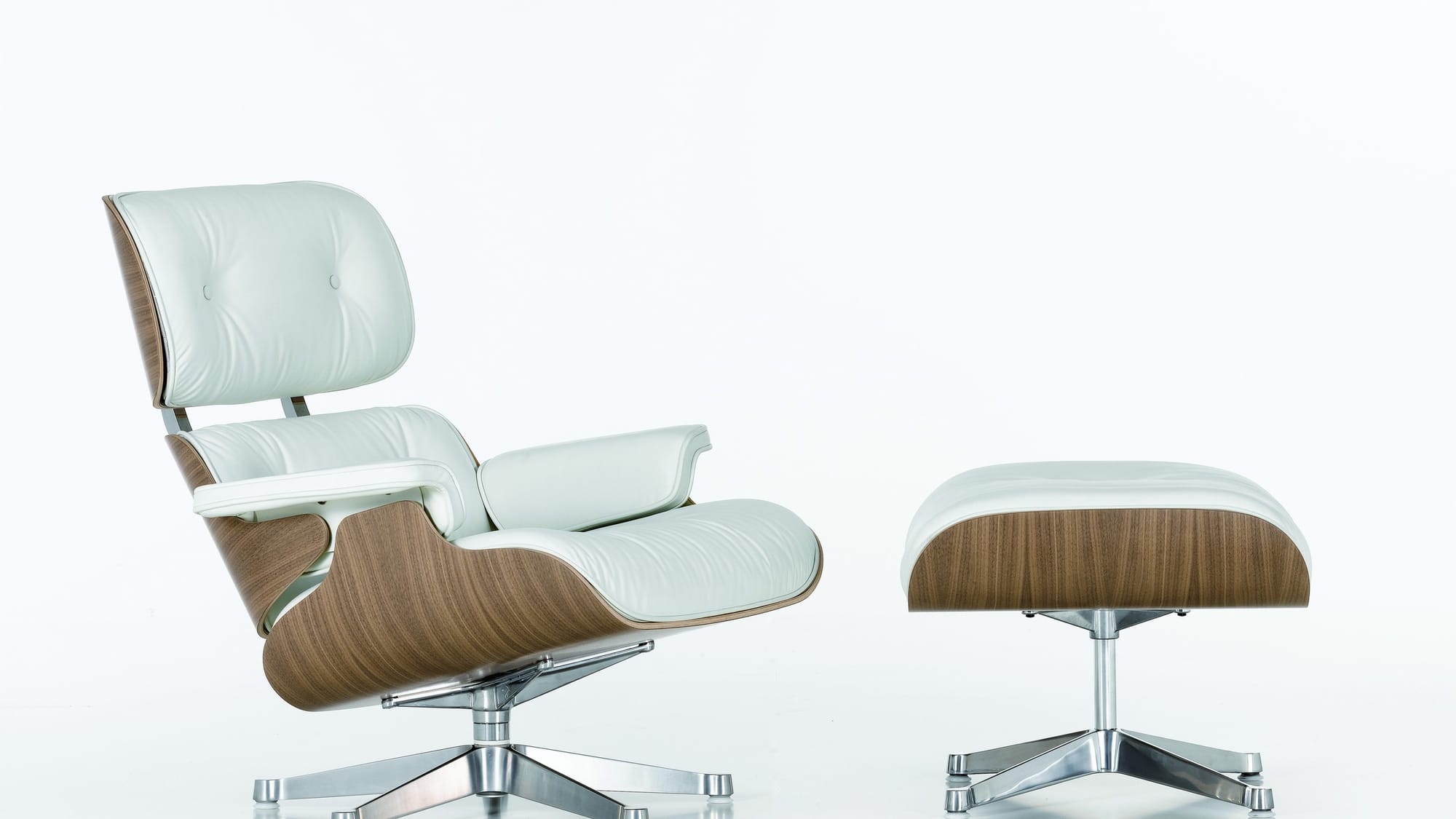
Eames Lounge Chair and Ottoman
The first lounge chair and ottoman, produced in 1956 was based on an earlier prototype from 1940. It departs from other Eames designs by being made for upper-echelon clientele. It preserves the aspects of design that comes from the repertoire of Eames moulded plywood, allowing maximum comfort, but it also adds luxury materials including leather. It’s part of the permanent collection of New York's Museum of Modern Art.
Shells are seven-ply cherry, natural cherry, walnut, or santos palisander veneer (although you must add 1,070 USD for the santos palisander). The base and back braces are die-cast aluminium.
Price 3,757 USD (chair and ottoman)
Contact
Herman Miller Middle East
Dubai, UAE
Tel + 971 4 397 5161