Moxon is a name that has been around for longer than most can imagine. Founded by the Moxon family in 1556, this was a time when the Ottoman Empire was at its zenith thanks to the reign of Suleiman the Magnificent and England was in the height of its Renaissance period under Queen Elizabeth I.
Huddersfield, an idyllic town, situated near the confluence of the River Colne and the River Holme, may be best known for its important role in the Industrial Revolution or even as the birthplace of Rugby League, but too few know about its real claim to fame, Moxon.
As I arrive at the mill, I immediately behold the lush environment and beauty of the grounds. The facilities include a huge lake that feeds one of many streams that flow directly under the mill. As I later discover, this water is actually an integral part of the cloth making process for its purity is supposedly second to none.
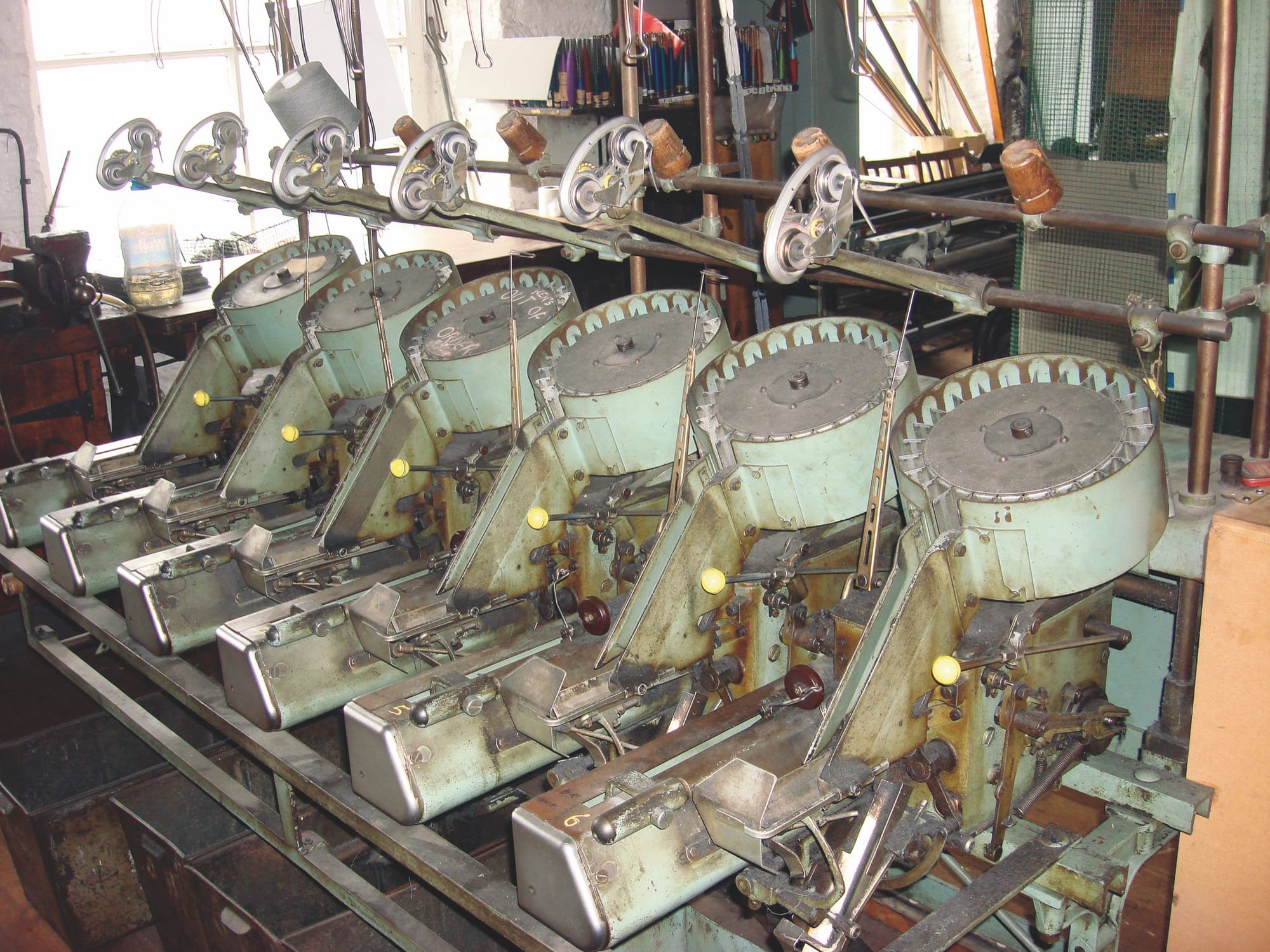
The building itself dates back to the Victorian era, clad with stone from the outside and featuring some resplendent wooden staircases inside. Remarkably even the machinery harks back to a past era; the sampling machines are well over one hundred and fifty years old and the weaving machines are no younger than a century. Don’t expect any new composite materials either; rather good old wood is the machinery material of choice. Most of these golden-agers run at very slow speeds and you can bet your bottom dollar that firstly none of these machines are produced anymore and secondly that they must be incredibly good to have never been retired.
What is perhaps most surprising of all is that this quintessentially English brand is headed by a gentleman by the name of Firas Chamsi-Pasha. Moxon’s chairman’s name suggests Ottoman roots which he proudly confirms. In fact his family had lived in Syria from the early twentieth century and then in the 1950s they moved to Lebanon. However, following the onset of Civil War the Chamsi-Pasha Group bought Hield, another old English weaving business, and then moved to the UK, where they have remained.
One of the first decisions the group took after they bought Moxon was to slash production by 90 per cent, cutting out its middle-market cloth production to concentrate only on the very finest cloth by using the rarest and most sought after raw materials. Prior to this buy-out, Moxon was producing 5,000 pieces of cloth a year (which can produce approximately 120,000 suits). Today, Moxon employs just fifty two people and produces 500 various cloth pieces annually (meaning around 12,000 suits). “Cutting production by so much in the first year was very tough as we had to maintain business as well as retain all the employees. The capital outlay proved to be heavy too, as we had to rebuild old machinery from blueprints,” explains Chamsi-Pasha.
Furthermore, before the acquisition, the least expensive fabric was 50 USD per square metre, now it is 600USD per square metre while the most expensive fabric was 800 USD per square metre while now the most expensive fabric is 12,000 USD per square metre. Moxon’s fine materials include wool from Australia and New Zealand, mohair from South Africa, linen from Ireland, vicuña from Peru and cashmere from Mongolia. Shrewdly, ever since the 1930s Moxon has enjoyed world exclusive rights to Altai and baby Altai cashmere following an agreement with the Mongolian Government.
Now, pivotal to the core-business is the first 12.9-micron, Super 210 wool, which is spun on the ancient looms that are so slow that they are able handle the delicate fabric. The gossamer-like cloth, which is regarded as superior to both cashmere and vicuña, is made from the wool of a rare breed of sheep. The material can be produced only every three years—it takes that long to collect enough fibre from the animals, which are specially cared for and kept isolated.
Incredibly Moxon are pioneering ever more extraordinary materials. First came the announcement of the extremely rare ‘long staple’ super 230 wool which is equivalent to 12.1 microns. And then most astonishingly of all, it turns out that Moxon are currently in talks to purchase 11 micron wool but are facing two obstacles: the first being that the breeder is asking the price of 1 gram of gold for every gram of the wool, and secondly there is the issue of whether or not there is enough of the wool to actually make a suit.
Nowadays Moxon has proven the inverted pyramid theory to be true. Basically that as you raise your prices, your client base shrinks until you reach the point of bust, but if you push on through, while maintaining exceptional quality, the client base will grow again.
In making the most of these ultra rare raw materials, Moxon has expanded its business model to include ties, coats, jackets, sweaters, scarves (the baby Altai cashmere scarf goes for almost 3,000 USD) and socks (the baby Altai cashmere socks are so fine your toenails will tear them after ten wearings). Moxon has even expanded into tea following an exclusive deal with a tea farmer in which they shall purchase all the quantity of one of the rarest teas in the world. This single plantation Himalayan ‘first flush’ white tea’s total annual production amounts to just 250 kg (Moxon sells this exclusive tea at 600 USD per 125 grams). Generously, Firas offered me a cup so as to taste the tea and I must admit it was incredibly delicate and truly superb. But the tea offers a telling insight as to where the company is heading. With its new found aspirations the company now wishes to be a lifestyle brand rather than just a cloth maker. Already in development is an entirely new collection that shall include ready to wear, cigars, chinaware, furniture and furniture fabric amongst others.
Moxon’s influence in the world of fashion can never be denied. The company started archiving its cloth samples 200 years ago meaning that you can go back and see the actual cloths chosen by such dignitaries as Tsar Nicholas, the Emperor Hirohito and Winston Churchill amongst others. There will soon be a museum to house all the archives and this will be an incredible resource for such brands as Cavalli, Tom Ford, Gucci, Brioni and Purple Label by Ralph Lauren who count on Moxon to fabricate their superior materials.
But it is the individual purchases that are the most intriguing of all. If you are interested you will be visited by a member of Moxon’s sales team who are really more design-consultant than salesman as they take into account your complexion and help make recommend the look accordingly. But if you wish to be an informed customer remember the six key points to quality: micron (the fineness of the cloth where 1 micron is equivalent to one thousandth of a millimetre); sheen (how the cloth shines); colour (the original wool ascertains how it will accept dyes); crimp (how many kinks the wool has in it; the less the better); length of the hair (the longer the hair, the better) and lastly twist (the straighter the hair, the higher the quality).
And so my day came to an end but not before Firas Chamsi-Pacha could throw down the gauntlet, “Quality, quality, quality. Nobody is as quality oriented as Moxon. Even Loro Piana [Moxon’s closest competitor] is seen as mass produced when you compare their 120 looms [new machines] to Moxon’s 8 looms.” There really are no two ways about it; this company’s attention to detail is second to none.
Moxon Huddersfield,
Southfield Mills
Kirkburton
Huddersfield
W. Yorkshire
England,
+44.1484.602622