It’s fair to say that London-based yacht designer and naval architect Philippe Briand is having a career-defining year. For a man with as many achievements as he has, this is no mean feat. He has recently announced a number of exciting projects both for sailing superyachts, under his eponymous design company, and the Vitruvius motoryacht brand.
The somewhat media-shy Frenchman has a mantelpiece fully loaded with awards for his skill as a helmsman as well as his talent for designing beautiful, technically advanced designs. Yet rather than push his personal profile, he has preferred to remain focused on his passion for precision and the ever-evolving challenge to become more streamlined, go faster and beat the competition on the water.
A successful competitive sailor himself, Briand took part in round-the-world races and has won both the Half-Ton Classics Cup and One-Ton Cup in the early 1980s. Having spent more than 40 years designing sailing yachts, including challengers of the America’s Cup as well as winners of the Admiral’s Cup, Briand has designed well over 12,000 vessels from little Jeanneau to the tenth largest sailing boat ever made, Vertigo, for Alloy Yachts. In fact, his first foray into superyachts came in 1995, with a winning submission for the design of the groundbreaking, award-winning 44.7-metre sailing boat Mari Cha III, and then the 2003-built Mari Cha IV (which held the “fastest monohull in the world record” after she crossed the Atlantic in 6 days, 17 hours, 52 minutes).
Yet, after decades of honing his skills in sailing yachts, you’d have thought it would be safe to presume that he’d rest on his laurels and keep to this market. Not so however. For Briand managed to embark on another challenge, that of motorboats, because he says felt that their owners weren’t being given the product that they deserved. And so, like any true innovator, he set about making the difference himself and in the mid-Noughties, Briand diversified into the motoryacht market.
“At the time, there was generally a lack of efficiency in the naval architecture of motoryachts. I also felt that yacht designers and builders needed to approach the interior and exterior design of yachts in a different way, to help owners achieve a fully custom yacht that truly meets their needs,” he says.
Vitruvius Yachts was born, named after the Roman engineer who later inspired Leonardo Da Vinci’s ‘Vitruvian Man’, in reference to the importance of efficiency and perfect proportions, to which all of Briand’s designs aspire.
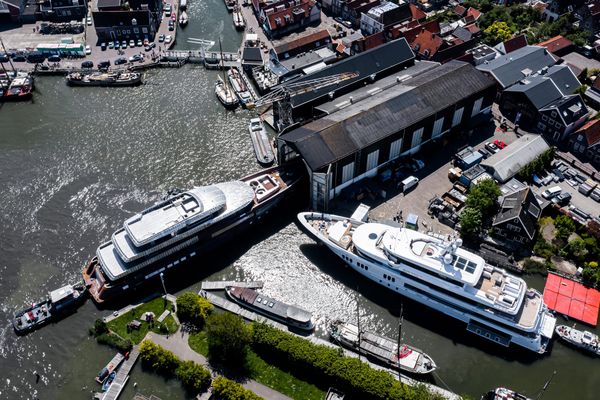
The first three Vitruvius Yachts – Exuma (50m), Galileo G (55m) and Grace E (73m) – were all built in the Perini Navi-owned Picchiotti shipyard in Italy. Each ended up gracing the covers of international magazines and all won numerous awards for their striking designs and high level of technical efficiency.
In recent months, Briand has announced the signing of two more Vitruvius projects now under construction: an 80-metre to be built in Turkey with Turquoise Yachts, and a 60-metre with Feadship in the Netherlands. There is also a collaborative project for a 105-metre motoryacht design with Oceanco that was announced at the recent Monaco Yacht Show, as well as smaller projects with Ocea in France.
So how does Briand feel that his thinking behind yacht design, whether for sailing yachts or motoryachts, differs from the approach of other designers today?
“Most designers start with a standard hull shape and then look to fit the accommodations into this,” he explains. “Although this may be suitable for a production or series vessel, I feel that it’s not the best way to approach a custom design. To create the exterior first is like designing the exterior of a house before you know what you want to put in it.”
“For some owners, who are less experienced or aware of their needs, this can be beneficial as it provides some pre-existing structure. But all the clients who we have worked with so far have been very experienced yacht owners, who may have had more standard, ‘predeveloped’ yachts in the past but now know exactly what they want from a completely custom design. This is where our approach can better help them to find a solution.”
There have been a number of particularly exciting developments in his most recently delivered motoryacht, Grace E, for example. The large vessel, built for very experienced American owners, features the beach clubs and multiple dining and entertainment spaces that have become so de rigueur on superyachts over the last 15 years. Her most unusual feature however, in terms of life onboard, is the wellness deck, which dedicates an enormous amount of space to health and spa treatments. It signifies the important shift for many yacht owners in how they envision their yachts in terms of function, today.
Ironically, as the average size of superyacht is increasing, many owners now consider their yachts as a private retreat for close friends and family rather than a space for entertainment on a larger scale. They are reflections of how the owner wants to live and feel on the yacht, rather than an overt sign of wealth. And working closely with the owner to learn how they want to “be” when onboard is the starting point for Briand’s vision for his designs, before pencil is even put to paper.
“With Vitruvius Yachts designs, we start with a blank sheet of paper and talk with the client about how they want to live on board, how they want to move around the yacht, what their family members might need and how they interact. I incorporate all of this into a layout design and then put the exterior envelope around it. Once the interior layout has been rigorously discussed, we look to optimise the hull shape to maximise efficiency.
“We have seen a trend that the average age of superyacht owners is decreasing, and that they are using yachts in different ways than has been the norm in the past. Yachts are being built to take into account the evolution of their families. Many of our clients see yachts as a more private space, where they do not invite a lot of guests at once, and they are spending more extended time aboard. The owners want to treat their guests and crew really well. They understand that looking after the crew will reap them benefits by being able to retain the team and that offers continuity and better service.”
Now the he has conquered his motoryacht challenge, the indefatigable Briand is pushing the boundaries once more, in a new field of marine-related design. Whereas famed land-based architects such as Philippe Starck and Norman Foster have dipped their toes in yacht design, Briand has been asked to work on a ‘land yacht’ club in Hong Kong, to bring his distinctive Vitruvius Yachts’ style ashore. The question now is: does he see a distinction between the design of the land-based project and how he approaches a yacht design?
“I’m very excited about this first land-based project; we will be involved in every aspect, right down to the staff uniforms. And no, I don’t see a division between the design of a yacht and the design of a building in terms of the philosophy behind it. The approach to any design should be the same: without a line out of place, and all elements in harmony. This is the thinking that we follow on all our projects, and our Vitruvian Man always reminds us of our ethos.”