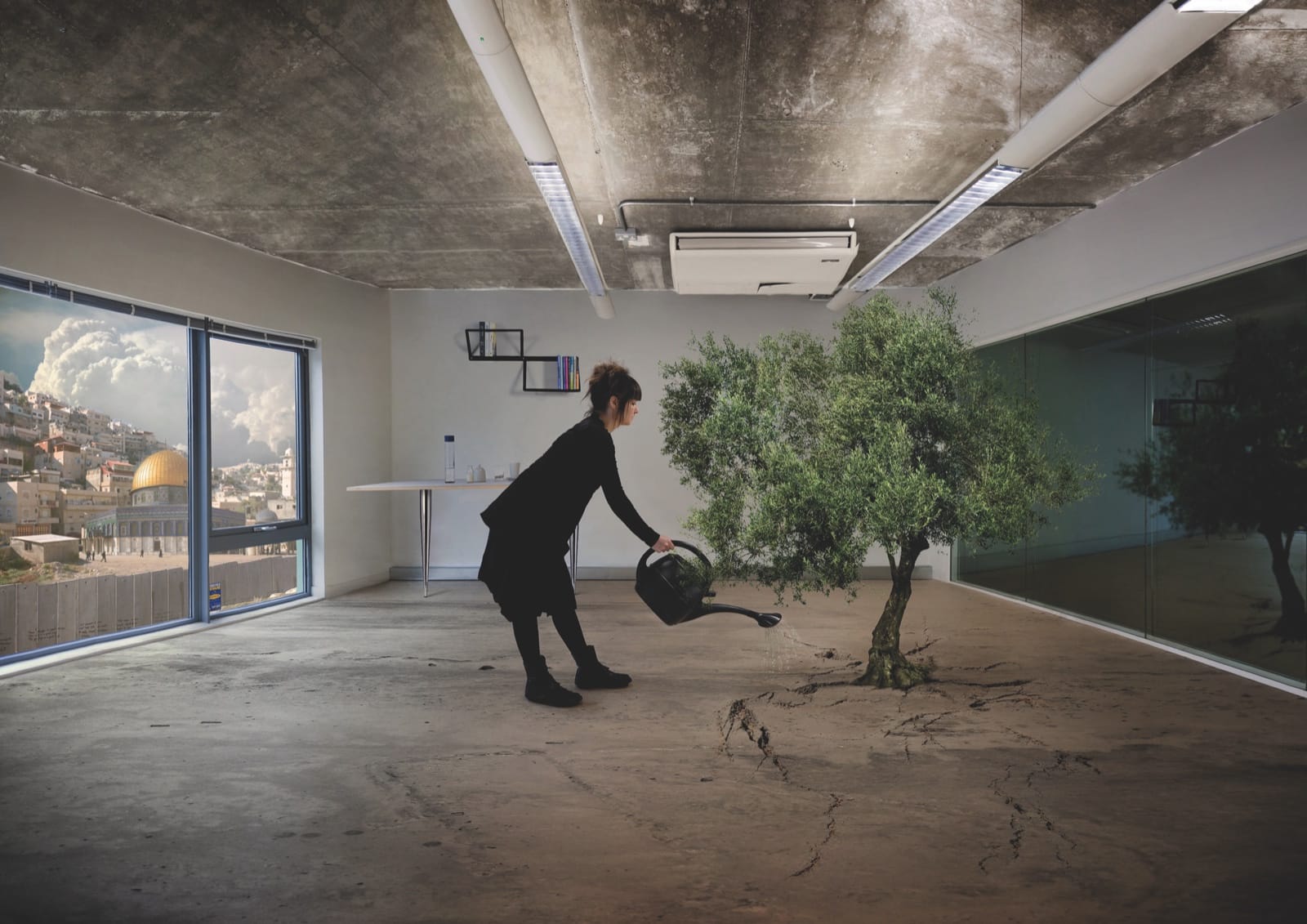
You might think that having your work disqualified from entry into a prestigious photography competition run by the Musée d’Elysée in Lausanne would have deterred, or at least dampened Larissa Sansour’s spirits just a little. It hasn’t. Instead, the photo series she originally proposed – before her nomination for the prize was revoked - has become the inspiration for the final stage of her most recent work. Entitled ‘Nation Estate’, it is currently being developed into a full-length, glossy film and Sansour stars in the lead role. Less a proposal to create another kind of nation-state, it is disturbing and defiant, a dystopian, visually gorgeous vision of one possible future for Palestinian statehood.
“On the ground, there is so much chopping away and confiscation of territory, with the Israelis creating corridors for themselves and settlements that it is virtually impossible to think of Palestine without Israeli tunnels or passageways,” Sansour tells me, explaining how her idea came about. “The only solution is go to vertical.”
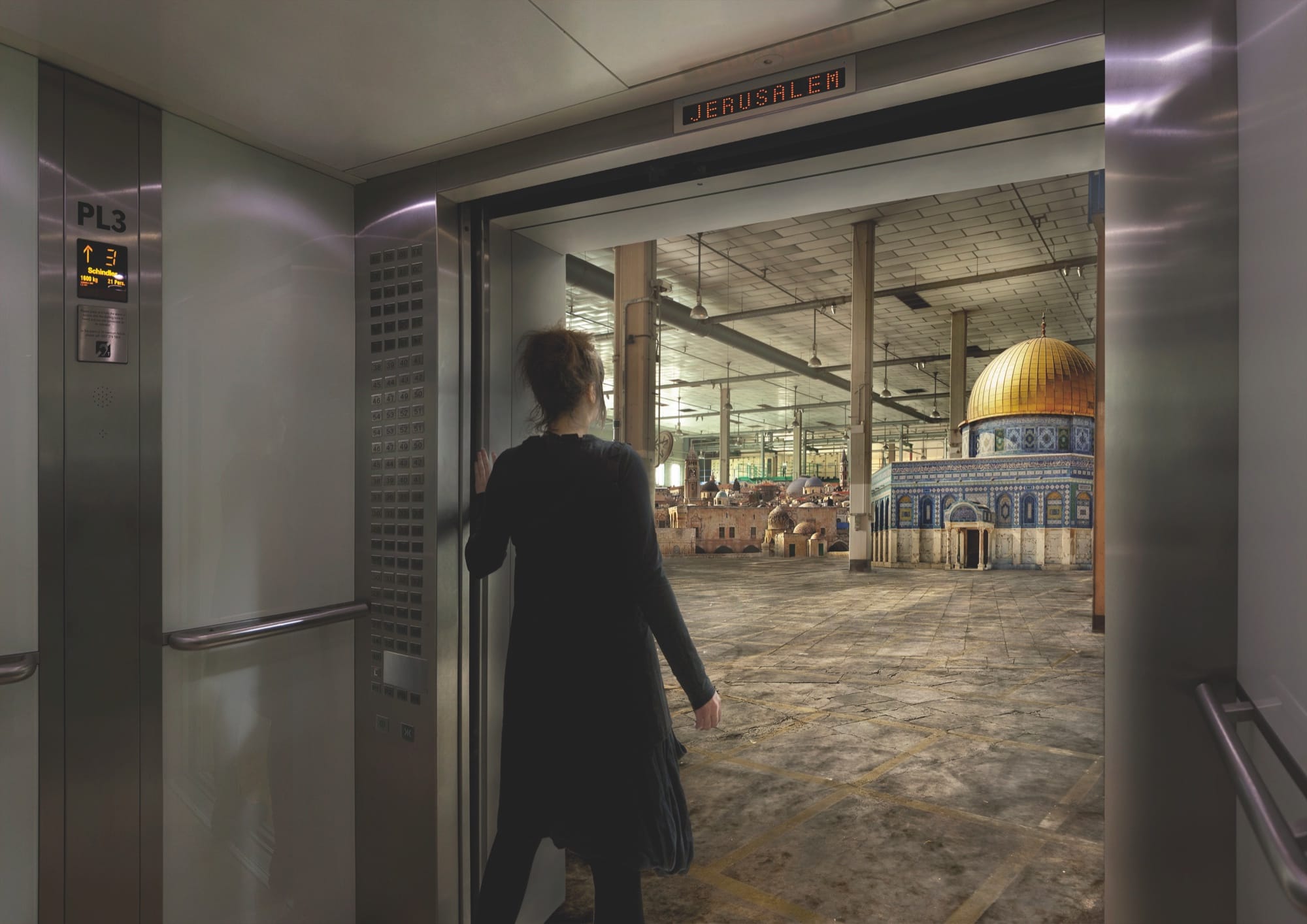
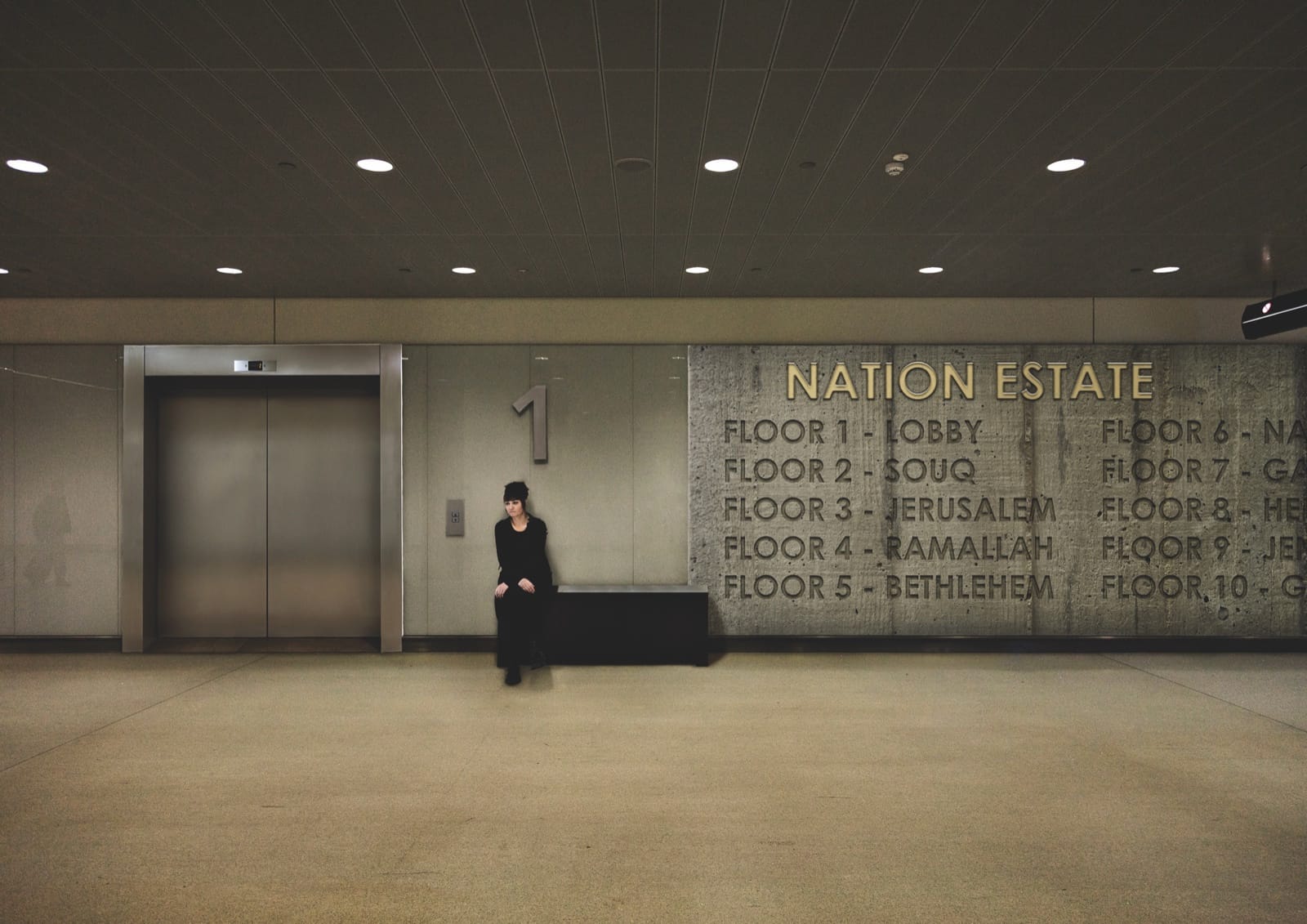
Here, the Palestinian state is envisaged as a skyscraper - the Nation Estate - surrounded by a concrete wall, the colossal high-rise houses the entire Palestinian population, who are “finally living the high life”. The irony is razor-sharp.
“Each city has its own floor,” says Sansour, explaining how she her series is based on projections of actual city maps and intercity trips previously made next to impossible by checkpoints are now made swiftly by lift. “Each floor re-enacts iconic squares and landmarks, the lift doors on the Jerusalem Floor open onto a full-scale Dome of the Rock.”
“Nation Estate went through different stages before I decided on the form. It started off as an idea for an installation, then leaned towards photography before also becoming a film project,” she explains. “I enjoy working in film and find the fictitious realm highly suitable to explore ideas without factual restrictions. Somehow, even concepts of the near and real tend to crystallise once you discard reality for a second.”
The “factual restrictions” (beyond those on the ground) pertaining to Nation Estate are revealing. Nominated for the 25,000 Euro (33,350 USD) photography prize sponsored by luxury French clothing brand, Lacoste, Sansour was one of eight artists shortlisted in November 2011. The only representative from the Middle East - the others were from Europe and Russia - Sansour chose to interpret the year’s theme, ‘La Joie de Vivre’, in satirical fashion.
Just one month later, she was asked by Lacoste to withdraw, censored by the very people who nominated her in the first place.“Business as usual,” as Sansour puts it, adding that “the Palestinian brand is not quite as toxic as it used to be.”
When news of her disqualification filtered out, creating a furore, organisers claimed that her work did not fit the rubric, this despite Sansour having submitted preliminary sketches of her proposal, for which she was awarded a bursary of 4,000 Euros to produce her final photo series.
“I was asked to approve a statement saying that I had voluntarily withdrawn from the competition ‘in order to pursue other opportunities’,” she continues. “This, for me, was perhaps even more incriminating than dismissing me.”
Sansour refused. Lacoste terminated their sponsorship and the prize has been suspended. The label’s cartoon crocodile emblem suddenly took on a less benevolent appearance and protests were held in front of Lacoste stores all over France. In the end, the ban got Sansour’s project more attention than the prize ever could.
It’s not like organisers didn’t know what they would be getting. Sansour’s heart has long been on her sleeve. In 2009, she produced a video entitled ‘A Space Exodus’ where she features herself as the first-ever Palestinian astronaut to land on the moon. As you watch her symbolically plant the flag of a country that still has to fight on a daily basis to ensure that it does not cease to exist, you may find the idea absurd, surreal even. But this is precisely Sansour’s point, by re-imagining Palestine in this fashion, she seeks to subvert the (dismal) stalemate and force us in the process to picture the (seemingly) impossible.
Despite the dreamlike, bizarre elements in her work, she has rarely strayed from the political realm but her recent shift to the science fiction is where she sees her work heading in the future. “I think I am most comfortable when I function in a parallel space, that is not separate from the political reality, but somehow comments on it from a different portal, so to speak. The crisis in the Middle East is repetitive and I feel all solutions on the ground have reached an impasse. It’s necessary to change the way we approach commentary on the subject. I think that erecting a meta-space that functions according to its own abstractions and logic could be more effective in finding solutions, than the standard tools of analysis used when it comes to the Middle East.”
Grim but not gritty, Nation Estate’s approach is almost clinical. Minimalist and clean, it looks, she says “much like a Japanese horror film.” Though Sansour proposed Nation Estate in the wake of Palestine’s bid for UN membership, the idea has been fermenting for years. “I’ve been working on this for 5 years and it’s my most ambitious undertaking so far. I’m working with an Iraqi musician who is converting raw Arabic sound to digital, a group of 3D experts, as well as a Danish theatre costume designer and production company for the futuristic interiors.”
Visually quirky work is becoming the artist’s trademark, her way of re-conceptualising her highly militarised environment. She says she started by drawing inspiration from director Stanley Kubrick – of 2001: A Space Odyssey fame. “There is a universal uneasiness that transpires in Kubrick’s work. It is horrific and supernatural, but in my case, what horrifies me more is the real, which is why I express my fears in a similar format – that of science fiction - fears that are universal.”
She continues. “By resorting to science fiction, Nation Estate continues a path I laid out a couple of years ago. In several pieces over the past years, I have been exploring not only the sci-fi genre, but also the comic book superhero. Both forms have an ability to communicate the fundamental ambitions of a people or civilisation in a way that is naturally inspired by, but never restricted by a non-fictional reality.”
Perhaps it is easier to understand Sansour’s creative obsessions once you learn that she was raised in Bethlehem by a Palestinian father and a Russian mother, before leaving during the first intifada to study art in London and then New York and Copenhagen. “Initially, I was interested in Russian constructivism,” she says, adding that after September 11 and 8 years in the U.S. and the siege upon Bethlehem, it became clear her interest lay in the Middle East. “There’s simply no shying away from it. I mean, I lived in Moscow from 2003 – 4, but I am more fascinated with the idea of Russia than its reality of oligarchs. Russia to me is more like a fairytale.”
The tales she tells in her own works often playfully defy the viewer’s expectations. Take her 2003 video ‘Tank’, where the Israeli tank on the offensive retreats for no reason or her ‘Bethlehem Bandolero’ (2005), where she plays a Mexican gunslinger in a duel with the apartheid wall, or even the absurd ‘Happy Days’ (2006) where vignettes of everyday life in Palestine are set against the music of the 1970s sitcom Happy Days.
“Here I am positing a different formula to what is happening in Palestine. I have a hard time in commenting on what’s happening, but I cannot not comment,” she explains. “I cannot be serious about it either. The irony or humour of my pieces is never really calculated, but they somehow always end up that way. Humour, especially when dealing with matters of extreme gravity, has a way of toppling ideas and opening new modes of interpretation. In the case of Palestine, circumventing the expected seriousness tends to open people’s minds and encourage a less inhibited approach to the subject. The more realistic I am, the more people don’t believe me. People are immune to what’s real. When reality is more like fiction, it is easier to address it as such.”
Sansour admits that the urge to fictionalise has always played a part in her work, even in her earlier documentary-style pieces. With science fiction, though, comes a curious contradiction that is related to how the genre frames nostalgia. “Even the slickest sci-fi almost invariably carries within it a sense of retro, ideas of the future tend to appear standard and cliché at the same time as they come across as visionary. In the case of Palestine, there is an eternal sense of forecasting statehood, independence and the end of occupation. The ambitions we hoped to achieve have long since become so repetitive they’re an odd mix of nostalgia and accomplishment.”
Presenting a world where going forward somehow also means going back,. Larissa Sansour, champion of pen, not sword, asks us to suspend our ideas not just of past and future, but also of the possible and the imaginable, of victory and defeat, but never lets us forget what is really, truly at stake.