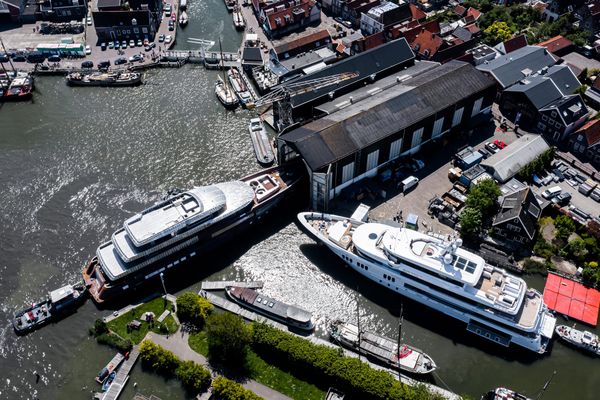
The superyacht Ulysees suffered a rather faltering start to life on the high seas. Having been damaged by fire shortly before completion, she was relocated to Brisbane for two years of redesign, reconstruction and upgrade work involving 200 people from 30 specialist companies who worked to replace not just the entire superstructure but also 1,500 square metres of interior space. An epic task, and at a cost of around 31 million USD, not exactly cheap but the boat that finally emerged in 2006 was worth of every cent. The new Ulysees was a resounding success, winning the Australian Refit of the Year Award and immediately taking her place as one of the most capable expedition yachts in the world.
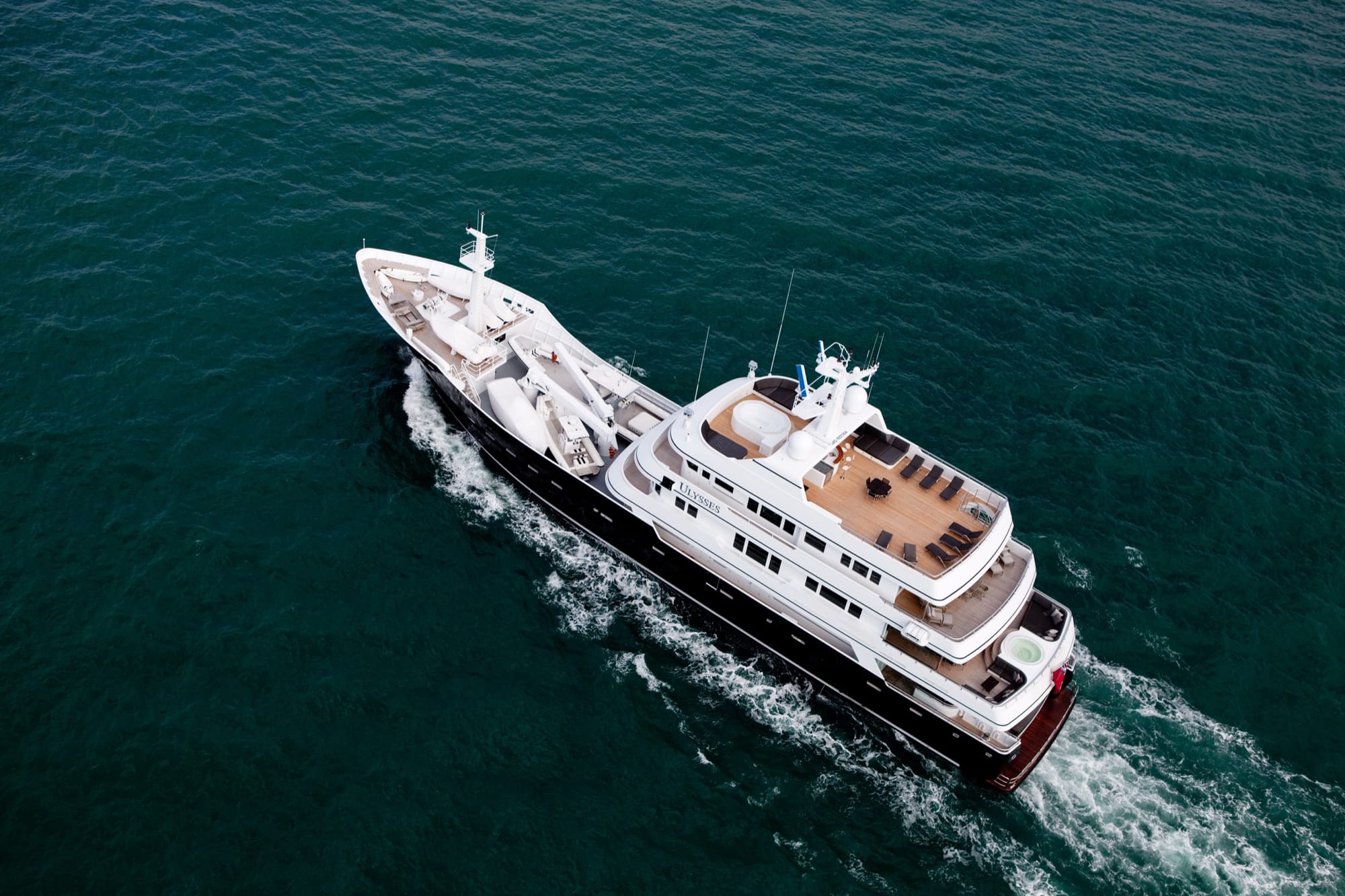
Named (rather fittingly) after the hero of Homer’s Odyssey, this muscular craft exhibits an external form halfway between that of a military survey vessel and a commercial icebreaker. Constructed for billionaire businessman, Graeme Hart, her imposing 60-metre, five-storey bulk appears distinctly prosaic by superyacht standards. But the purpose behind this is very clear. While some high-end yachts are built for island-hopping in the glamorous playground of the Caribbean, this craft is designed to shrug off oceanic swells and ice-strewn Arctic waters with the phlegmatic ease of a commercial workhorse - and the yacht’s Australian redesign played a vital part in bringing about this versatile range of talents.
Murray Owen, MD of Marine Engineering Consultants, was closely involved with the refit and as he intimates, the combination of a steel hull and an aluminium superstructure is central to her success. “By replacing the steel superstructure with lighter aluminium,” he told me when we spoke, “the GM (centre of gravity) was made lower, giving much greater stability.”
This is of importance because the lofty vertical elevation of the craft’s five-tier design might easily have put too much weight up high, potentially damaging the boat’s ability to recover from a heeling moment in rough seas. On a serious expedition vessel, designed to traverse oceans, it is plain that offshore composure needs to be first-rate and that’s precisely what the lightweight topsides help to achieve.
On a more basic level, the builders eschewed the fragile catwalk glamour of a fibreglass hull and opted instead for the heavyweight credentials of steel. This offers outstanding resistance to impact and abrasion, plus great structural strength as well as making repairs easy and affordable. It’s a very effective choice for expedition-class vessels. So too is aluminium. As a very tough, tensile alloy, it doesn’t rust, corrode, split or rot and it will not ignite or burn. Aluminium withstands extreme freezing as well as temperatures of up to 200 degrees Centigrade and in addition to immense strength it’s also very simple to maintain. In short, Ulysees is without question one of the toughest and most durable superyachts in the world.
However, it would be wrong to describe her as an icebreaker. Vessels specifically designed for such work tend to employ a reinforced bow, a vast reserve of low-end torque and a hull designed to minimise friction as broken ice rolls down the sides. Its frontal shape might also be rather bulbous and flat, allowing downward weight (rather than forward slicing) to break through an ice sheet. But features of this kind can generate some very unpleasant sea-keeping traits, with a slamming bow and exaggerated pitch and roll, which would prove ruinously painful for a long-distance skipper. So again, Ulysees adopts a hybrid approach.
The boat’s bow steers clear of the broad, open suntraps so beloved of the superyacht market and opts instead for a boldly elevated structure with the massively raised freeboards of a serious offshore passage-maker. With a bulbous subsurface profile allied to a relatively angled stem and flare-free hull sides, her cruising range is equally impressive. Twin Caterpillar diesels and a 176,000-litre fuel tank mean she can cruise at 12 knots for 6,000 nautical miles nonstop - enough to cross the entire north Atlantic between Britain and America with 2,400 miles still comfortably in hand.
However, we shouldn’t let her dynamic potency blind us to the opulence of her fit-out. Up on deck, in addition to two spa pools, two 20-tonne cranes are on hand to deploy the pair of Yamaha FX1100 personal watercraft, a 4.5-metre Gemini and a 350hp jet-driven Naiad RIB, stored on board. In itself, that’s already an impressive fleet of tenders but if you wanted to upgrade the toy collection, you could add a helicopter on the retractable helipad, a 13-metre RIB or even a small submarine, the Ulysees’ vast expanse of foredeck is more than capacious.
As Owen goes on to explain, it’s another nod toward her expedition prowess. “Where other superyachts need a shadow vessel to carry all the toys and equipment for an expedition, Ulysses can manage by herself while still having the luxury you would expect from a superyacht.”
Take a look at the internal arrangement and his words certainly ring true. An 11-metre beam enables Ulysees to accommodate 19 guests and 14 crew with ease and yet the owner’s stateroom remains pleasantly remote. Separated from the 13 lower deck cabins by two levels, it comes with its own office, bathroom and private dining area. Up top, the sundeck is one of the largest ever seen on a yacht of this size, with an arc of sun beds around a central Jacuzzi, plus a barbecue, a shaded bar and a crow’s nest. Meanwhile, down on the middle deck, the full-beam sky lounge boasts not just a pool table and pinball machine but also an Inside/Outside bar, that serves both the internal salon and the external dining deck - yet another first-rate option on a craft already bristling with versatile party spaces.
In short, Ulysees is a very gratifying contravention of the established superyacht formula. She may not be a true icebreaker, but there is a profound gravity to her build, style and purpose that makes a great many superyachts seem rather silly and trifling. A stoic workhorse in a world of frivolous show ponies, while her hull shape suggests pungent commercial resonance, her internal fit-out allows Ulysees to claim parity with the finest custom craft out there.
Specifications
Length 60m
Beam overall 11m
Displacement 966 tonnes
Draft 2.8 metres
Guest capacity 19
Crew capacity 14
Builder Trinity Yachts
Top speed 15 knots
Range 6,000 Nm
Price 49 million USD