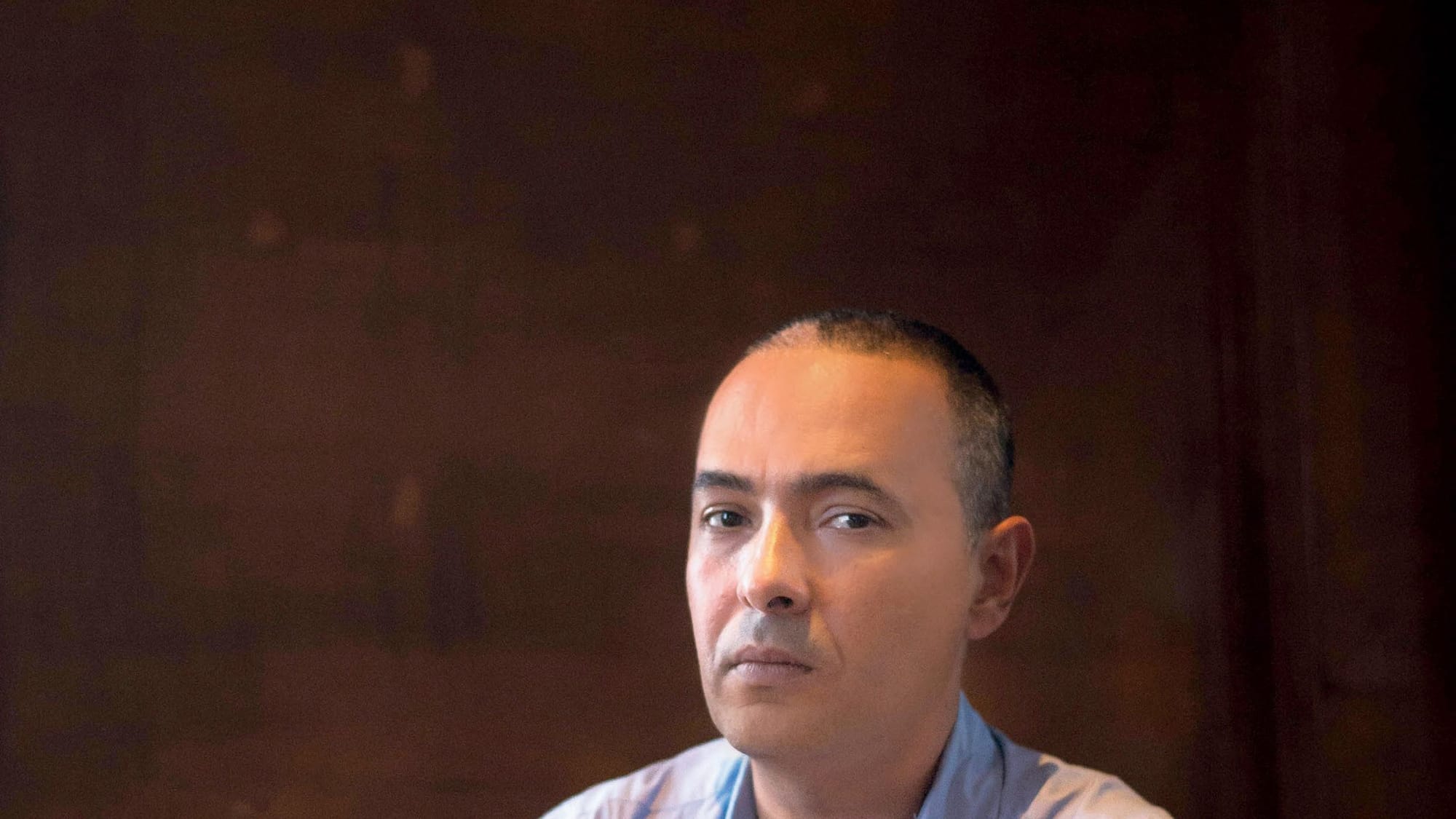
At the end of Camus’ ‘The Outsider’, the anti-hero, Meursault, is condemned by an Algerian court for the crime of killing an Arab in Algiers. Nothing is known of this man – he is never even named – and his only role in the book is to be killed by a French colonist. It is a harsh, fierce book, an evocation of the emptiness of a world without God, of modernity.
It is Kamel Daoud’s response to the brutal anonymity of the victim that, with one short novel written in a month, has turned him, deservedly, into a global star, winning three of the big French literary awards, including the prestigious Goncourt first novel prize. ‘The Meursault Investigation’ is narrated by the brother (Harun) of the murdered Algerian, who is now given a name (Musa), and the story is told to a stranger in a bar. It is a mirror image of ‘The Outsider’. The first sentence of the Camus is: “Mother died today.” Daoud’s first sentence is: “Mama’s still alive today.”
“Like everyone else, I read the story of the murder and I didn’t even think about the murdered Arab. I ignored him. Meursault’s genius is to make you forget the crime. Even if you were a victim of it!” Daoud said enthusiastically.
In a tongue-in-cheek critique, the author audaciously has Harun commit a murder that’s a reflection of Meursault’s, when he kills a Frenchman after Algeria’s war of independence, enabled by his own mother who was seeking revenge for her other son’s murder.
“It was a matter of analysing Camus’ work, of ‘rereading’ it, of having it reread by an Algerian and by contemporary readers. Camus still provokes polemics in Algeria. I wanted to pay tribute to his work and his thinking but also to provide another version of the story. ‘The Stranger’ is Camus’ character, but also a symbol of the philosophical and human condition. It was valid in 1942, the year the novel was published, and it’s still valid today. I wanted to take another look at that strangeness and find my own path through Camus,” Daoud said, about his deconstruction of what is considered a significant part of the French literary canon.
Born in Algeria, Camus was an existentialist, a member of the French-led movement that produced a global generation of pale, black-clad young people in search of authenticity and freedom. It was, in other words, a fashion as much as a thought process, and, like all fashions, it didn’t last. But Camus, unlike the existentialist thinker Jean-Paul Sartre, did. “He was one of the rare authors who survived existentialism and fashion. Camus was much closer to men than ideas – Sartre was closer to ideas than men.”
“I contradict him, but I also vindicate his position. You have to know that the status of Camus in Algeria today is extremely complex. He's at once both French and Algerian. He's both claimed by some people and rejected by others. And he's also someone who evokes an extremely painful moment in Algerian history.”
Daoud is 45, so he was born just eight years after the long and bloody Algerian war that freed the country from French control, and he lived through the terrible civil war that raged between the government and Islamists in the 1990s, which came close to turning Algeria into yet another failed Arab state. Now that an awkward peace prevails, the political context gives him the chance to pull off a brilliant mirroring. In the Camus version, Meursault seems to be on trial as much for not weeping at his mother’s funeral as for killing the Arab; in Daoud’s, Harun is questioned after he kills the French colonist, but the questioning focuses on why he did it after the war ended and why he had not fought in that war. Neither seems actually to be guilty of murder, although both are.
“The murder itself is absurd, because they reproach him for killing a Frenchman two hours after independence,” Daoud says. “But all murders are murders – you may refer to a war, but it’s still murder. He didn’t kill for killing, he killed because he wanted to distance himself from his mother – so who is culpable, who actually killed? The fundamental question is, does vengeance give rise to justice? And the answer is, no. That’s what I wanted to say.”
‘The Meursault Investigation’ redeems Camus’s victim by naming him, giving him an identity. But its more profound achievement is to raise the question: what is this identity? The answer lies with God and philosophy. Daoud says he went through an intensely religious phase between the ages of 13 and 20, and, coming out of it, he encountered Camus. “It was the philosophical aspect I was interested in, in his books ‘The Rebel’ and ‘The Myth of Sisyphus’. I was attracted to religion because I needed philosophy that gave me opportunities, and it was another philosophy I found in Camus.”
At 20, Daoud needed a philosophy – he still does, but so, he notes, does every other Arab. “The drama of the Arab world is philosophical collapse. The Arab Spring was not a failure in itself. I think it’s an intermediate failure but long-term, there is something underway, and I believe it will develop over time.” The lack of a philosophy – of a project, if you prefer – creates the depressing and frequently lethal mix of boredom and Islamism. The Arab Spring offered an alternative.
“Before it, I was really bored. I am no longer bored. But they were half-revolutions, because we made the mistake of just toppling the dictator without religious reforms. We needed to touch the sky and the earth at the same time. Instead, we have replaced the dictator with a different kind of dictatorship. The question is, what is dictatorship in the Arab world? And why is it possible to have a dictatorship in the Arab world? It is the answer to the second that is important.”
Daoud’s repeated use, in conversation, of the image of the sky is an almost subliminal connection with Camus. For Daoud, it seems to mean religion or simply something higher than immediate concerns. In ‘The Outsider’, the fierceness of the Algerian sun appears to drive Meursault to murder. Both imaginations seem rooted in the climate of Algeria.
His own answer to his second question is fear. “The answer is, first of all, a closed religion, so they go to dictatorship out of fear. They are scared of the future because they are scared of the present. The security of dictatorship is safer. A dictator is not going to think about the sky. He comes through us and that’s why he is strong, because we have accepted him and because, in submission, there is comfort and safety.”
The Algerian government cynically uses the violence in neighbouring Libya to promote fear – look, they say, democracy equals chaos. The people are thereby subdued. Algerians, he says, are now quick to rebel as individuals but not as a group. “To unite, you have to have the confidence of trust in each other, and you need leadership. There are no leaders now.”
Then there is the boredom. He speaks of the sheer tedium of life in Algerian villages. It is not a poor country. “People in Algeria are not hungry, they are not poor. But even when they are 20, they have nothing to do but wait until they get old. They call that age ‘waithood’. They are waiting for death and paradise.” People leave not for economic reasons but because they are bored. Even when they don’t physically leave, they leave in their imagination and Daoud found that the best way in which to do that was through his writing.
“I always wanted to be a writer. I am a journalist by accident – and because it’s the profession that brings me closest to writing as well as to a vivid experience of reality. I wrote a novel because, for once, I was able to put a little distance between myself and journalism. It’s a profession that consumes my writing energy, especially with all that is happening in the region where I live. The novel is also a longer, more attentive, more serene, and better-thought-out interrogation of the world.”
As a novelist, Daoud is lucky to find himself in this situation. Few western novelists have such clear and urgent subject matter and probably none has the chance to respond so directly to great work from another culture. “If I hadn’t followed up ‘The Outsider’, somebody else would,” he says modestly.
‘The Meursault Investigation’ fulfils some old requirements of the form – it introduces the world to a point of view and a culture of which few outside our own region know much, and it tackles the most fundamental aspects of politics and human destiny. I suspect this is why Daoud could produce it so quickly – it really was just one month. It simply appeared as a finished object in his mind before he started writing. He says it is his experience as a newspaperman, producing two columns a day, which made it possible to write so fast.
The success has changed his life. He has had to devote last year to promoting the book around the world, and that includes dealing with the script for the film that is already being prepared. He intends to devote next year to writing another novel, which is already in his head. At the same time, he wants to keep up his journalism in Algiers.
The novel was published in 2013 and less than twelve months later, a member of the Islamic Awakening Front in Algeria issued a fatwa against him, calling for his execution on the grounds that he had “placed the Qur’an in doubt, along with the sanctity of Islam.” I ask Daoud how he feels about this. He looks amused and shrugs. I suspect he takes some literary satisfaction from the fatwa and the spectre of his own public execution.
“Well, that fatwa is applicable to the whole of humanity now. We’re all condemned by them. They are fascists – they want a binary system of us and them, so there’s no difference between you and me.”
But I live in London and feel much safer than I would in Algiers, I reply. “Yes, but there have been attacks in London as well. I don’t want to leave Algeria. I haven’t got the courage to leave at the moment.”
He is in that city now, and we are talking on Skype. He should have been in London, but he was kept out because of visa issues. Suddenly, off screen, I hear children’s voices, and I find myself meeting his son, Ikbel, 12, and daughter, Aïda, six. The latter is scrambling all over him and demanding screen time. I feel for him. Here is the man at the cultural and political epicentre of the great conflict of our time, and here are these fragile souls depending on him. I ask him if he wants to bring them up in Algeria.
“Yes, but I want them to see the world. That’s the only way of learning tolerance, so I want them to travel a great deal. I can’t bear this business of visas, because it stops you from seeing the world. People have got to understand that we are all human beings – I think that’s the only way of doing it.”
WHO Kamel Daoud
WHAT Author of ‘The Meursault Investigation’
PUBLISHED In 2015 in French
WHY Despite the weight of the subject matter and the fact that Daoud has been declared an apostate, his novel is brilliant, full of sharp insight and humour. The fact it can be seen both as a Camus’ comeback and a highly creative work in its own right demonstrates Daoud’s talent.
Quotes:
The threat is serious, but it is serious for everyone: you, me, the tourist, the cartoonist, the dancer, the woman, the Nigerian schoolgirl. The threat was addressed at me, but more importantly at all of us. I take many precautions; I am vigilant, but I am alive and I like to live and to defend my freedom. I don’t want to spend my life thinking about fear, because that would kill the desire to write and to live. It would be impoverishing. I am careful, but I live as before: my eyes open and watchful.
I love to write. To find the right phrases, to dig beyond appearances. Lyricism is a hymn to language and to life. Metaphor is a gift from the gods. I am going to write, I write, and I have always written: it is my vocation and my passion. I will defend it. It is also the proof and the practice of my form of luck: my freedom. I have a right to freedom because I am alive and because I am going to die. This is why I write.