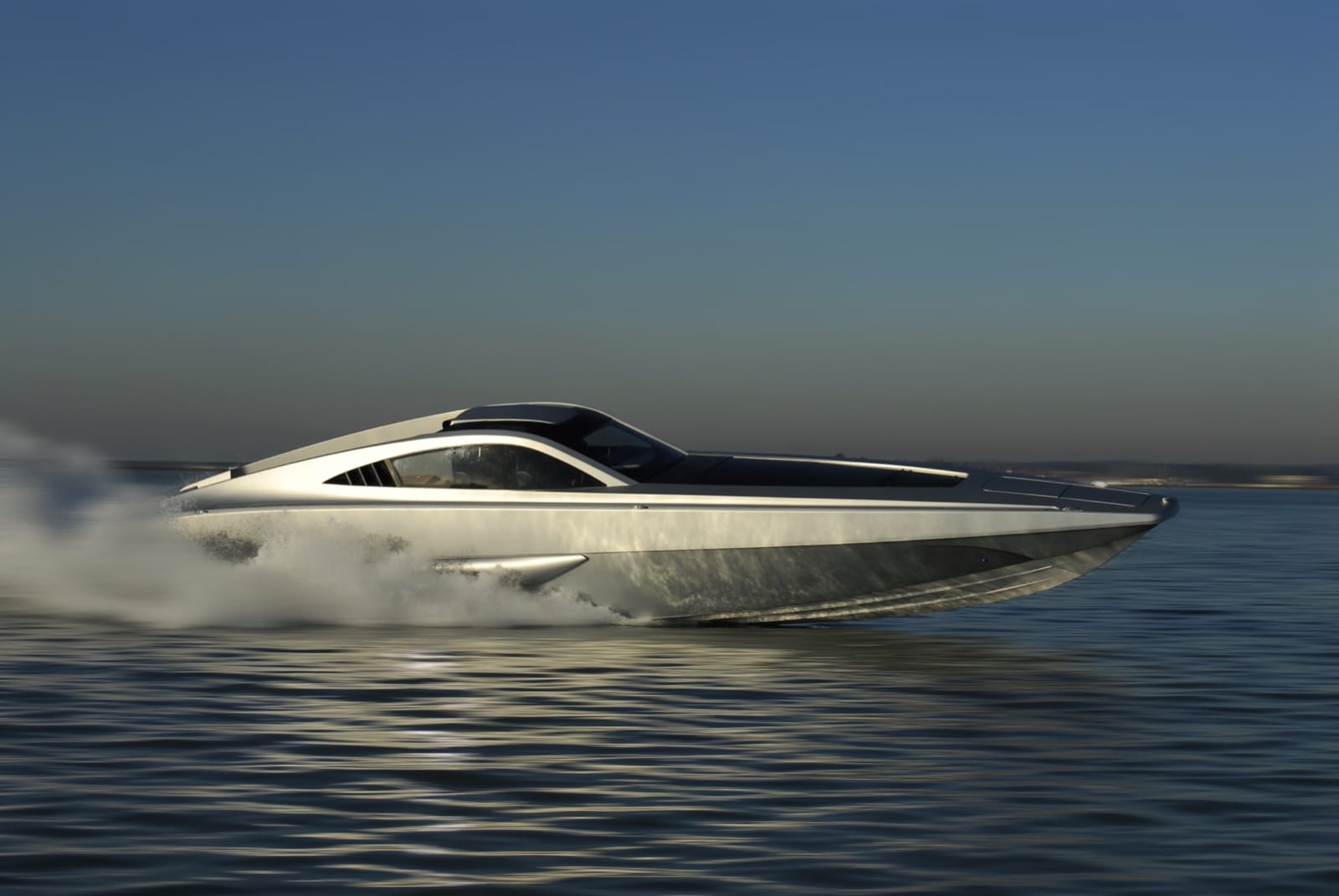
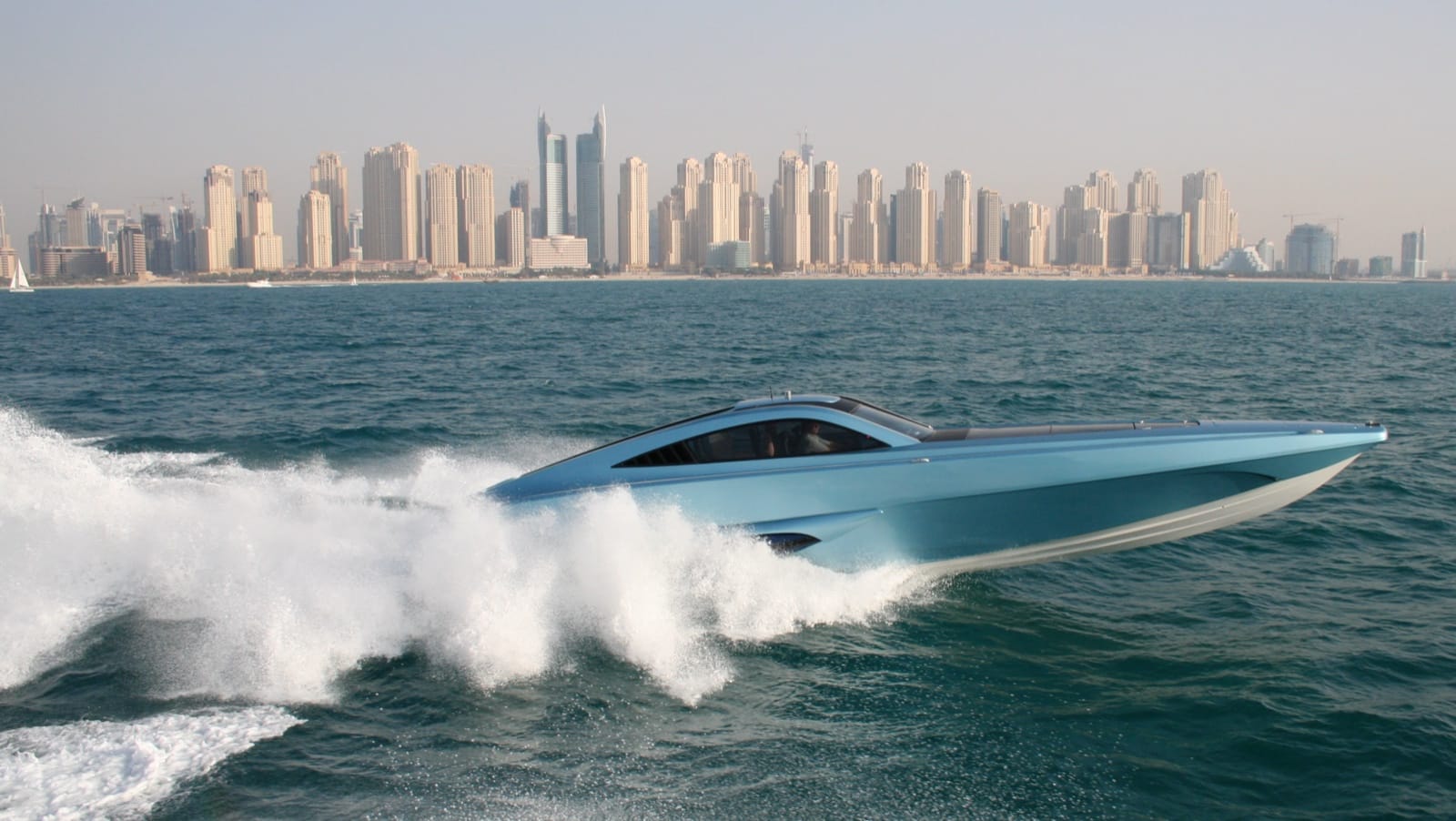
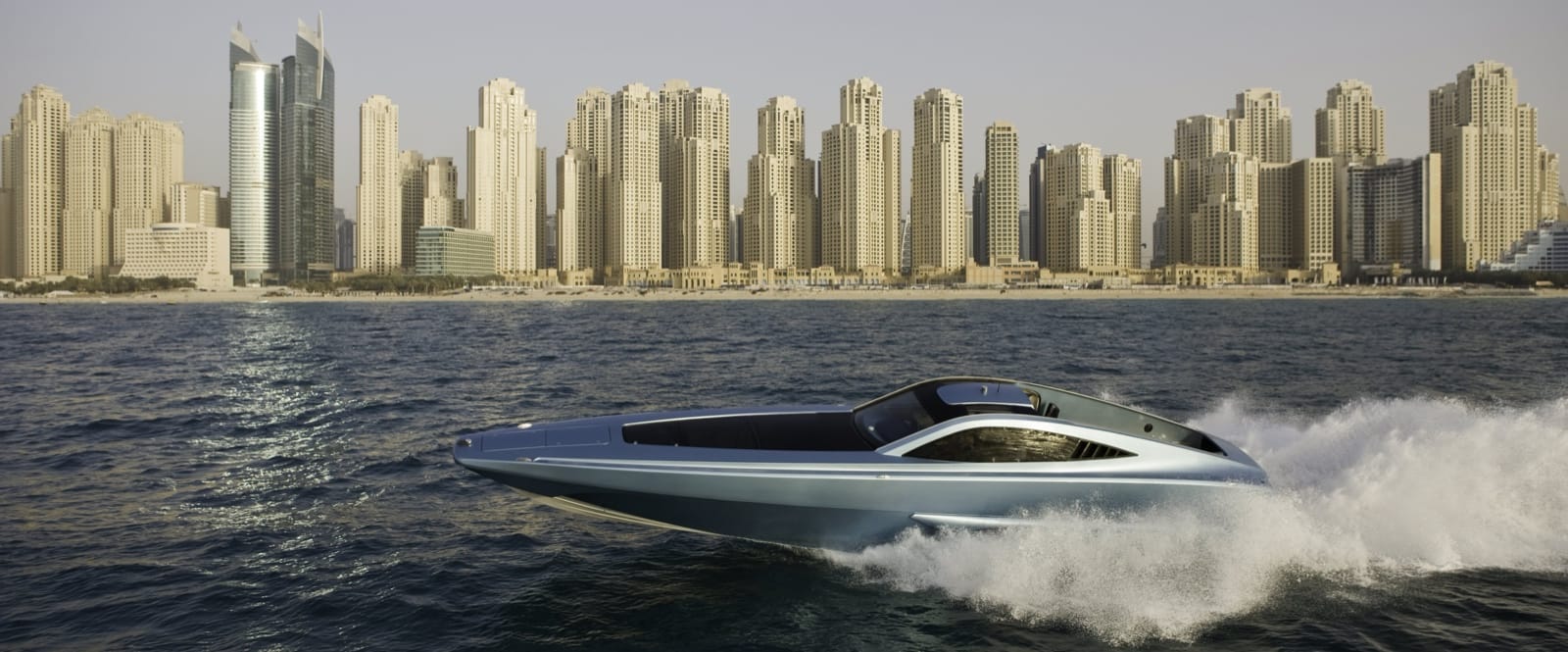
Amongst the imposingly large and flamboyant superyachts at the Monaco yacht show this year was a section titled ‘Tenders’. This division - exclusively reserved for exhibiting vessels that provide support and entertainment to the floating gin palaces - had the usual array of rigid-hulled inflatable boats as well as some rather good looking little Wallys. Yet standing at odds with literally everything else on display was a metallic blue dart of a boat that goes by the knotty name of XSR48.
The English manufacturer behind this boat is equally as unconventional. Ian Sanderson the chief executive is actually on hand to show off every detail and literally leads by example in getting his hands dirty with customer relations and sales. This is a man who certainly knows a thing or two about speed. He is a record-holding powerboat racing enthusiast who has won at all levels in international offshore endurance powerboat racing and is the current holder of 10 UIM World Endurance Speed Records.
Sanderson conceptualised the project and then brought in the help of some leading authorities such as composite specialist High Modulus, performance motorboat expert Fabio Buzzi and celebrated superyacht designers Redman Whitely Dixon.
“There was a huge gap in the market for an F1-type powerboat that could be positioned as a supercar of the sea, a superboat if you will. It would be the water equivalent of a Bugatti Veyron, the Ferrari Enzo or any other super sportscar. Essentially, I longed for a powerboat with the passion, technology, powerful performance and the driving experience of an F1 car, so I decided to go ahead and make one. The boat took 30 months and 65,000 hours of development work, but we did it.”
So what is it that makes this yacht so special? Primarily two things: weight and power. The first is achieved through extensive use of carbon fibre thanks to the aforementioned world leaders of marine composite engineering – High Modulus. The carbon-fibre and Kevlar monocoque construction provides immense strength to the structure while also keeping weight down to a minimum. On the other hand, the power comes courtesy of two 11.3-litre, Isotta Fraschini six-cylinder bi-turbo diesel engines giving 1600 hp, that provide tremendous acceleration and enough juice to propel the craft through the water at speeds of over 70 knots.
Of course power and weight alone cannot offer the supposedly unprecedented driving experience that this boat delivers. I overheard a new customer claim that this vessel handles rough waters with ease and it even corners like it is on rails. If true that much can be attributed to Fabio Buzzi’s carbon composite hull. Fabio Buzzi’s FB Design is the only shipyard in the world whose craft have set world endurance and speed records in every existing class, with all types of hulls. And it is thanks to this track record that Sanderson hopes to take one away from the Italian when he tries to break the London to Monaco endurance record in an XSR48.
"Now," says Sanderson, grinning, "Wouldn’t you like to feel firsthand how fast this thing can go." Without even a moment’s thought I grab at the opportunity, board the blue bullet and strap myself into one of the five stunning onboard seats. It really is a case of attention to detail here. Each chair is made from carbon fibre exactly in the same manner as a Formula One racer’s sculpted seat and each one features a seven-point harness too. Sanderson notices my inquisitive eye and interjects, “We can place up to six seats on board but this configuration gives a little more room.”
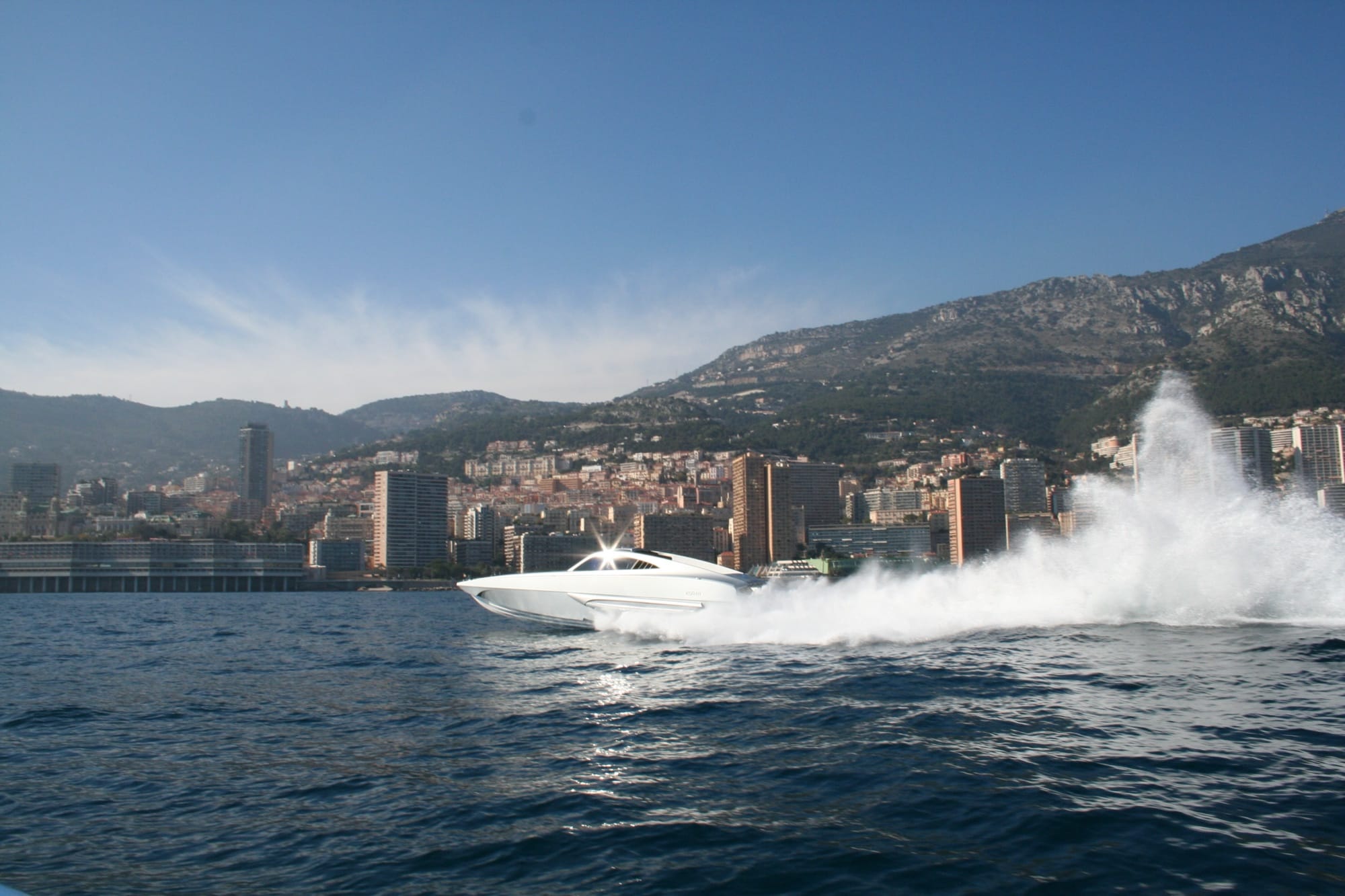
We glide out past the port captain’s offices and pull away into the open sea, speed restrictions are non-existent now so I ready myself. A quick blip of the throttle later and the boat has accelerated to 140 km/h. “We could make it from Port Vauban in Antibes to St Tropez in just 27mins,” Sanderson informs me over the communication system. That is quite a difference to the 3 hours you should allocate to the traffic logged roads. But my mind is trying to take in all the aspects of the handling performance. The ride is smooth, the controls precise and intuitive. Amazingly the boat corners without buffeting. In my excitement I had not even thought to ask whether the boat was propelled by waterjets but it is quite clear from the wake’s very particular and large rooster tail that these are a couple of surface drives.
Just 100 examples of this vessel will be built and unsurprisingly XSMG insists that buyers undergo at least two weeks of training by the manufacturer so as to get to grips with the demon like performance of the craft. Given the small production run and the flexibility of the composite monocoque structure, the XSR48 can actually be exclusively tailored to suit the taste of each individual owner. First of all there is a choice of a closed-cockpit version or one that is open at the back.. Then you are faced with the choice of exterior colours and next there is a wide array of engines: there are four diesel options and two petrol options although only the oil burner will be available in Europe as the petrol one will not pass stringent EU emission regulations.
So what of the interior and finishing of this yacht? Well it is very avant-garde to say the least. Redman Whitely Dixon have outdone themselves here: in no way has style been sacrificed for speed. The main deck is focused towards the pilot and copilot’s handcrafted aluminium console and unique instrumentation. An additional two to four seats can be added behind the drivers. As mentioned before, these seats are true works of art but they also help to make the boat feel more comfortable through their amazing shock mitigation technology - hydraulic cylinders that absorb bumpy rides.
The interior makes the most of the monocoque construction which actually increases internal cabin space over a conventionally constructed powerboat by as much as 40 per cent. That is because the external skin bears the load meaning there is no need for an internal frame or truss. Naturally there is never going to be that much room in a boat that has a total height of just 3 metres and a beam of just over 2.5m. Yet the result is amazingly spacious and free, thanks in no small part to the enormous amount of light filling the cabin via the glass roof overhead. This little touch is quite an innovation for it is in fact the largest glass roof to be found on a powerboat of this size.
Belowdeck there is a double berth, stylish leather sofas, an entertainment system incorporating the iPod classic and a lavatory featuring a stand up shower and a regular marine head. The airy, futuristic cabin is a world away from the fusty wood, brass and plaids of standard speedboats.
So as we pull back into the Port of Monaco I ponder the maker’s optimistic claim that this is the closest thing to an ocean-going Bugatti Veyron and find myself unable to utterly refute it. Both have optimised the use of Formula One style carbon fibre technology in order to achieve monstrous power to weight ratios. Both have the same attitude towards price in that if you need to ask you definitely cannot afford it – the Bugatti Veyron Grand Sport goes for the same price as the XSR48, a cool 2.5 million USD. Both have pushed their respective vehicular categories to new heights. Both require your own personal oil fields once you really open up the taps - the XSR48 can go 300 nautical miles if you keep to the cruising speed of 50 knots. But ultimately the XSR48 provides the ultimate weekend lifestyle and entertainment platform, if for the simple reason that out here there are no speed cameras and no traffic.
It remains to be seen whether Sanderson does actually complete the trip from London to Monaco in a record time (with plenty of fuel stops along the way). But one thing is for sure, these guys have created the most ground breaking vehicle in a long while.
KARIM MUNIB
XSMG Marine Ltd,
Lymington, Hampshire, England
Tel +44 1590 646 000
www.xsmgworld.com
Technical Specifications
Engines
Diesel
Option 1 – 1640hp – 2 x 10.3-litre Seatek 820 Plus turbo
Option 2 – 1700hp – 2 x 13-litre CAT C13 turbo
Option 3 – 1900hp – 2 x 10.3-litre Seatek 950 Plus bi-turbo
Option 4 - 1600hp – 2 x 11.3-litre Isotta Fraschini bi-turbo
Max speeds – between 70 and 85 knots
Cruising speed 50+ knots
Range 300 nautical miles
Petrol (not available in Europe)
Option 1 – 1900hp – 2 x Mercury supercharged V8
Option 2 – 2400hp – 2 x Sterling supercharged V8
Max speeds – between 75 and 90 knots
Cruising speed 50+ knots
Range 250 nautical miles
Dimensions
Length (overall) 14.60 m
Length (hull) 13.10 m
Beam (max) 3.13 m
Beam (w/o stab inflated) 2.60 m
Height (above waterline) 2.20 m
Height (overall, excl. props) 3.00 m
Draft to keel (excl. props) 0.75 m
Draft (incl. props) 1.10 m
Draft at speed (incl. props) 0.40 m
Displacement (standard eng.) 8,750 kg
Fuel capacity 1,000 litres
Fresh water capacity 150 litres
Drivetrain
Propulsion ZF Trimax 2200 surface drives
Transmission ZF 312 2-speed gearboxes
Propellers Rolla 17/4/PH stainless steel
Trim Tabs ZF Trimax full race composite tabs
Rudders Trimax twin rudders