There was a time when to be notable, an artist had to die. Just ask Van Gogh. These days, you have living artists who have appropriated entire movements, enjoy Pop star levels of fame but who seem to have been overtaken by their own success, endlessly reproducing themselves.
If the 1960s gave us performance and conceptual art and the 1970s produced installation art and post-expressionism, then the 1980s and 90s gave us the Young British Artists. With their propensity for shock and sensationalism, the YBA generated reams of coverage with their early warehouse and factory exhibitions. Many were graduates of London’s Goldsmiths, Fine Art students like Damien Hirst and Tracey Emin, who quickly became famous and went on to win Turners. Young and brash, they made self-portraits sculpted out of their own frozen blood and installations consisting of an unmade bed, littered with cigarette butts, bloodstained underwear and other detritus of a ‘typical’ weekend in bed.
In 1988, Damien Hirst curated the YBA group exhibition, Freeze, in his second year of studies. Freeze put Hirst on the map. His first animal installation, entitled A Thousand Years, was bought by the prominent Anglo-Iraqi art collector and advertising tycoon, Charles Saatchi. A hideous piece, as much performance stunt as art, the installation was composed of a rotting, maggot-infested cow’s head, encased in glass. As the maggots hatched and fed, an electric bug zapper killed them.
It was in 1992 that the YBA were officially born. Saatchi began staging a series of exhibitions under the rubric of Young British Art and under his patronage, the movement became unabashedly self-promotional, making art as commercial as it was provocative, even spawning a new generation of contemporary art spaces dedicated to showcasing their work, like Jay Jopling’s East London gallery, White Cube. The same year the movement was championed by Saatchi, Hirst exhibited his infamous and wildly hyped installation, Physical Impossibility of Death in the Mind of Someone Living. A tiger shark pickled in a large tank of formaldehyde, it is now on display at New York’s Metropolitan Museum of Art. This piece led to there, a gold-plated calf, pickled zebras and piglets, all examples of Hirst’s trademark obsession of making ‘art’ from death.
Fast-forward twenty years and Hirst has become one of the richest artists in the world. And the most infamous. Even in the middle of 2008’s financial downturn, he sold 223 art works at Sotheby’s for over USD 200 million. The auction, entitled Beautiful Inside My Head Forever, included the sale of one of his medicine-cabinet installations, Lullaby Spring for 19.2 million USD to Qatar’s royal family and was also notable for marking the first time an artist bypassed dealers to sell directly to an auction house, pocketing all the profits.
As auction prices for contemporary art have skyrocketed over the last few years - with most of the demand coming for Russia, Asia and the Middle East - Hirst and his ilk have profited handsomely, pretty much by producing more of the same thing.
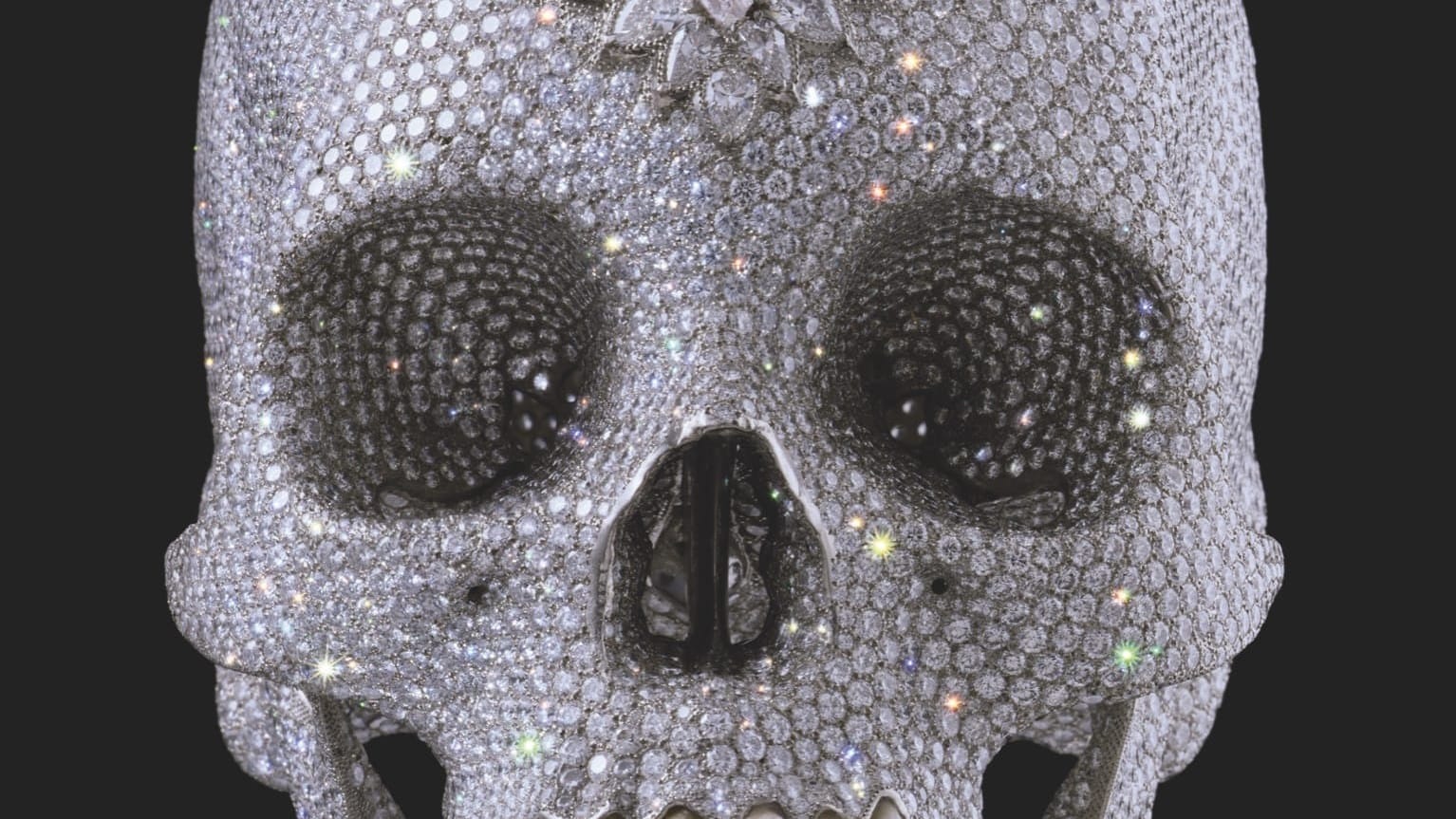
It’s one thing to reproduce oneself – Warhol was a genius at self-reproduction - but it seems that Hirst has been busy reproducing other people too. In recent years, the Stuckists - a figurative, anti-conceptual art movement in the UK - has levelled major claims of plagiarism at Hirst, claiming that everything from his Pharmacy installation in 1989 (which they say is a copy of a 1943 piece by American sculptor Joseph Cornell) to his crucified sheep and his 8,601 diamond-encrusted 100 million USD skull (also claimed to have first been produced in 1986 and 1993 respectively, by New York-based British artist, John LeKay) is copied from the work of other, lesser-known artists. Even his butterfly pin paintings seem to have been done first by Los Angeleno, Lori Precious.
To a certain extent, all art is borrowed, whether consciously or not. What the Stuckists say is that it is one thing to ‘borrow’ from others but another entirely to reproduce their work and take the credit. Certainly, none of those he is said to have copied are listed amongst the artist’s influences. Perhaps because they weren’t sufficiently famous.
Hirst doesn’t shy away from the accusation. “Lucky for me,” he was once quoted as saying, “when I went to art school, we were a generation that didn’t have any shame about stealing other people’s ideas. You call it a tribute.”
Though commendable, on one level, for its honesty, this statement does beg the question of why Hirst deserves the fanfare if his work is “a tribute”. Beyond his visceral, often ironic celebration of death, the inevitability of decay and life’s fragile transience, the answer may simply be because he is both incorrigible – and everyone loves an enfant terrible - and apparently unstoppable.
With a retrospective of his grid-like dot painting series early this year, held simultaneously at all 11 Gagosian galleries worldwide, followed by another at the Tate in April, that progress has become a blizzard. Three hundred canvases will be displayed from 150 collections spanning 20 countries, of a technique he ‘began’ in 1986, Compulsively repeated, the paintings are named after narcotics and Hirst says he got the idea from his father, who painted the door of their house in Northern Leeds with blue spots.
The fact that only about 5 of the 1,400-odd paintings were actually done by Hirst - the rest were ‘created’ by his 120-strong army of assistants, though Hirst did oversee, making sure no colour combination was repeated - and that they directly reference (naturally, without crediting) Gerard Richter’s colour charts of the 1960s, appears to bother no one.
“You have to look at [art] as if the artist is an architect, and we don’t have a problem that great architects don’t actually build the houses,” Hirst explained in an interview to Reuters. “Rather than think about whether a painting is important or high brow, I try to imagine a painting, that if you left it in the street outside a busy bar, would it still be there in the morning? Or would someone think it cool enough to take home?”
More interesting still is what he revealed to Time. “The spot paintings, the spin paintings. They're all a mechanical way to avoid the actual guy in a room, myself, with a blank canvas,” adding that the earliest spot paintings were done directly on the wall, “so they looked like a giant machine had painted them. I was sort of trying to deny that there was an artist.”
Perhaps in the mash-up, post-sampling world, where ideas (apparently) no longer have to be original and copying is (supposedly) no longer the equivalent of counterfeiting, art is not about authenticity but about the statement and the way it is marketed. In our Age of Ennui, it’s cynicism that collectors find worth buying.
“I wanted to be stopped and no one stopped me I wanted to find out where the boundaries were,” Hirst told the Financial Times in 1995. “I’ve found there aren’t any.” Perhaps attitude is what makes Hirst’s work so (counter)revolutionary. For better or worse, his has been a defining moment for Art, one to be re-visited and countered once again.