A first glance at Laudi Abilama’s work and you might mistake it for being a Warhol – if it weren’t for the subject matter, that is. Her paintings capture Arab stars from a golden age of cinema and music, among them Faten Hamama, Omar Sharif, Umm Kulthoum and Fairouz. Executed in bright, eye-catching shades, they are in the distinctly Western pop art style that Andy Warhol pioneered in 1960s New York, albeit with beloved Arab celebrities of that period instead.
Asmahan stares regally out of a canvas on which her distinctive features are superimposed nine times, in an identical wash of colour, the veils of blue and purple emphasising her queen-like appearance. It is reminiscent of Marilyn Monroe in Warhol’s famous screen prints. In another work, Umm Kulthoum, her hair piled atop her head in a towering beehive, is framed against a delicate Islamic line drawing within a circle of traditional patterns, glittering with gold and silver leaf.
By cleverly juxtaposing the old-fashioned appeal of stars who were famous long before she was born – during a period dominated by optimistic Arab nationalism – with a subtle hint of post-war irony and the idea of a vanished ‘Golden Age’, Abilama is also expressing changing times and a certain contemporary Arab malaise.
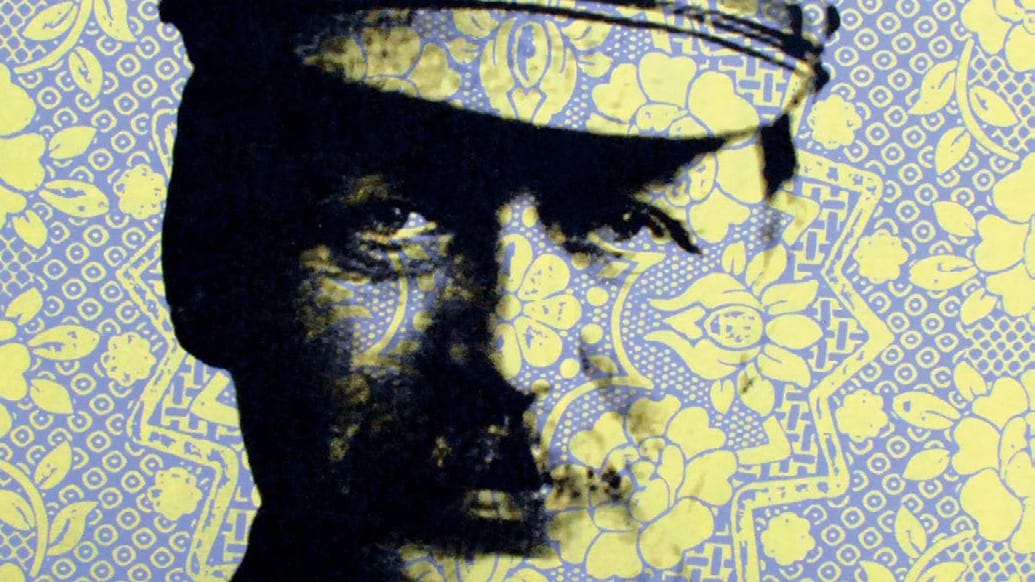
She doesn’t limit herself to film stars and singers though. Blending silkscreen and acrylic, her layered works – which are based on digital scans of old photographs, reproduced on canvas and accented with glitter – also capture politicians such as Kamal Jumblatt and Yasser Arafat. One set of pieces, in which black-and-white portraits are superimposed on neon-hued floral backdrops, even includes images of Georges Picot and Mark Sykes, whose combined influence so decisively shaped the Middle East and the problems it faces today.
Abilama was born in England to Lebanese parents, visiting Lebanon only during her summer holidays and it wasn’t until she graduated from the University College for Creative Arts in Farnham, near London, that she moved to Lebanon to live. Long inspired by Andy Warhol’s work, Abilama felt his approach to celebrity culture and consumerism had relevance to the Lebanese society she suddenly found herself immersed in.
“We don’t know how to be subtle really… I feel like we’re the ultimate consumers. That could be as a result of a post-war society. We have these ongoing existential problems in our heads,” she says in a Skype call from Surrey, where she was born and raised.
But Abilama’s fascination with Warhol’s work was initially linked to aesthetics, rather than ideology. “It was really like an infatuation,” she explains, “I was exposed to his work at the age of 14 or 15. I went to see some kind of huge exhibition at the Tate Modern, I remember I was absolutely fascinated by how he could produce such large works. I had no idea what silkscreen printing was. It wasn’t until years later that I had the luxury of having my own studio and getting familiar with his techniques, so I feel like I’m now just starting to get it out of my system. It’s more of an obsession than an influence.”
Her focus on Arab stars, on the other hand, is more recent. It began with a trip to Lebanon during her teenage years. “Growing up in England, obviously I was never really exposed to any sort of Arab culture,” the 28-year-old artist recalls. “When I got to an age that I sort of understood that I was Lebanese, I realised that I was searching for Arab culture. And I found it very easily on a trip to Lebanon, flipping channels. There were these old Egyptian films that I was completely fascinated by. Immediately, you see scenes of Arab women smoking cigarettes, being slightly provocative, almost flirting with male characters, and it’s something that you’re completely unused to, so that I think was what drew me into Arab culture.”
Since she began work on her Arab pop art portraits in early 2007, Abilama has gradually diversified and produced several distinct series of work. While the subject matter varies, all share a characteristic use of visuals rooted in Western art history, which Abilama repurposes to explore a contemporary Middle Eastern reality.
For the ‘The Great Depression’ series in 2011 and 2012, she photographed people on the streets of Lebanon, Singapore and the U.K., each wearing a white board on which they were asked to share their thoughts and opinions. A combination of photography and elaborate drawings in silkscreen and acrylic, the works in the series provide a measure of insight into the attitudes and concerns of citizens in three very different locales.
Created in Abilama’s trademark bright colours, they are reminiscent of the kind of online activism facilitated by social media, in which ordinary people can share their thoughts with the world through a single, easily disseminated image. “This was before everyone started doing the hashtag business,” she says, “but I feel like the work slightly mimics the hashtag effect – the idea that you create a message that other people can replicate and that will always be identified back to you. It’s a bit like Andy Warhol’s 15 minutes of fame, but with words instead of media coverage.”
In 2013 and 2014, she moved away from the pop art aesthetic, producing a series of paintings based on Greek and Roman mythology as depicted by European Old Masters. She lifted characters from famous paintings and put them together to create new narratives, inspired by Lebanese society. “I think that the Old Masters are a huge influence on my work,” she explains. “I always looked to them because they were very much concerned with the human form. I think as an artist, you always have to look way back to get to something new.”
In the meantime, she has gone even further afield. After undertaking an art residency in Singapore in 2011, she produced a colourful portrait of former Prime Minister Lee Kuan Yew, which was exhibited at the 2014 Singapore Art Fair. From February to April this year, Abilama had a solo show at Singapore’s Sana Gallery, filled with vivid paintings of the politician, who passed away in March.
Abilama’s most recent portraits have moved from politicians to writers and thinkers. “I’ve come back to the Arab celebrities, but I’m touching more on philosophers,” she says. “So people like Amin Maalouf, Said Akl - it’s an act of desperation to show people what these people look like and to remind them to please look at them for references.” Although some of the figures she paints are controversial, Abilama admits, they are all people who she admires in some way and who have had a profound effect on the world.
“It’s to do with a search for my identity,” Abilama says of the evolution of her portrait series. “When I grew up, I didn’t really know what it meant to be Lebanese and what it meant to be Middle Eastern. I feel like you look at a portrait and maybe it doesn’t really have a profound effect on you but the image sticks in the back of your mind and you ask yourself, ‘Okay, who was that person?’ The idea is that it triggers people who are searching for some kind of relationship with who they are.”
Through juxtaposing East and West in terms of technique, past and present in terms of content, Abilama encourages deeper reflection on personal identity and public celebrity, not just as a figure of glamour but as what also forms a collective national consciousness, a cultural identity.