Eight years ago, a successful Kuwaiti businesswoman purchased a beachfront plot in Muscat with the aim of building a weekend retreat. She enlisted an Omani architect who made his reputation restoring historical monuments to turn her ideas into reality.
A shrewd and particular client, with an eye for the smallest details, the businesswoman was looking to create a hideaway from her fast-paced, high-powered life - a place where she could recharge.
Prominent, prestigious and more accustomed to working with royalty, the architect was more used to dealing with budgets that ran into the hundreds of millions of dollars and having the last say on everything. And so, somewhat unimpressed, he was categoric in his refusal.
The businesswoman, a person who is known for getting what she wants and who was convinced that she had found the right man for the job, persisted. The architect, who also had his pride, continued to refuse, so the businesswoman pulled a few extremely influential strings. Flattered, probably bemused by this outsider's evident wasta and perhaps even a little intimidated, the architect finally relented. Work began immediately.
His brief was this: to create a Moroccan-influenced Omani residence that could serve as both family home and weekend getaway. The house should be intimate enough not to overwhelm, yet large enough to entertain, from time to time. There was to be a pool, a courtyard with a fountain, some garden space and, most importantly, there should be domes. Lastly, the house already had a name; Anassa, a Greek word that means 'queen'.
Let me pause here for a moment because I'm fairly certain I know what you are thinking, that this clash of titans must have produced some gaudy palace of gilt. An Almohad fantasy in scale replica perhaps, a marvel of muqarnas and a cornucopia of cornices. Hubris-sur-Mer, if you will.
If you are, let me tell you that although everything you have just read is true, your impression could not be farther from the truth. Allow me to continue.
Safa al-Hashem bustles towards us in an elegantly embroidered caftan with a disarming informality that suggests we should become fast and instant friends.
"Habiiiiiibi! Ahlan, ahlan! Over here," she says, motioning the photographer and me around the pool to the sliding doors leading into what turns out to be an airy, open plan living room.
"So," she says, gesturing around her. "What do you think of my little hideaway?"
My first though is that it is cosy. Despite the six-metre ceiling and gold-painted dome overhead, the living room is just that, a living room. Homey and inviting, it is devoid of all pretence. It is neither a conversation piece nor a museum, the furniture here is meant to be sat on, not looked at. The built-in sofa is large enough for several people to sprawl out upon at the same time. The books on the coffee table are ones al-Hashem is reading and the room is decorated simply with knickknacks, rugs and paintings that she has picked up over the years. These are objects that have personal meaning rather than objects intended to impress.
The living room is combined with the kitchen. A large tiled island acts as a nominal separator between the two areas but effectively it is a single large multipurpose space and is clearly the heart of the house.
"The best part of all my houses is the kitchen," she adds, leading us out towards the courtyard. "I love to cook and so I usually build a huge island so that my family can sit with me and chat while I cook."
The living room gives out onto the swimming pool to the right – which al-Hashem says works as her de facto outdoors lounge - and a garden courtyard on the left.
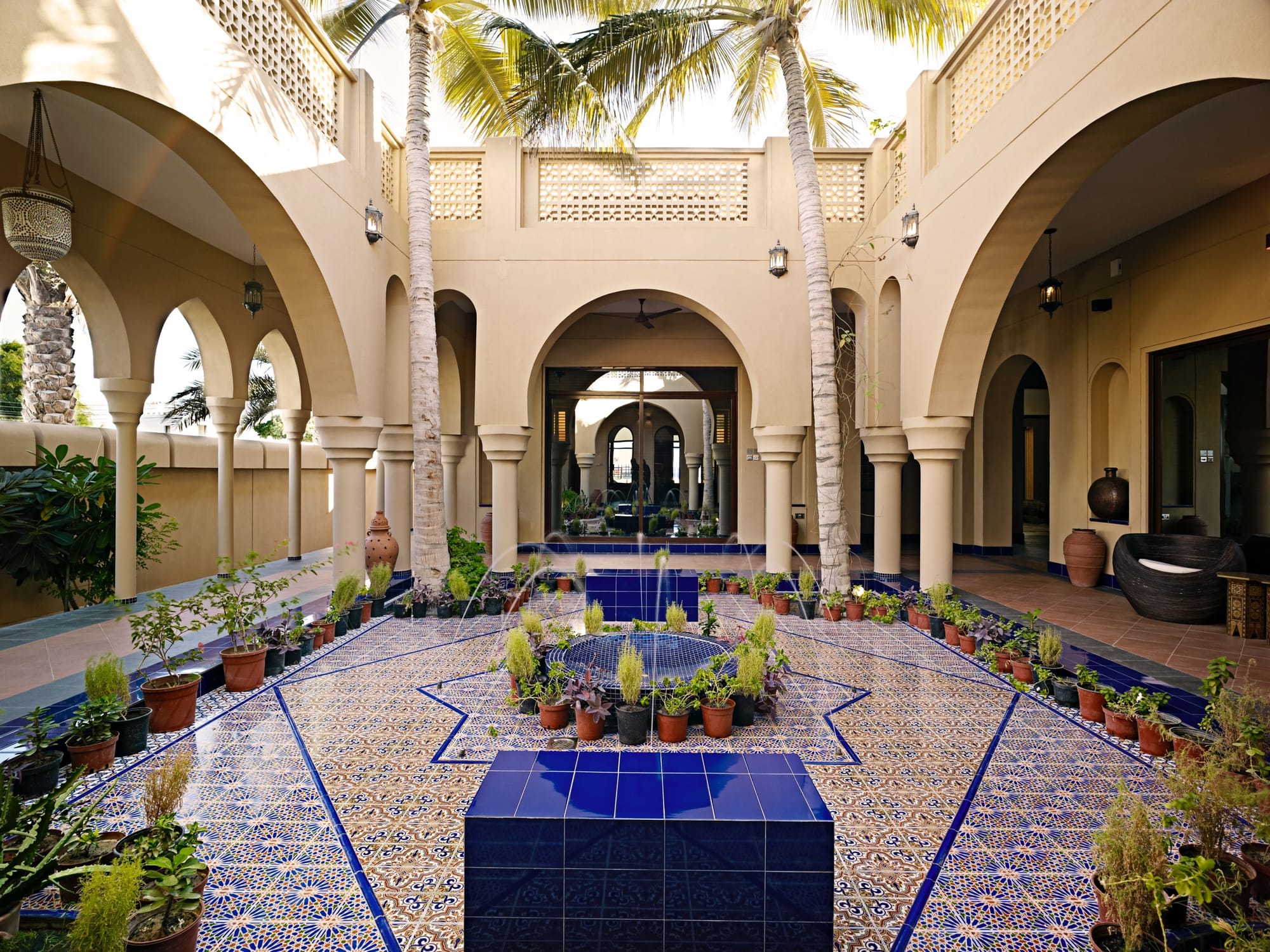
Decorated in blue and zellij-print tiles, the courtyard is centred on a low, bowl-shaped fountain. Potted plants fringe the fountain and the courtyard and four Keralan coconut palms rise up and over the roof. The left-hand side of the courtyard is formed by the 27-arch arcade that runs along the front facade of the house, at the end of which is a staircase that leads up onto the roof terrace. Sometimes used for barbeques, the terrace offers uninterrupted views of the beach and at sunset, of the crumpled rose-coloured mountains that rise dramatically behind the city as well.
On the far side of the courtyard, directly ahead and to the right are the three suites used by al-Hashem and her family, each simply but comfortably furnished. The lower right-hand corner of the courtyard is taken up by a shaded nook, in which traditional banquette-style seating has been arranged. It is a perfect spot to relax with a narguileh or a good book and enjoy the courtyard.
Privacy guaranteed by tall compound walls, the house is designed to open up to the elements as much as possible. Not only does this ensure that the property is flooded with light – al-Hashem has a marked dislike of doors and curtains – but together with the high ceilings and seaside location, the open layout ensures a near constant breeze. Even at the height of summer, the house keeps relatively cool and so the air-conditioning does not need to be kept running full-blast. It's a far cry from the hermetically sealed environments so much in vogue elsewhere in the region.
No more than a few fishermen's shacks on the beach when al-Hashem moved here eight years ago, Athaiba has since grown into one of Muscat's most desirable neighbourhoods. The Chedi Muscat is just around the corner and since Casa Anassa was built, villas and family homes have begun to fill up the beachfront.
Despite this, the neighbourhood has managed to remain surprisingly quiet. Apart from the occasional passing car and muffled shouts from a street football match a few streets away, the only sounds are the gently gurgling pool, the splashing of the fountain and the wind rustling through the palm trees in the courtyard and along the front of the house.
"I'm ashamed to say this but before I first came here, I had the impression that it was a boring place," she says, adding that were it not for the insistence of a friend she might never have visited in the first place. "I fell in love with Oman from the airplane; the mountains, the light, the colours of the sea, it was all so beautiful."
Driving along the coast one afternoon towards the end of her trip, she spotted the plot of land on which she would eventually build her house.
"I knew immediately, this was the place for me. Three weeks later, I decided to come back and buy it."
Since then, al-Hashem has grown into a passionate adopted Omani and at a state banquet for Oman's ruler Sultan Qaboos, hosted by the then Emir of Kuwait, she (half) jokingly asked the Sultan if he could arrange for her to be given Omani nationality. Quite possibly a breach of protocol – if only because her own monarch was in hearing range – her request didn't get her a passport but it did earn her a rare smile from the famously retiring Sultan.
"I love it here. This is my resort, my weekly detox," she tells me as we sit eating lunch by the pool. "It takes me away from what I do for a living."
That would be her very busy life as Chairman and Managing Director of Consulting Advantage, one of the most successful financial consulting and management restructuring companies in the GCC, which not only keeps her busy in Kuwait but also has her commuting to meetings around the region several times a week.
Listening to al-Hashem talk about international finance, the price of oil and its ramifications on regional development, the essential resilience of the family-owned business and who she thinks is likely to emerge as winners from the current financial meltdown, it is difficult to believe that she has ever been anything other than head of her own company and yet in some ways, her life reads like modern-day fairytale – albeit one in which the heroine rescues herself.
The youngest of seven children, al-Hashem was brought up in relative hardship. Her father died shortly after she was born, leaving her in the care of her mother, who was suddenly forced to seek work to take care of her family.
Unhappily married at 17, she spent the next fourteen years of her life being (house)wife and mother, before circumstances finally led her to seek a divorce. It was only then, at the age of 30, that al-Hashem took her first steps towards the life she leads today.
"I won't say it was a hard life, but we knew our limits," she says, speaking of her upbringing. "It made me tough. My life has taught me never to take no for an answer."
I casually remark that Kuwait appears to have produced more than its fair share of tough, high-powered successful female executives. Something in the culture, perhaps?
Explaining that contrary to widespread belief, Kuwaiti and other GCC-country women are generally dynamic and are often involved in business, al-Hashem tells me that being a woman tends to open rather than close doors.
"The problem is what you do once the door is open," she says, a reference to the fact that even once they agree to do business with them, there are plenty of men who don't take their female counterparts seriously, especially when she is obviously more qualified.
"It's true, for example, that when I first went to Riyadh, I raised some eyebrows. I mean coming in as both a Kuwaiti and as a woman to tell these men what to do with their companies on a financial level, well, you should have seen the body language," she says, recalling how few of them would look her in the eye and the one that did practically winked at her. "But after a few months of restructuring, they sat up straight when I spoke, I can tell you."
In fact, al-Hashem believes that women have a natural business advantage in the GCC, where many companies are essentially family enterprises and doing business with them is as much about negotiating family dynamics as it about negotiating a deal. That, she says, is when a woman's 'emotional intelligence' gives her the edge.
"You have to know when to be firm and when to go easy. Sometimes, there are clients you have to bang on the head to make walk straight; sometimes a little gentle advice is more than enough."
"Imagine going in to a family-run company, where everything has always operated under one umbrella and is probably run by one 'Big Daddy' and explaining to them that now, they need to do an IPO, so they have to open their books to outsiders. Imagine doing that in conservative business societies like Saudi, Qatar and Oman. It needs patience, understanding and a lot of persuading but I love that part of my work.
She pauses briefly, eyes twinkling and flashes a smile that is part mischief, part unadulterated pleasure.
"And yes, I have been called names, but I don't care. I'm made of tougher stuff. Don't forget, I was the youngest of seven children."