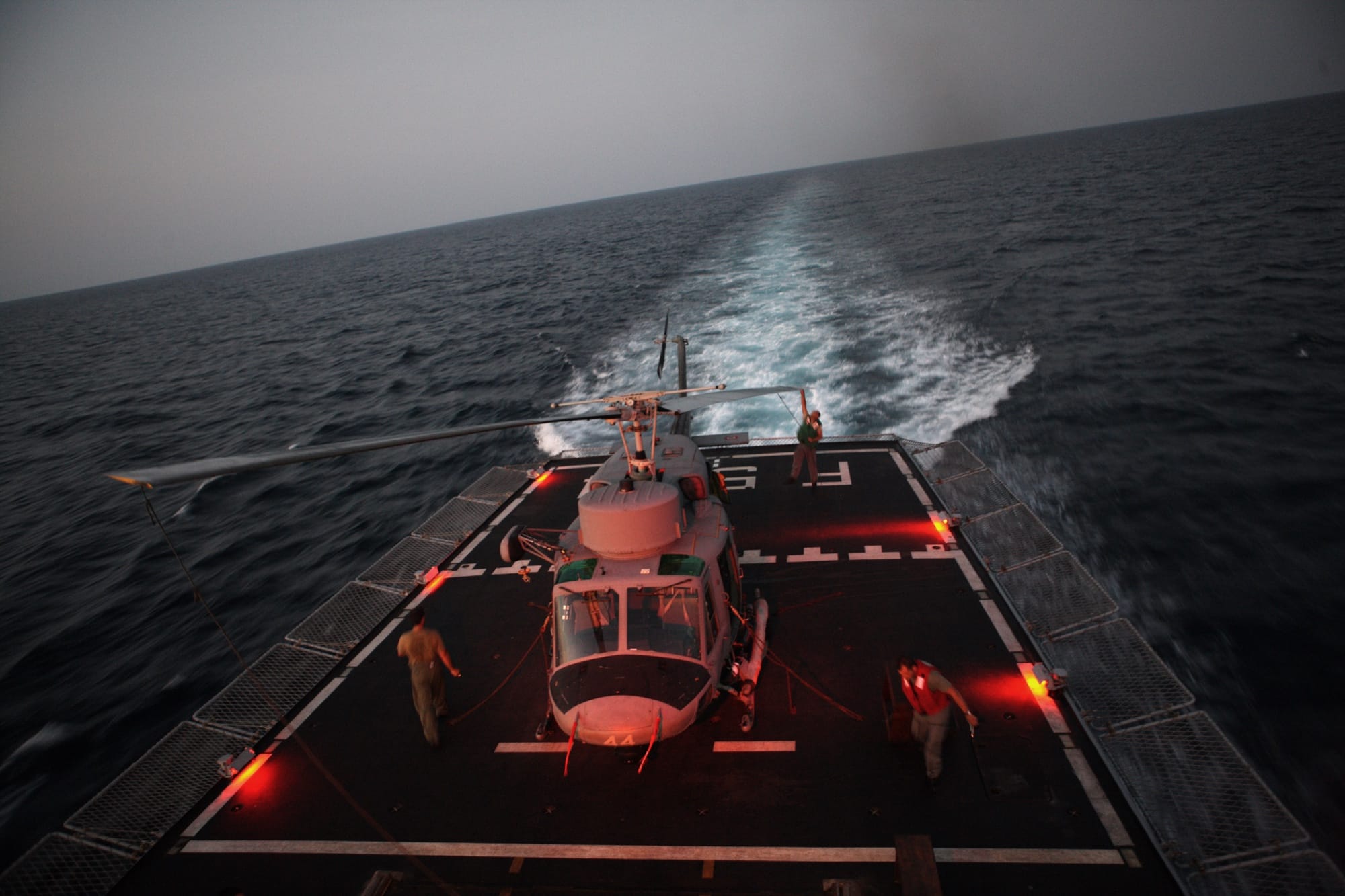
On one side is the defence. The Bersagliere is an Italian Navy frigate, 113 metres long, with a crew of 188 men, and impressive firepower: a 25-tonne Otobreda 127mm/54 calibre cannon capable of pulverising a target more than 100 kilometres away, two 40mm/70 calibre cannons, two anti-aircraft and anti-ship defence systems comprising a total of 24 missiles, two heavy Browning machine guns, two 20mm/70 calibre machine guns, four 7.62 calibre MG machine guns mounted on a helicopter, and everything is controlled from a state-of the-art electronic warfare centre.
On the other side is the threat: a dhow, a wooden cargo barge seen throughout the Indian ocean, built by hand in the same way as it would have been a thousand years ago, hewn with an axe wielded by a Somali craftsman, and powered by a rusty diesel motor that came out of a truck. But on-board this dhow is a pair of skiffs or fast speedboats, grappling hooks attached to rope for boarding raids, some ancient AK-47 rifles, perhaps a Soviet-made RPG launcher, some meagre provisions and drinking water, and a crew composed of half a dozen men with very little left to lose. These are the pirates of the new millennium.
These two opposing sides form the essence of Operation Ocean Shield, launched by NATO in August 2009 to counter piracy using Task Force 508: five warships (including the Bersagliere as from the end of 2010) and the Dutch submarine Zeeleeuw. The task force patrols the waters around the Horn of Africa, attempting to deal with the rising tide of pirates who originate from the Somali coast, and who in the last few years have caused devastating damage to merchant shipping as well as global commerce (amounting to around 16 billion USD according to a report commissioned by the U.S. Congress). In 2008 alone, according to the Kenyan Foreign Ministry, the pirates netted more than 150 million USD in ransom money paid out by the owners of the seized ships. Given these figures and the level of sabotage, the necessity for a mission such as Ocean Shield is clear, even if it costs 350 million USD a year.
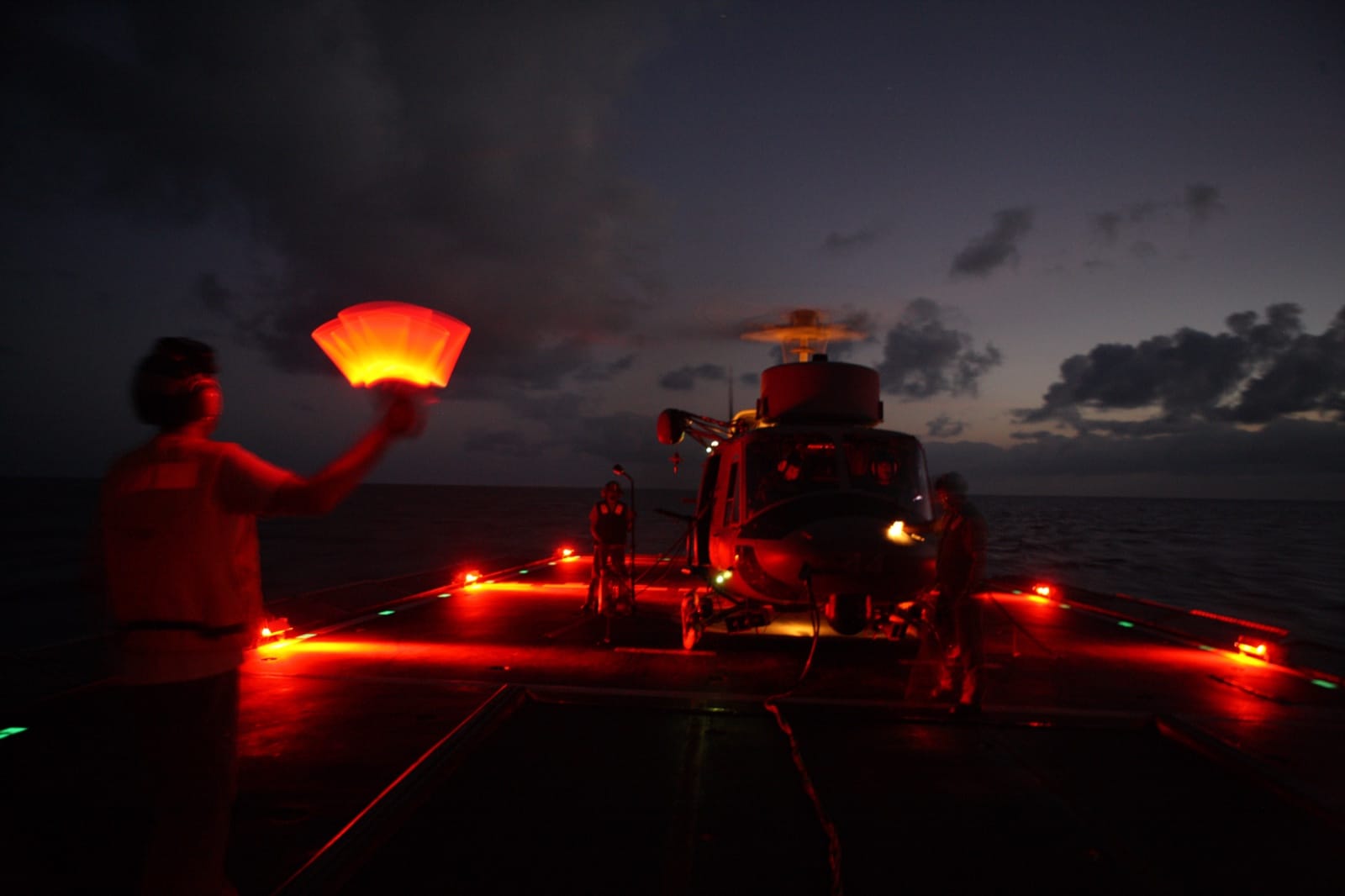
From the bridge of the Bersagliere, with 2,500 tonnes of steel slicing through the ocean beneath you and 9 metres of cannon aimed at the horizon, the waters of the Gulf of Aden don’t seem so terribly hostile. The ship patrols unceasingly, first in a south-westerly direction, then northeast, then southwest again, sailing at twelve knots between the coasts of Somalia and Yemen, always with the same daily routine. Every morning at 5am, the flight unit prepares the helicopter - an AB212 modified with bulletproof Kevlar panels - for patrol. Take-off is at dawn, around 6am, and on board are two pilots and a radar operator, who if needed is also the machine gunner, with two 7.62 MG guns mounted on both sides. Dawn and dusk are the pirates’ preferred moments for attack: there is enough light for them to identify a vessel as a cargo ship and not to risk boarding a warship by mistake (as happened in 2009 with the French Navy ship the Somme, with disastrous consequences for the pirates), but not so much as the skiff can be spotted from miles away from vantage points by lookouts. While the helicopter is in flight, the crew are on full alert.
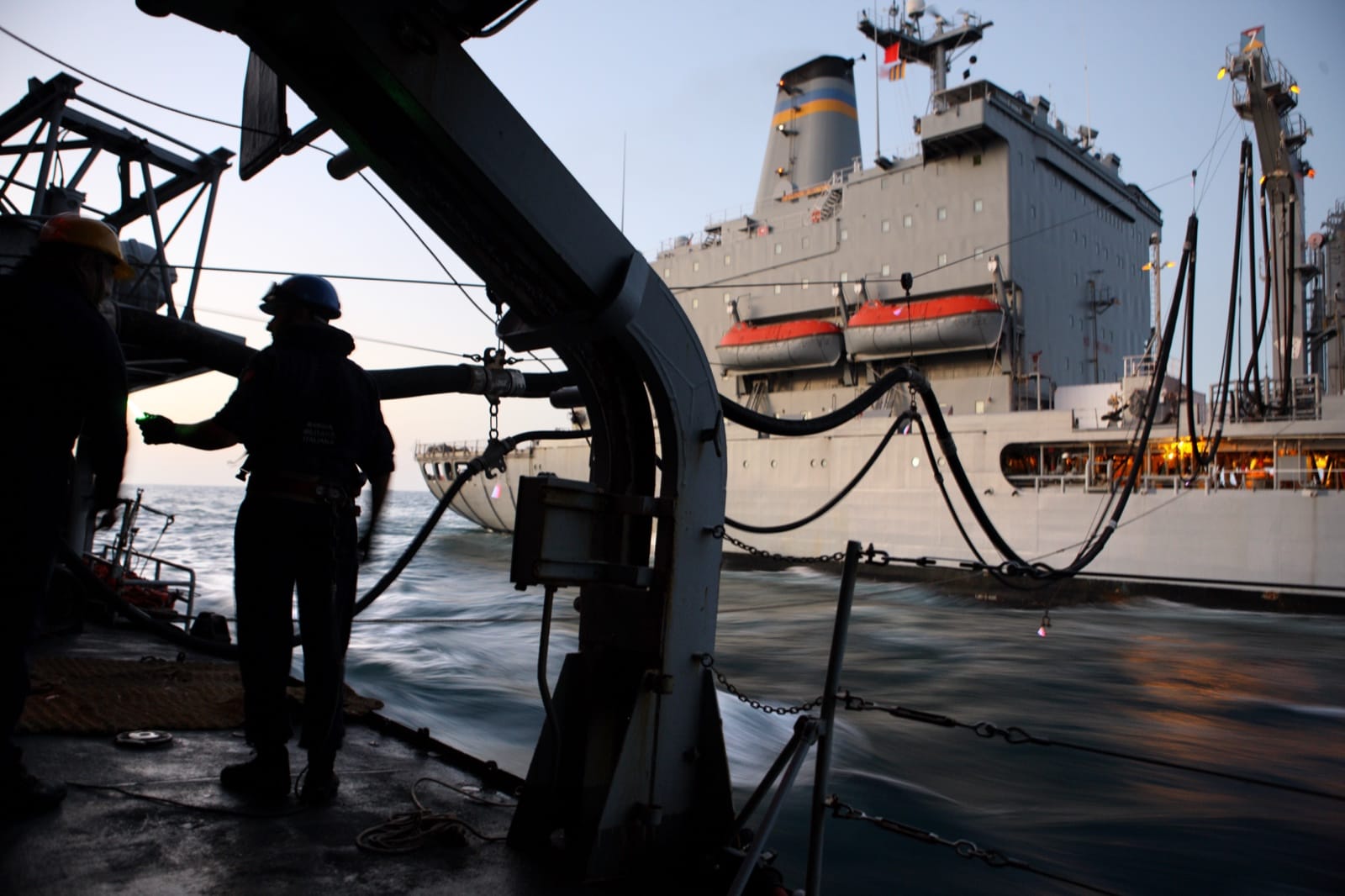
At 8am, the ‘quick reaction force’, a squad of ten commandos from the San Marco regiment, goes on standby, ready to set out in a rubber dinghy within minutes to intercept any suspicious dhow. Meanwhile, in the command centre and on the bridge, in the electronics room where the radar and weapons control systems are located, in the galley, in the helicopter hangar, in the infirmary, and in the engine room where two diesel motors produce 8,000 horsepower, and two aeronautical turbines produce 50,000, as many as 180 men keep the ship running with clockwork precision.
Like the internal mechanism of a clock, life for some on board can end up being monotonous. Thus the ship, at least with regards to ergonomics, is superbly conceived, and every spare space has been turned into a gym, with cycles and weights for releasing tension. In the afternoon, the flight deck becomes a jogging track (albeit a short one). The commandos, many of them veterans of Afghanistan and Iraq, shake their heads, saying: “It was better there - at least something was always happening.”
What can happen’ here is that they come across a dhow sailing one or two hundred miles from the coast, which may be innocuous in appearance, but which carries an enemy rendered lethal by desperation. And a Somali pirate deprived of hope is by definition desperate; hunger is what drives him to raid ships in virtually suicidal actions. Thus the rules of engagement mean treating every dhow as if it has the most dangerous kind of armed men on board: those with absolutely nothing to lose.
A pirate dhow can usually be spotted from a distance by several distinguishing features: It has at least one pair of skiffs on the bridge, six or seven crew on board, no flag, and a plastic sheet spread out on deck. This latter is the most chilling detail; not for its main function (to hide the crew and protect them from the salty spray), but for its secondary role. “The pirates are so hungry,” the commander of the Bersagliere, Gennaro Falcone says, “they often travel 500 or 600 miles from the coast, with only enough fuel for the outgoing journey. If the attack succeeds, they take possession of another ship and all is well. If it fails, or if they do not achieve their objective before the fuel runs out, the sheet becomes a sail, and they remain at the mercy of the wind and the sea a thousand kilometres from land, with only a few ways to save their skin. Ironically, if they throw their weapons into the sea, as does happen, under international shipping law, they are in effect shipwrecked, and we - the people who want to arrest them, or the cargo vessels they were planning to raid - are obliged to rescue them.”
Dealing with a suspect dhow always follows the same pattern: the frigate stays at a safe distance since a desperate man armed with an RPG might choose to die taking as many others with him as possible; a marksman on the flight deck keeps the boat within the telescopic sights of his rifle; and the commando squad, armed to the teeth, approaches the dhow in rubber dinghies to inspect it. Besides weapons for responding to attacks, they also carry bottles of water and cigarettes. If the dhow, as it often is, is simply a fishing boat, these are gifts for the crew, always greatly appreciated, and nearly always exchanged for fresh-caught shark and swordfish. The dhow is however still photographed and, as they say in the control room, ‘tagged’ (electronic warfare uses the language of Facebook, or is it the other way around?), and added to the computer systems the ships of Task Force 508 use to exchange information in real time, so as to avoid it being stopped a second time.
The real (bureaucratic) nightmare comes if during the on-board inspection the soldiers discover the raiding kit mentioned above. At that point the commander must secure the dhow, arrest the crew (the Bersagliere has rope cages, which are rudimentary, but occupy minimal space and serve the task well), and organise a videoconference trial, with a defence counsel and a magistrate. On the basis of the evidence, they will decide whether or not to convict. If found guilty, the pirates are held on board until the ship returns to its native country, whereupon they will serve their respective sentences, or be transferred (in a legal process that is not always successful) to a prison in Djibouti, the Seychelles or Kenya – regional countries that have signed an agreement with the European Union (not with NATO), allowing a third party to punish the pirates’ crimes on their behalf.
“However,” commander Falcon adds, “ours is more a preventive, policing task than anything else. Our presence in the Gulf of Aden serves to reassure the cargo vessels that cross it, and to dissuade pirates from assaulting them. But at the same time, we must be careful not to become an annoyance to local traffic, like the fishing boats and cargo dhows, and that’s why we give them something after every spot check. It’s a way to excuse ourselves for the time we cost them.” And time here, unlike in many other military operations, is literally money.