“Hey mister, I bet you can’t pull a wheelie off the lights. I bet you’re too scared. I bet you don’t know how to. Give me the bike and I’ll show you how it’s done.” Those were the taunts directed at me by an 11-year-old school kid as I waited at the traffic lights on my way to work. I really must ignore him; I must not react; I must rise above this childish provocation. Oh what the hell.
Wheelie in first, in second, even in third! By the time my front-wheel had landed back on the tarmac, and the grin on my face had faded, I had reached the office in record time. This morning there was no need for my regular espresso stop-off. I had arrived fully energised.
Bikes represent many things to many people. Some see them simply as a mode of transport, others as a way of life, a flash toy, a statement of gang membership, a babe-magnet, a mid-life crisis, an excuse to wear leather pants, the list is endless. Whatever your desire, there is a bike out there for you to fall in love with. The fact that bikes are selling in record numbers across all demographics is proof that the Grand Amour with the motorbike is going from strength-to-strength.
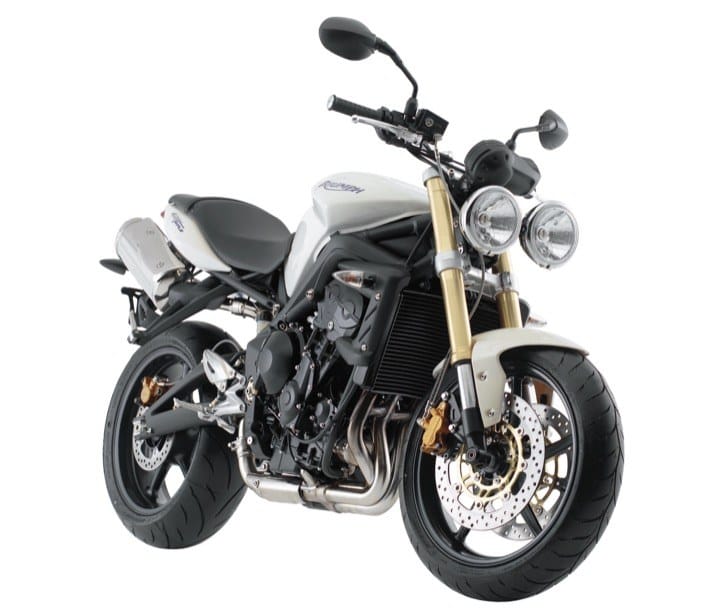
Nowhere is this more apparent than in my preferred bike segment, the roadster. Designed mainly for city use, roadsters are naked versions of sport bikes where the ride position is slightly more vertical, making them easier to ride around town. Some of the main contenders in this category are the Ducati Monster, the Honda Hornet, the Aprilia Shiver, the Suzuki GSR, the BMW F800 and of course, one of the newest entrants, the Triumph Street Triple – considered by some critics as the newly-crowned leader of the pack.
Triumph is a British manufacturer that has been making bikes for over a hundred years. It is an iconic brand name strongly associated with a period when the UK led the world in producing quality motorbikes. Many still consider the late 1950s and early 1960s as the golden era of biking when Triumph launched its most well known bike, the Bonneville. However, since those heady days the British motor-bike industry has descended into terminal decline. Famous names such as Norton, BSA, and Royal Enfield have all disappeared. Triumph survived – albeit by the skin of its teeth – as the only major British motorbike manufacturer in operation today.
As they say, what doesn’t kill you makes you stronger, and sure enough, Triumph is a success story once again, outselling the likes of Harley Davidson, and Ducati in many markets. This renaissance happened in the 1990s, mainly with the launch in 1997 of the Triumph Daytona. Today, Triumph has built on that success to grow fast as a company and now produces a broad range of about 15 models, with the Street Triple being regarded as a key model that will take the company onwards and upwards.
“The Street Triple has been our most successful launch ever. The 1997 Daytona launch was good, but not as good as this. We have never received so many deposits in such a short period of time since its launch in June 2007,” says Trevor Barton, Triumph’s product co-ordinator. “In fact, there is a six-month waiting-list and we are building more Street Triples than any other model in our range to keep up with demand,” he adds as we walked through the assembly line at the company’s impressive factory in Hinckley, UK.
So what’s all the excitement about? I was about to find out. As an overview, the Street Triple combines the roadster styling of its older brother, the Speed Triple, with the 675cc engine, chassis and performance of the award-winning Daytona 675 sports bike. It is positioned to compete in one of the most popular bike segment, the roadster category between 600-900cc, where it is up against some of the best bikes around.
Within the first few minutes of riding the Street Triple, I realised why the bike has built up such a strong reputation in such a short period of time. The Speed Triple is special in two key areas: handling and power. At 167kg, the bike is very light. Riding it in traffic, I feel alive in its handling and at ease manoeuvring it around the city’s many obstacles; on open roads it gives me the confidence to push hard and ride it with vigour and purpose.
It is important also to mention that although it is light, it is by no means a flighty bike. In fact the Triple is remarkably planted on the road. There’s no nervousness or tendency to headshake. The front-end is rock-solid and it needs to be because the power the engine produces is truly thunderous.
Which brings us onto its other key strength. The bike is powered by a 675cc, fuel-injected, water-cooled, three-cylinder, 12-valve engine which unleashes 106bhp. This gives a power to weight ratio which is truly outstanding.
At the lights, turn the ultra-responsive throttle and the acceleration is immediate; from thought to throttle to tarmac instantaneously. The sound it produces while it pulls away is what horsepower should sound like, the sound of a thoroughbred declaring its confidence to all it leaves in its wake.
As if the acceleration thrill was not enough, the Street Triple continually tempts you into pulling wheelies. Like a young horse, the bike wants to constantly prance around in joyful exuberance. When it comes to wheelies, there really should be a place and a time, but with the Street Triple, the place is wherever and the time is whenever.
On motorways and at high-speeds the Speed Triple has the feel of traditional ‘faired’ big sports bike as it stabilises itself the faster you power into the horizon. For deceleration, the Nissin two pot sliding callipers with sintered pads give top of its class braking, that is both powerful and immediate. The ride itself is comfortable both in traffic and on long journeys
The bike has few negatives. First, the turning circle is too constricted, especially for tight manoeuvres in town. Also, there is minimal room for a passenger, and the gearbox suffers occasionally from getting all confused about which gear the bike is in. Lastly, on an aesthetic point, I simply haven’t gotten used to the dual lights at the front which I still find awkward looking.
And that brings us onto an important factor in a modern day bike. In a world where banks are promoting plastic surgery loans, we can safely say that now more than ever, looks matter. This is where the Street Triple divides opinion. So where better to test its styling than around London’s fashionable style-conscious neighbourhoods from the trendy King’s Road to the café-ridden streets of Knightsbridge? Some people stared while others didn’t even notice it at all. Inconclusive then, but whether you find the Street Triple attractive or not, one thing is for sure, she is bursting with personality.
My own love-affair with bikes revolves around the sense of energy I feel each time I set off on a journey. No more so than with the lively Street Triple, a bike that stimulates the senses and exposes the playful side of our characters. For me personally, the cheeky wheelie monster that is referred to in grown-up terms as the Street Triple is a true expression of the sheer joie-de-vivre of motor-biking. Here’s to the next cheeky 11- year-old-kid who dares to taunt me at lights.
Contacts
Triumph Qatar
Alfordan Motorcycles Centre
Doha, Qatar
Tel +974 446 3504
HYPERLINK "http://www.alfordan.com.qa" www.alfordan.com.qa
Triumph UK
Hinckley, UK
Tel + 441 455 251 700
HYPERLINK "http://www.triumph.co.uk" www.triumph.co.uk