Who Farah Behbehani
What The Conference of The Birds, an intriguing take on a Sufi classic
When Published in June of this year
Why Innovation in the ancient art of calligraphy and the retelling of a Middle Eastern masterpiece of Islamic enlightenment.
Farah Behbehani is a humble soul – you’d never know the magnitude of her achievements from speaking with the 28-year-old Kuwaiti graphic designer. For not only has she taken an ancient text and breathed new life into it using calligraphy and illustrations for a western audience, Farah has created a whole system, the first of its kind, to enable occidental readers to understand the meaning, reading direction and flow of the calligraphy, giving a previously hidden insight into the intricacies of the Arabic script.
But let’s start at the beginning. Eight hundred and thirty years ago in modern-day Iran, a Persian poet and Sufi mystic named Farid ud-din Attar penned an epic poem of such eloquence, beauty and enlightenment it has captivated readers ever since. The Conference of the Birds (Mantiq at-Tayr) tells of the journey by a group of 30 birds, led by a hoopoe, to find their king, an allegory of a Sufi sheikh leading his pupils to enlightenment in some of the most beautiful Persian poetry ever written.
In June 2009, after three years of hard work, Farah Behbehani, published her own interpretation of the poem and has enlightened readers even further. “As an artist I had always wanted to use Arabic art and script in my work,” Farah tells me when we meet in London. “It’s my history, my background, my roots and I wanted to celebrate my heritage and culture but in doing so reach beyond the realms of this traditional art form and communicate to an international audience.”
“The problem was when the idea first came to me I had never studied or done calligraphy in my life, I still can’t believe I managed it.” During the second year of her Masters studies in Communication Design at London’s Central St. Martins College in 2006, Farah came up with the idea for The Conference of The Birds as her thesis project recalling that Attar’s epic poem was one she loved. At that point she approached the renowned Syrian calligrapher Khaled al-Saai who agreed, after some persuasion, to take her as an apprentice. “I was in awe of Khaled because he’s such a master but he was generous and taught me a range of styles including Sumbuli, Kufic and Jali Diwani which is the script I used for the book,” says Farah.
At her degree show in 2007, which she passed with distinction, London-based publisher Thames & Hudson immediately snapped up her book and the rest is history. May 2009 saw her first solo exhibition and book launch at Dar Al Funoon in Kuwait and also the book’s launch later that month in London at the prestigious Conran Shop. “It’s been a rollercoaster ride but I guess it’s all been inspired by Farid ud-Din Attar’s exceptional poem. I just fell in love with this tale of the birds in search of their mythological king – the Simorgh,” she says. “I’d never been exposed to the Sufi philosophy before and I appreciate so much its deep founded roots in Islamic tradition. I could relate to it and see myself in this story where all the birds represent the different characteristics found in human nature and find lots of excuses to not embark on their spiritual journey. My big challenge with my version was of course to make it engage with English-speaking readers.”
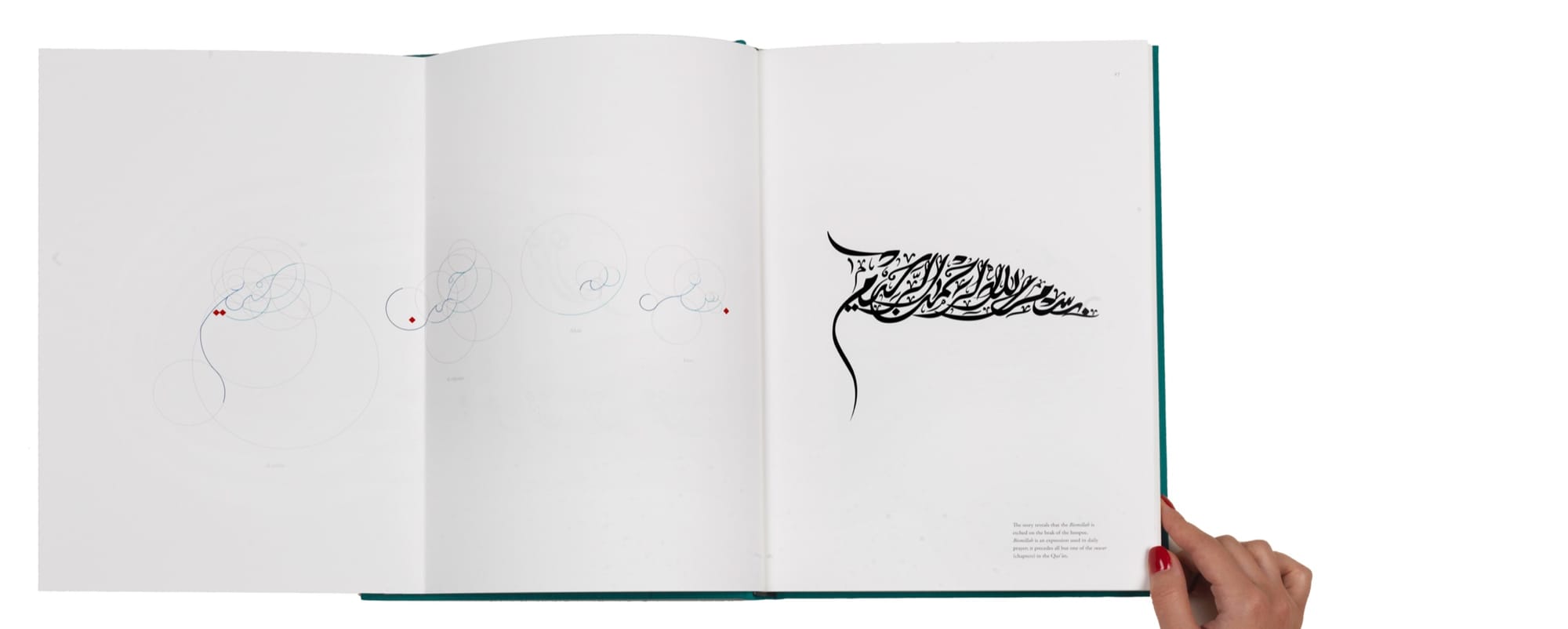
No small challenge but one which Farah managed with stunning results, even for a reader with little knowledge of what is good or bad in calligraphy. Her script is perfectly symmetrical, depicting a traditional ‘Arab’ characterisation of the letters but one that is flexible and elegant at the same time as well as being heavily-line dependent rather than the traditionally compact form. “I selected 13 stories as the original poem is so long and I chose the specific birds because theirs were the strongest stories,” Farah says. “Each chapter begins with a passage from the book followed by the name of the bird in the Jali Diwani script.” The name is followed by a line from the Arabic version of the poem (with a literal English translation) representing the essence of each story, which is then illustrated and broken into its component elements using Farah’s method.
“The system relies on the premise that calligraphy is based on a series of harmonious curves. The circle, considered to be one of the most sacred forms in geometry, is used to highlight the curves within each calligraphic letter. I then add a colour coding system to the part of the circle that falls on the letter, with a gradation from light green to turquoise and finally dark blue, indicating the beginning, middle and end of each word, respectively,” Farah says. What’s great is that in this way through shape and colour, the reader can follow the form and flow of the calligraphy. And as each word drawn in the system is also accompanied with an English translation and transliteration, the reader is able to view the words in Arabic as well as understand their meaning. It is a clever and accessible system for what is an excellent book. I wondered what Farah’s tutor thought of her work.
“Khaled al-Saai, my mentor and teacher, made jokes about it because that’s the sort of the person he is, but he really approved of the book which was so important to me. He said I had something special in my talent. I am so proud that he was able to teach me and supported me throughout,” she says. With such an achievement already under her belt I ask where Farah will turn her talents to next. “I have decided to move back to Kuwait and really try and help build this wonderful country of my birth through my work, though I will keep travelling,” she says. “But my first big project is an attempt to create an animated version of The Conference of the Birds. I want to do it using the calligraphy and painting which I have always been interested in. I am collaborating with a friend who is much more talented than I in moving visual media so will be travelling to New York a lot. Oh and I am also interested in working with calligraphy and textiles. Something material, creative.”
There’s no doubt I think when we part that we’ll be seeing much more of this brilliant new talent in the not so distant future. The Conference of the Birds is available now.