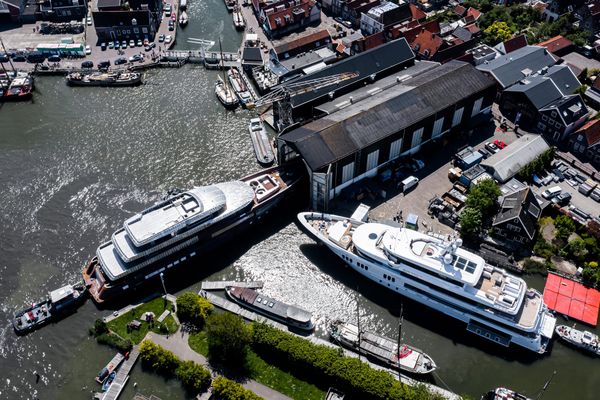
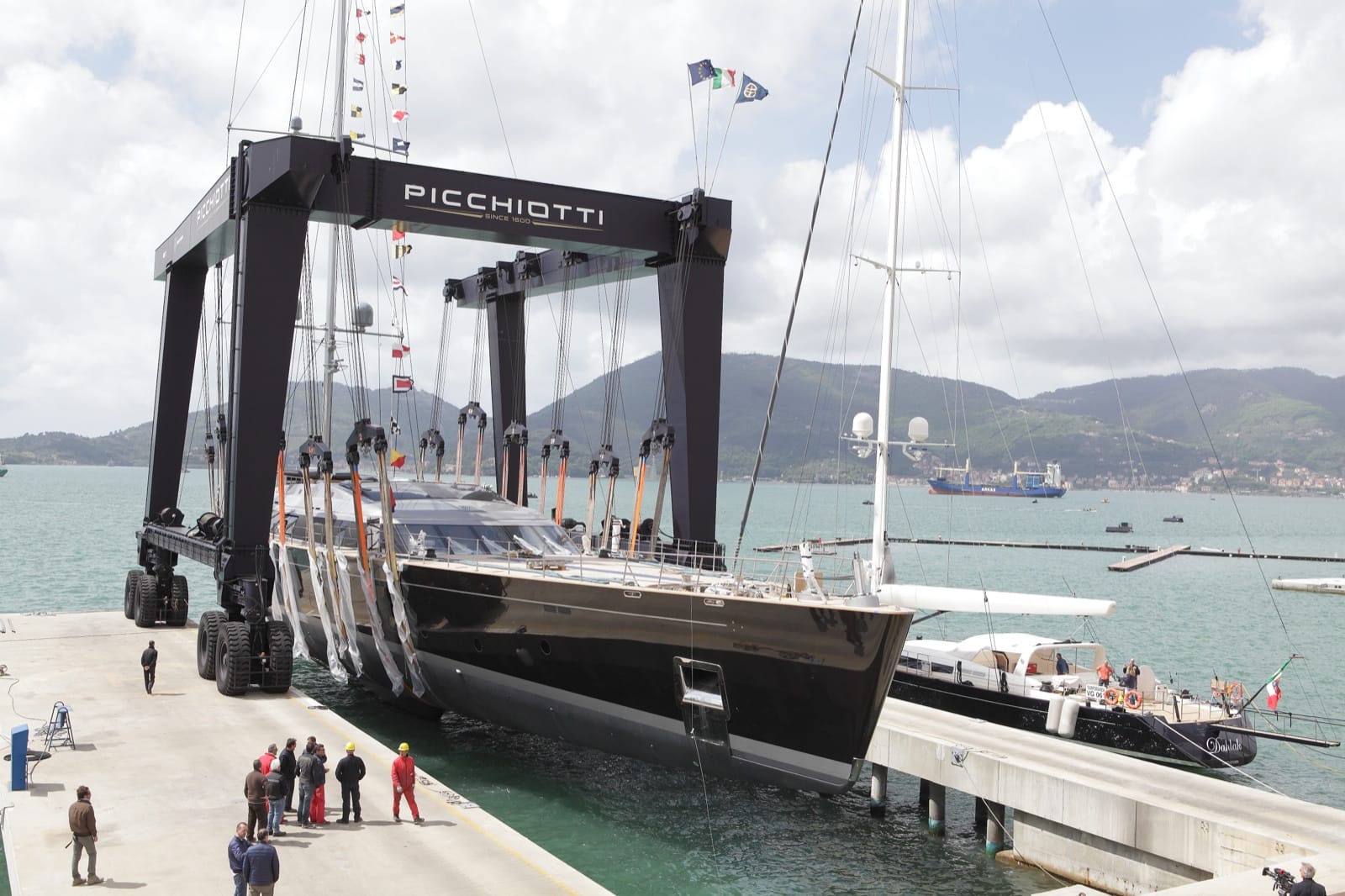
Perini Navi’s latest 70-metre launch was one of the largest and most noteworthy yachts at last September’s Monaco Yacht Show. Sybaris was not only the belle of the ball among this year’s superyachts, she is also the most significant launch for the Italian yard since they revolutionised the sailing world in 2007 with the 88-metre Maltese Falcon.
“She’s a different animal from what we’ve been delivering,” says Burak Akgul, Perini Navi’s managing director. “She is a big step forward as far as her magnitude is concerned, but she also encompasses a series of engineering developments. She represents an evolution in Perini Navi’s exterior design.”
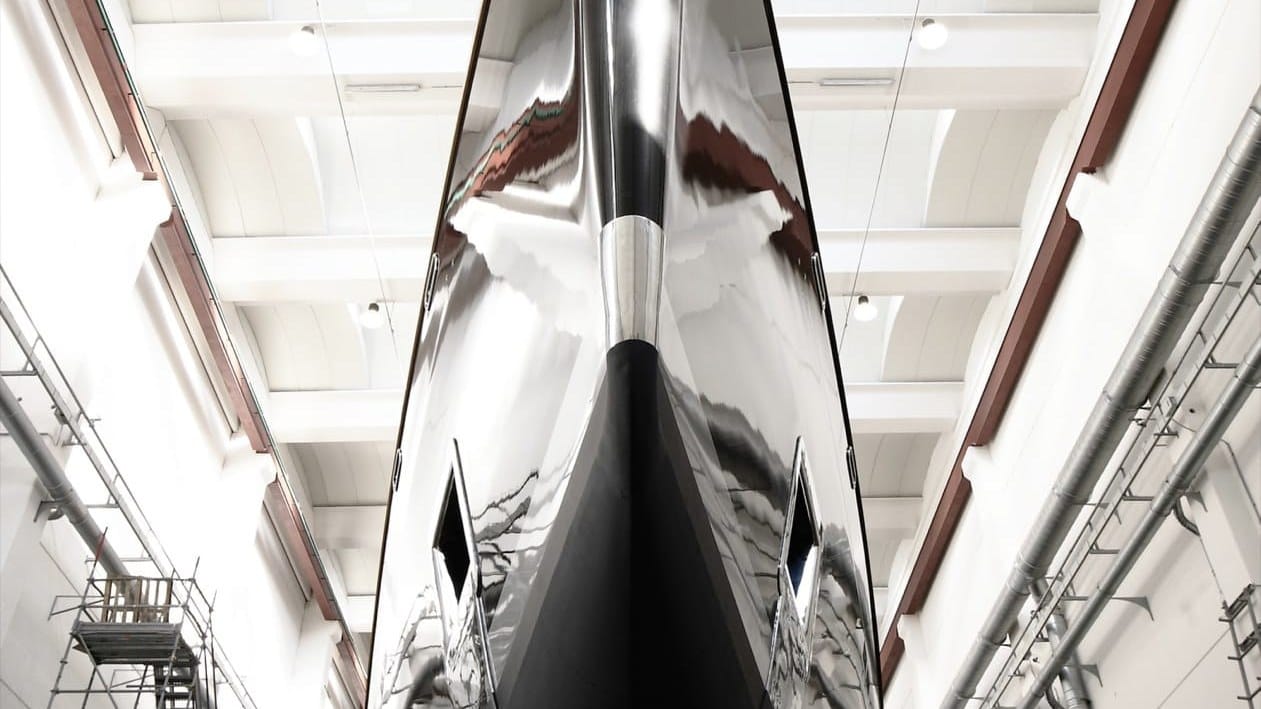
Commissioned by 66-year-old American lawyer-turned-software mogul Bill Duker, and designed in-house by a team led by Franco Romani, Sybaris’ superstructure is more integrated with the hull than previous Perini launches. “With 13 meters of beam, we wanted to keep the superstructure as sleek as possible,” says Akgul. “We did away with the brow of the window-line on the superstructure, so the windows are completely flush with the side and foredecks.” The grey colour of the mast bases also blends with the silver superstructure for a more unified look. “You don’t notice the mast in the same way that you might have on our previous sailing vessels,” adds Akgul.
The yacht’s sail-handling system, which allows one person to furl and trim almost 3,000 square metres of sail plan, is also a revolutionary step forward. “We introduced a new breed of captive winches on our 60-metre Seahawk,” says Romani. “But that was not enough for Sybaris. We also had to develop new furlers to achieve sail deployment speeds commonly found on much smaller yachts.”
Philippe Briand helped with the sail plan optimisation. The system handles 80-plus metres of sail per minute, synchronizing three machines so the captain can furl and unfurl the sails with a single joystick. “This is a huge step change in the one-man sail handling that we’ve been proudly offering for so long,” says Akgul.
While the exterior represents significant technical and aesthetic advances, the most valuable jewel in Sybaris’ crown is her interior. Duker has owned multiple superyachts, but he has been planning Sybaris for decades. “I wanted a minimal interior that was not minimalist,” Duker said at Monaco, during an onboard press event.
The mix of primary design materials, like titanium, American ash and glass, along with Carrera marble and bronze, could have been a disaster. They turned into a subtle symphony of light, textures and low-key elegance.
Peter Hawrylewicz of PH Design understood the critical nature of getting the interior just right. Hawrylewicz had first worked with Duker twenty-five years earlier when he handled the design of Duker’s Miami Beach home. “I actually met Bill at around the time I was working on Gianni Versace’s Miami palazzo,” adds Hawrylewicz, “since then, we’ve become good friends. I’d worked on several of his residences in Miami Beach and Manhattan, and even one for his son.”
Having never designed a yacht’s interior, Hawrylewicz surveyed the latest and greatest superyacht builds. None seemed particularly inspirational. He realised that he would have to cut his own path. “I wanted the interior to be modern, warm, and personal,” the designer says. “I wanted it void of clutter and embellishments, yet rich in detail. Bill inspires people naturally; I wanted his boat to do the same.”
Feeling pressure from the magnitude of the commission, not to mention his professional relationship and friendship with Duker, Hawrylewicz understood that a lot was at stake. “I didn’t want to blow it,” he says. “There are only so many yachts in the world, proportionally speaking. As design commissions go, it’s a scarce pearl to squander.”
The interior had to be open and light, the two decided, and contemporary. Hawrylewicz wanted to use influences from residential design, which tends to be more “forward-thinking” than many yacht interiors. “For whatever reason, yacht owners tend to get tacky when they trick out their interiors,” he says. “I wanted to apply our company’s aesthetic and create a very modern, clean and warm interior.”
American ash became the wood of choice, providing organic warmth, while titanium ceilings, furniture and glass walls injected a modern edge to the design. The choice of titanium, not only on the ceilings but also in door handles, stair railings and even hardware in the steps, was agreed upon at the outset. “I found the muted, reflective surfaces of the titanium ceilings in the large interior compelling,” says Hawrylewicz. “Titanium has the warmth of pewter but reflects more light. It is also able to be expressed in a very thin edge.”
Titanium, in fact, became the signature metal throughout Sybaris, even on the custom furniture and tables Hawrylewicz personally designed to make the yacht truly unique. “I designed about ninety per cent of the furniture on board,” he says. “I love designing furniture. It’s like dessert after doing all the other architecture.”
Hawrylewicz’s favourite piece is the large cockpit dining table on the aft deck. “The design is based on an unfurling rose, a meaningful emblem for the Duker family,” he says. “The table is made of concentric titanium rings and is mimicked in a tempered reflection in the titanium ceiling above.” The ceiling’s concentric rings are lit at night to provide soft light for evening dining. These subtle and surprising details were what set Sybaris apart from the other new launches at Monaco but they did of course create significant challenges for Perini Navi. “Titanium is strong and resilient, but can be difficult to work with,” says Hawrylewicz. “Welding can leave a keloid scar if not done correctly. But whether it was welded, cut, cast or folded, Genesis Yachtline and Perini Navi supervised the work excellently. Many pieces of the furniture required a level of artistry that exceeded industry standards. They were successful at every turn.”
Hawrylewicz says that the Italian shipyard proved to be a “great mentor” for his first yacht interior, initially providing interior images of other Perini interiors and providing a naval architect’s perspective when necessary. Being a superyacht that heels at significant angles under sail forced Hawrylewicz to think differently about the positioning of the three-floor stairwell and even the beds in the master and guest staterooms.
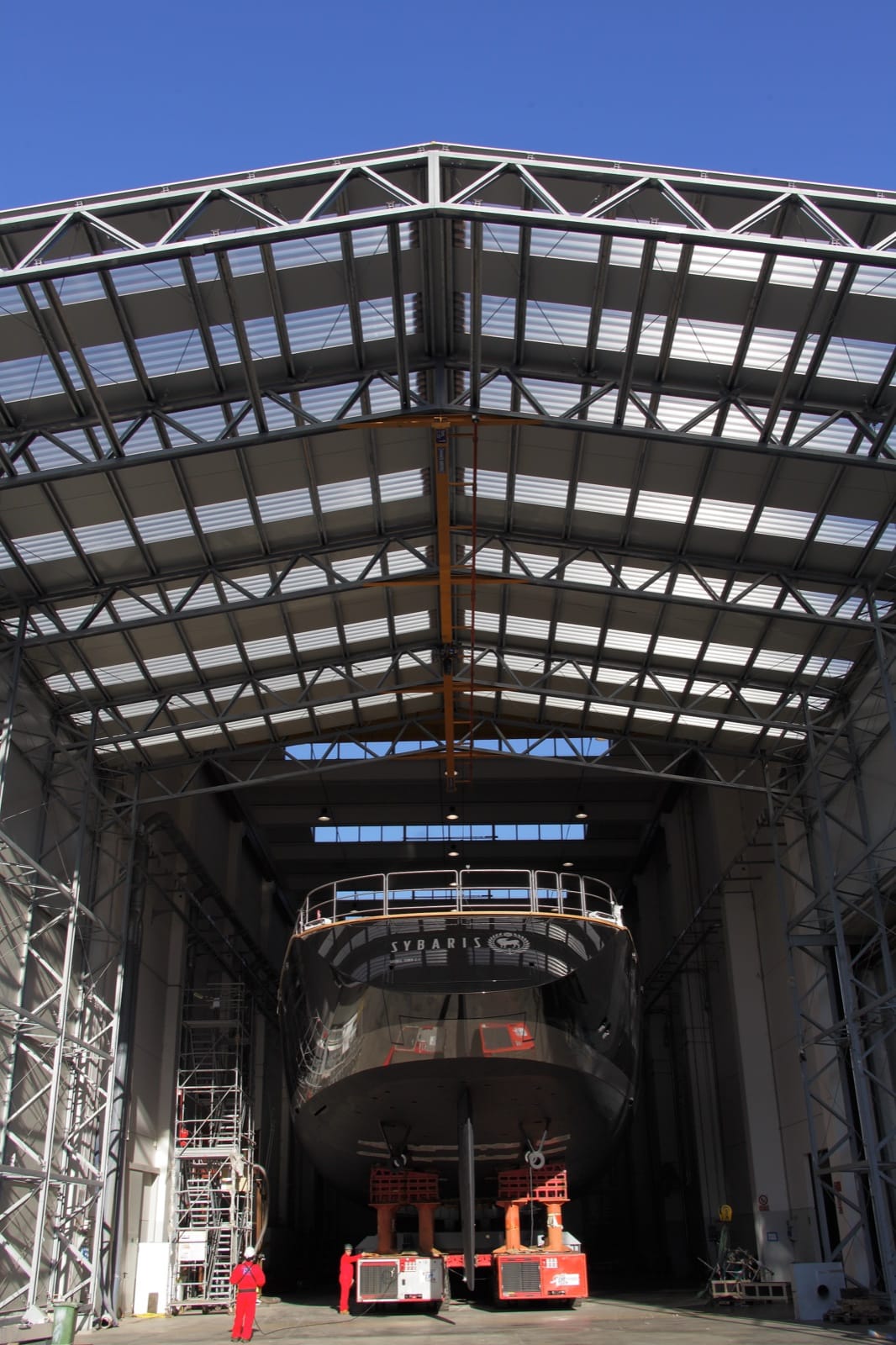
Behind the scenes, Romani and his team had to make sure Hawrylewicz’s designs could be translated into the real world of yachting. The palatial main salon, for instance, did not have any pillars so as to maintain the open, modern feel. That necessitated creating structural reinforcements within the aluminium hull and superstructure that were invisible to the eye but could also bear Sybaris’s immense loads. The custom-made titanium doors had to be fireproof per Lloyds certification standards. Even the glass walls that supported the three-floor stairwell went beyond their intended purpose of creating a free flow of natural light into the salon. Weighing 650 kilograms each, they work as structural supports as well. Indeed, much of Sybaris was about blending aesthetics with structural design.
At Monaco, Bill Duker was understandably proud of his new yacht, a lifelong dream fulfilled. “I don’t know if it’s possible to get a higher level of detail,” he told his press visitors. Around him, yachting journalists, jaded by the me-too interiors of most other yachts, were crowing about the stunning interior. Beyond the metalwork, features like a bathtub carved out of a single piece of Carrera marble and a 1.5-tonne dining table made from the same marble simply added to the impressive details, not to mention, Duker’s collection of modern art that has transformed the interior into a contemporary galley.
After Sybaris, simplicity could well become the watchword of superyacht designers going forward. Certainly, this yacht is a game changer.