England gave modern menswear its dark palette, a fully canvassed construction and the form-fitting jacket. Italy deconstructed the suit, added colour, handset sleeves and dramatically angled pockets. Yet it’s the French, and Camps de Luca in particular, that has tastefully managed to find the best of both worlds.
The storied Western tradition of the gentleman’s bespoke suit is as contemporary as ever. In the face of worldwide economic crisis, a return to true value and an interest in investment pieces – sure to last generations – pose themselves as alluring alternatives to bling-bling and fast fashion.
The Camps de Luca sign boldly angles a prominent street corner on the busy and beautiful Place de la Madeleine in Paris, France. The signage may be bold but the interior of this second floor salon, receiving customers only by appointment, is anything but ostentatious. The elegant corner salon is the epitome of discretion and detailed refinement, which are also, not coincidentally, characteristics of a superbly crafted men’s suit.
What distinguishes a bespoke suit – apparel crafted largely by hand and measured entirely to the precise specifications of its wearer in both taste and fit – is, ironically, that there is nothing noticeable about it. That is, it appears as natural as a second skin. What is remarkable, however, is the ease with which the wearer moves and the overall refinement, balance and cohesiveness of its form. This subtly powerful effect is difficult to attribute to one detail but, rather, offers itself as an overall impression. It’s a classic example of when the exceptional whole amounts to more than the sum of its exquisitely detailed parts.
The market for bespoke suits is limited but important, namely entailing those who are willing to pay at least 7,500 USD for a suit and understand the value in doing so. Once in this price range, the services and styles available are vast and worthy of such a proper investment. Fully-tailored suits first bring to mind London’s Savile Row as the definitive destination, and this local tradition is, indeed, classic. British tailoring is highly structured while, to the south, Italian men’s tailoring is softer in form. Camps de Luca is situated perfectly in the middle, as one of the best European tailors to cultivate tradition, build relationships based on quality, and dedicate itself exclusively to its craftsmanship.
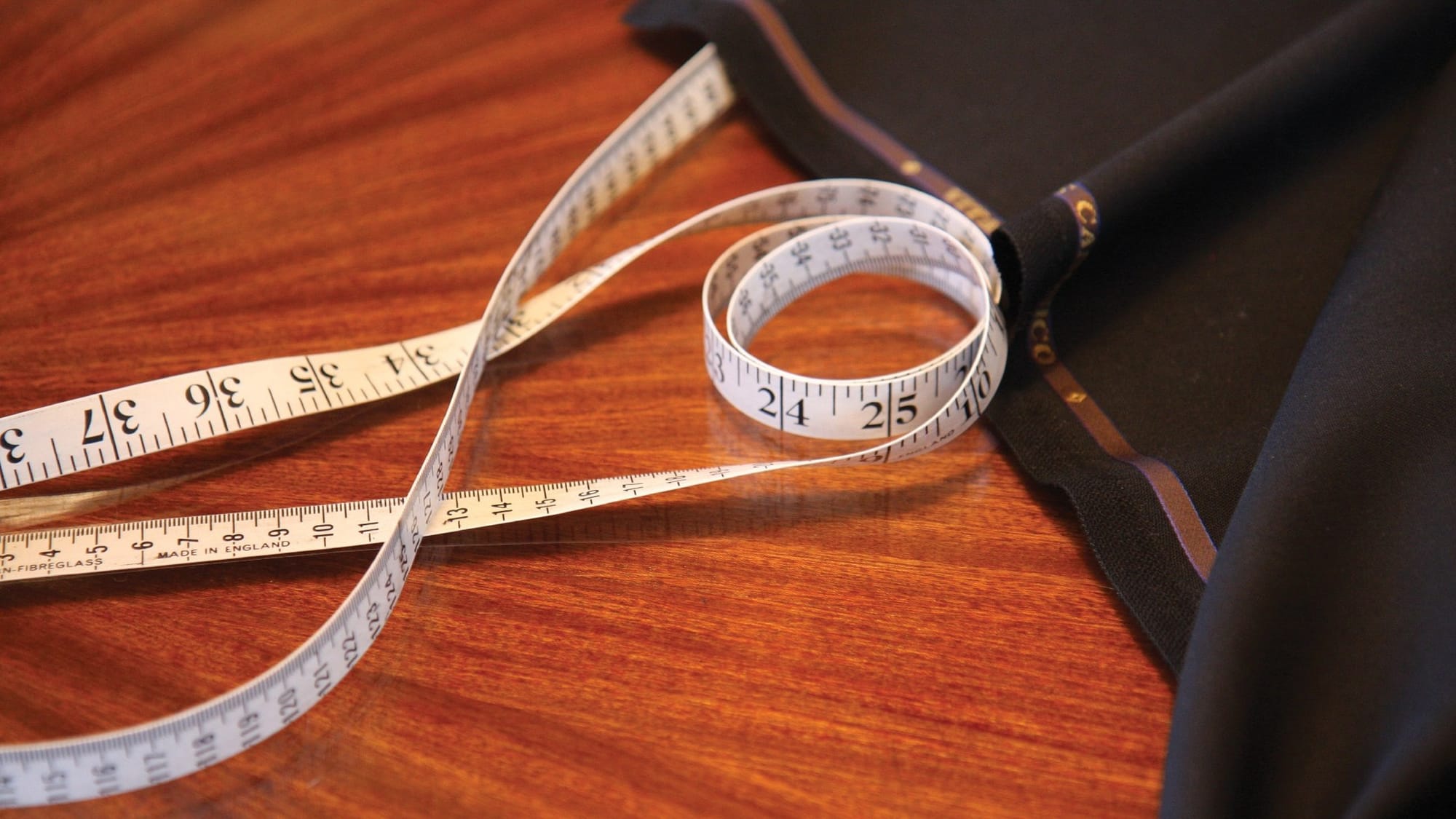
Enter the Camps de Luca salon and one wall presents, floor-to-ceiling, neatly organised cloth hailing from the finest suppliers on the continent: Holland & Sherry from England, Loro Piana from Italy, Dormeuil from France and Scabal from Belgium. One material in particular attracts the more decadent clientele – DiamondChip fabric is a mix of wool, silk and genuine diamond powder that adds a subtle catch of light. Another wall of the salon features a cabinet display of shirt collars in all its varieties and subtleties of form that are to be chosen specifically – and with proper counsel – to fit the face shape as well as the length and width of the neck and shoulders in a tailored shirt. In the centre is a large, round table with fabric and measuring tape strewn across haphazardly, with a sort of effortless chic. And with no pretension – this artisan workshop is constantly abuzz. It is one of the few tailor’s aterliers in which everything is done in-house in the space of five rooms – the aforementioned salon for material selection, another for private fittings and a set of three interconnected rooms filled with quiet and industriously focused workers, each set to an individual task that altogether form the final suit.
Every suit begins with a simple conversation. What climate does the client live in? What does he do in his day exactly – sit at a desk or move around a lot? What are his favourite materials, cuts and colours? Serving sometimes as both educators as well as stylists, master tailor Marc de Luca and his apprentice and son Charles de Luca use their ears and eyes to understand the client entirely. “We have a relationship of trust with our clients,” Charles states soberly. When clients choose details that do not truly suit them, they also serve as trusted consultants about what details distinguish a finely suited gentleman. And this is not to be understood in general terms – each gentleman is considered as, and who, he is; the suit is intended to bring out the best of his natural bodily form as well as fit his unique lifestyle.
Overall, one men’s bespoke suit takes nearly 70 hours of fastidious work, with the jacket requiring the most intensely detailed attention; even the button holes are sewn by hand. The first meeting, conversation included, lasts no more than an hour, with the technical measurements lasting about twenty minutes. Further and final fittings may take place, if the client is available for this.
The measurements are first made with two pieces of fabric, a front and back that form a sort of mock vest. With pins and marks, this fabric is the blueprint for how the suit jacket will fall and fit (as a single or double breasted suit) and determine the balance of the lines. A conversation ensues regarding the positioning of pockets, their size, number and depth. This first fitting offers a base from which a unique pattern will be drawn, and upon which more specific modifications can be made. This basic pattern is unique to the client, and will be a reference for further suit orders.
Some of the more complex and detailed work goes into how the suit falls upon the chest area. An internal layer of canvas is carefully contoured in a way that allows the chest area of the suit to fit against, fall upon and respond naturally to the torso’s movement. A total of four layers of various fabrics, including this principal piece of canvas, comprise the interior of the body of the suit. They are all hidden behind the main external fabric. It is what is inside that counts here.
Three further details distinguish a Camps de Luca suit as particularly fine. Firstly, and simply, is the sleeve. Where the sleeve attaches at the upper shoulder, there is an internal layer of canvas piping inside this upper arch that adds dimension and, most importantly, grants free movement to the arm. When the arm rests at one’s side, the sleeve falls seamlessly straight – no ripples in the fabric whatsoever. Also of note, the seam where the sleeve attaches to the main body of the suit underneath is closely fitted to the contours of the underarm. This is a detail that will largely be absent from an average “ready-to-wear” suit, with the underarm seam falling far below the actual underarm area.
Secondly, the way in which the collar and lapel turns and lays around the back of the neck is a detail of extreme exactitude that can distinguish any suit above the rest. The collar lies flat across the back shoulders without any interruption of smoothness (the overlapping, that accounts for the natural degree of curvature, is coyly done in the interior with an elaborate overlay technique).
Lastly, Camps de Luca has a signature detailing that is sure to delight the connoisseur. The internal coat side pocket, hand-stitched, forms the elegant shape of a drop of water, and is specified according to the user’s needs in terms of the size, width and depth – in order to fit their particular model of mobile phone, for example, that they intend to regularly house there. With one’s initials sewn on the inside of the wrist cuff, there are numerable finishings for your delight.
The de Luca men are certainly directors of delightful detail. Started in 1969, Camps de Luca remains in the original salon in which it was founded by a team of two important tailors at the time, Mario de Luca and Joseph Camps. Marc de Luca, who began apprenticing his father at age 16, becoming a master tailor in 1982, is, in turn, inviting his son Charles de Luca to one day take the helm of the company as he has just recently taken up an apprenticeship under him. “My father is my best friend and my boss,” says Charles, and there is evidently both warmth and camaraderie between generations, and a love for creating a truly fine product.
With its family tradition and tight team of craftsmen, Charles reflects on what he has learned so far, “One rule I’ve learned is to never be content with what we do, and always go further in surprising our regular clients and treat every client as a challenge to push ourselves in our craft.” With a highly international clientele – about which they maintain an ultimate degree of privacy – hailing from Singapore, China, and a few African presidents and the King of Jordan to boot, they are definitely the go-to resource for men who have a high-profile image. But superficial it is not. Often likened to modern armour, a finely tuned, one-of-a-kind suit is a near necessity for a man in a high profile position of power – something that once they put on, they don’t have to think about again and are, in a way, invincible. For men who are less in the spotlight, a bespoke suit represents attention to the details in life that can heighten one’s every day experience and make living that much more pleasurable in the smaller, every day ways. This is, perhaps, the definition of true luxury.