A walk down Rue Cambon, a narrow street off Rue du Faubourg Saint-Honoré, might furnish an everyday scene such as, on one side, the back entrance of the Hôtel Ritz Paris sprinkled with employees sneaking out for a quick smoke or, on the other, the legendary flagship Chanel boutique fronted with drivers waiting for clients to finish their shopping or – if you’re lucky – Karl Lagerfeld’s mega truck Hummer (in powdery gold) as he dashes in for some business in his role as chief designer for Chanel, a position he’s held since 1983.
This street, Rue Cambon, served as a bridge between home and work for the storied design doyenne Gabrielle “Coco” Chanel who lived on and off at the Ritz for over 35 years, and where she died in 1971 at age 87. Chanel, the business, has had some sort of footing on Rue Cambon since 1919. Legend has it that when she descended from her suite at the Ritz to go to work, the porter would call ahead to her staff who would promptly spray the boutique’s dramatic wrought iron staircase with her celebrated perfume Chanel No. 5, ready for her morning arrival.
On the other side of the Hôtel Ritz, of course, lies its grand principal entrance, for which it is celebrated as taking centre stage on the Place Vendôme. The Coco Chanel Suite looks directly upon the Place, with the Chanel jewellery store within sight just across the way. Considering design and architecture have never been estranged bedfellows, the glass top of a Chanel No. 5 perfume bottle is bevelled into an elongated octagonal shape – like that of Place Vendôme itself – a motif that is also present in the watch faces of Chanel’s less sporty models such as the Premiere Collection, for example.
Coco Chanel’s rapport with the Hôtel Ritz Paris is not without a spritz of scandal. While she moved into her suite overlooking the Place (with her own furniture in tow right behind her) in 1934, the turbulent events of World War II prompted her to close her shops in 1939. Then, in 1940, the Germans invaded Paris and fully occupied Hôtel Ritz Paris along with it. Coco Chanel remained; however, she moved into a back wing of the Hôtel, closer to Rue Cambon. The highest-ranking officers of the Third Reich occupied the main suites of the hotel.
During this time, she is said to have had an affair with Hans Gunther von Dincklage, called Spatz, a German officer and Nazi spy who may have arranged for her to be able to remain on the premises. She was later criticised for this liaison and even arrested by the Comité d’Épuration after the Liberation of Paris. Legend has it that, when interrogated about her alliance, she famously responded, “Really, monsieur, a woman of my age cannot be expected to look at his passport if she has a chance of a lover.” A shining example of one of Coco Chanel’s best bits of advice for women: that your vulnerabilities are your very strengths. After an extended period of retreat, Chanel reopened for business in 1954.
Coco Chanel has also once said, “For me, the Ritz is home,” and she certainly kept and decorated her surroundings there precisely for her comfort, where she also received friends Jean Cocteau, Pablo Picasso, Igor Stravinsky and Salvador Dalí. In fact, her view of the hotel was exactly as its founder, César Ritz, had ideally envisioned it to be, a place where the rooms were like private apartments, and the life of the hotel had an intimacy and community entirely apart.
The current Coco Chanel Suite can be likened to her original situation, overlooking Place Vendôme; it was thoroughly renovated in 2000 by art historian Patrick Hourcade, who drew upon photographs and sketches, as references, to recreate the designer’s universe as loyally as possible.
A stay at the Coco Chanel Suite runs for 9,000 Euros a night in high season, is the most sought-after suite at the Ritz, and is regularly used as a backdrop for parties hosted by the French couture houses. Invariably booked during Fashion Week, staying at the suite is for the fashion furious nothing short of a necessity.
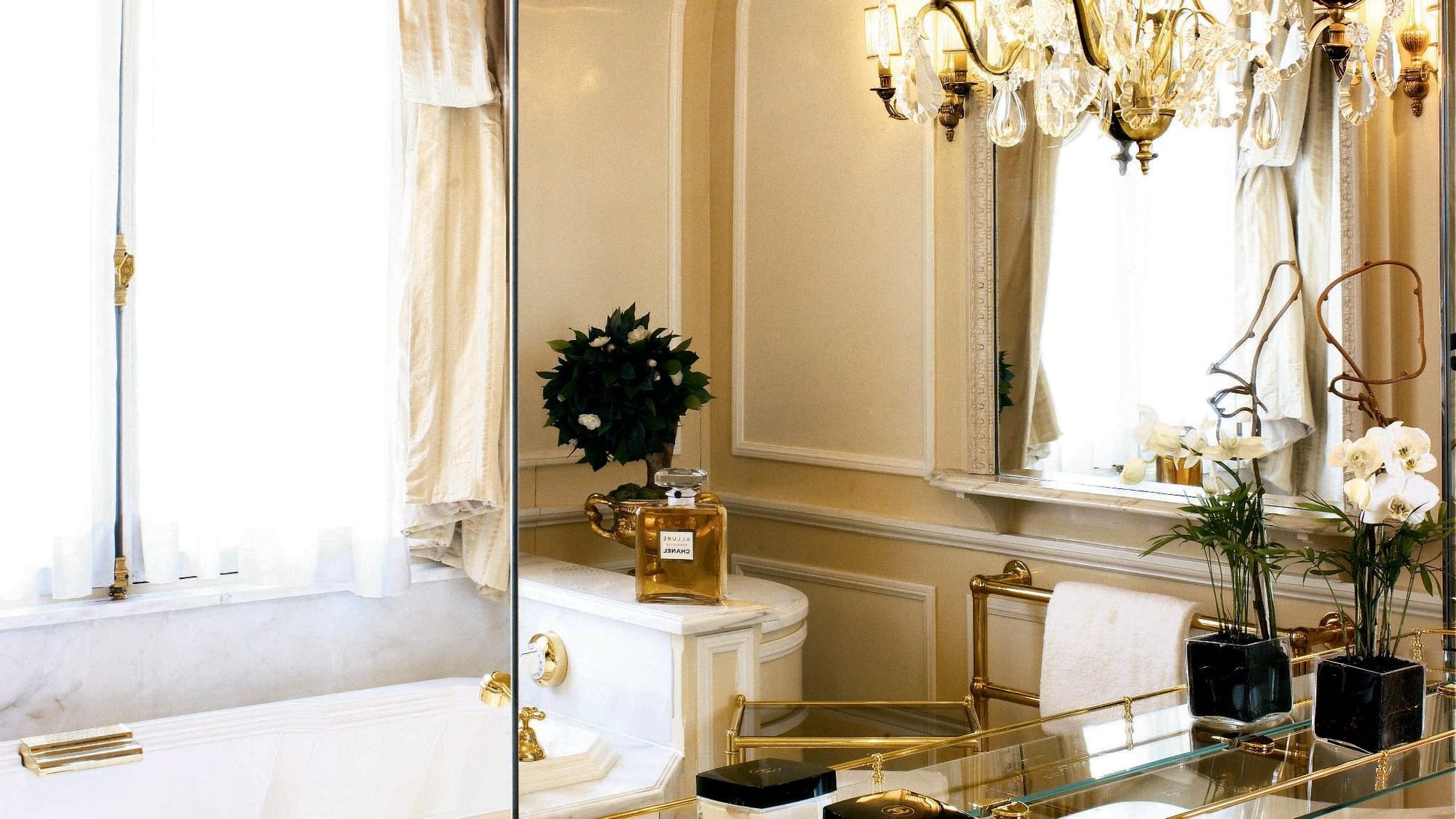
The Suite’s interior is a delightful cocktail of contrasts between Baroque and Belle Époque styles with sharp Modernism in between and the three rooms constitute a total of 155 square meters. A principal black and white marble hallway features interlocked C’s inlaid into the floor that is as modern as both the packaging and the formula of her renowned perfume Chanel No. 5. It was the first perfume to have synthetics in its formula that allowed the scent to wear throughout the day, a feature common to almost all modern perfumes today. Cleanly packaged Chanel beauty products in the Suite’s bathroom stand alongside the Ritz’s classic swan-shaped gold bathroom taps, in a mix of the classic and modern.
The bedroom is warm yet filled with light, featuring ivory damask along the walls that is echoed on the quilted bedding (Chanel handbags seen about town often carry this quilted motif). Two Venetian light fixtures flanking the bed, and dating from the 17th century, are of silvered bronze. They mix the most opulent styles of the French and Italian traditions, and are further offset by the gilded baroque headboard in between. The Oriental lacquered bedside tables add a perfectly well toned weight and sophistication.
Leading out from the bedroom is the smaller of two salons that bears a headier, almost masculine, side to the style of “Mademoiselle” (she refused to be called “Madame”, which for her conveyed pride in not having relied on a man for her success). Bourgogne satin lines the walls, on top of which is a large black lacquered Coromandel screen, whose dark tones are opposed by the richly syncopated floral sofa upholstery and rug, and the crème-coloured nubuck armchair.
Continuing onward to the main salon, this is where light is perfectly mastered and sophistication and femininity achieve harmony. The main wall is covered with amber mirrors and is further adorned with a baroque mirror framed by two Roche crystal lighting fixtures – giving the overall illusion of a window ensconced in the wall. Persian rugs contrast the abiding beige tone, while the ample light brown sofa, with Chanel’s signature quilted stitching, marries the contrast. Aside from the Blackamoor figures crouching in corners, another Chanel signature rests in the fireplace – bundled sheaths of wheat, which add a warm dimension to the gold detailing found throughout.
Perhaps the most stunning piece is the Louis XIV gilded and ivory clock above the mantelpiece, in an alliance of baroque style and personal symbolism. Coco Chanel’s zodiac symbol was the lion, and she loved all representations of the fire and sun, elements essential to the sign. Notably, she’s been credited with making sun tanning popular in Europe. When porcelain white beauty was invariably a mark of high birth and privilege, Coco Chanel was photographed at the height of her success stepping off a yacht with tanned skin. This photograph changed attitudes, in which a suntan meant living a life of leisure, an attitude that has endured to this day.
Dotted throughout the Suite are white flowers. Coco Chanel particularly liked the White Camellia flower, which can also be seen throughout many of the couture house’s designs. In the centuries-old classic palace that is Hotel Ritz Paris, a piece of Coco Chanel’s style remains preserved. Historical and affectionate links unite Hôtel Ritz to another Parisian mainstay, la Maison Chanel, and the unassuming Rue Cambon bears these irrevocable links between two Parisian legends.
CONTACT
Hotel Ritz Paris
15, Place Vendome
Paris, France
Tel: +33 1 43 16 30 30