There’s something very organic about smoking a cigar, the way the rolled tobacco leaves unravel as they burn, the feel of bristly layers between your fingers, and how the taste and scent evolve the closer you reach to the end. It’s a sensual affair, a fleeting, romantic moment that you savour for as long as it lasts.
“Every cigar lover has their own ritual,” Stéphane Nazzal tells me, “And it really is a ritual. I once met a man who has smoked five or six cigars a day for the past two decades and he still prefers to bite the tip of the cigar off with his teeth, spit it out, then light it with the kind of torch you’d use for a crème brûlée. It’s incredible to watch.”
We are chatting informally at a rooftop bar in Geneva and when I mention my longstanding passion for cigars; Nazzal isn’t at all surprised. He says that he recently found out that 30 per cent of all cigar smokers are women, an example of the kind of background research Nazzal did for the latest launch by Imperiali, a company he developed in 2013 with his partner, David Pasciuto, who he met in Geneva while working as a corporate manager for the same office. Pasciuto is an Italian born in Geneva, while Nazzal is Palestinian, with a Belgian-Austrian mother, and spent the first 18 years of his life in Jerusalem before moving to Switzerland to study hospitality and finance.
“The family business we both worked for was in charge of putting together the structure of investments for wealthy clients,” says Nazzal, “and sometimes, we would function as concierges do, buying their gifts, cars and planes. One day, one of our clients, who was a foreigner in Switzerland, wanted to purchase a cigar and he asked us to accompany him.”
“I took him to a Davidoff store in Geneva and I asked for the most prestigious cigar they had,” Pasciuto explains, “But our client was looking for a cigar not many people can afford.” In the end, as you probably guessed, since even the most expensive cigar is affordable, the client wasn’t all that impressed by Davidoff. “And if you think about it, the cigar world is limited. In the world of watches, and cars, you have brands like Pagani, with products that cost 2 million USD but it’s not the same with cigars,” Nazzal adds. “Though at the time, we didn’t think much of this particular encounter with our client, it ended up kicking off a huge adventure.”
The adventure began three years ago when Pasciuto and Nazzal decided to strike out on their own. “Things were getting repetitive at work, there was a financial crisis and so we thought we could do something else, create something new. We wanted to become entrepreneurs. The story of that cigar client came up again and initially, our idea was to create the ultimate cigar.”
One thing led to another and they were connected to the Rubaina cigar-making family from Cuba. “This family had taken their seeds with them during the revolution and planted them in the Jalapa valley (northern Nicaragua) and Jamastran valley (southern Honduras), which they say it is the closest in nature to Cuban soil.” The two budding entrepreneurs worked with the Rubainas on producing Grand Cru cigars from these plantations. And in order to find the right blend, they met with the community of cigar connoisseurs in Geneva, mostly via the city’s private clubs, sampling hundreds of combinations in blind tastings. “Our intention was to create a cigar that suits the largest palate, wasn’t too greasy, drags and pulls well,” Nazzal says.
Their quest for the ultimate cigar soon became the springboard for something much bigger, larger than themselves and the two partners took an imaginative leap by building it. In a real feat of technical skill, the Emperador, which would house their cigars, took 17,000 hours of work by a hundred craftsmen using 27 different crafts and 33 microprocessors to produce its more than 3,500 components, of which 2,765 parts were manufactured from scratch.
“We wanted to surpass the limits of what is technically achievable,” Pasciuto said, summing up their corporate mission statement. Their press releases put it in another way: Imperiali is driven by a desire to reinvent everyday objects into monumental works that combine inconceivable levels of mechanics and artistry. To do all this, they amassed some of the Switzerland’s best engineers.
“This country is so small that if you want to work with the best, it isn’t difficult. We contacted lawyers and friends and most of them pointed to the same experts. It took us months to select those who would push their own boundaries and weren’t scared of the unknown,” Nazzal continues. I smile to myself as I remember the Cocteau quote that was engraved on the conference table of their engineering team’s office in Lausanne, “Je ne savais pas que c’est impossible, alors je l’ai fait.” [I didn’t know it was impossible, so I did it.]
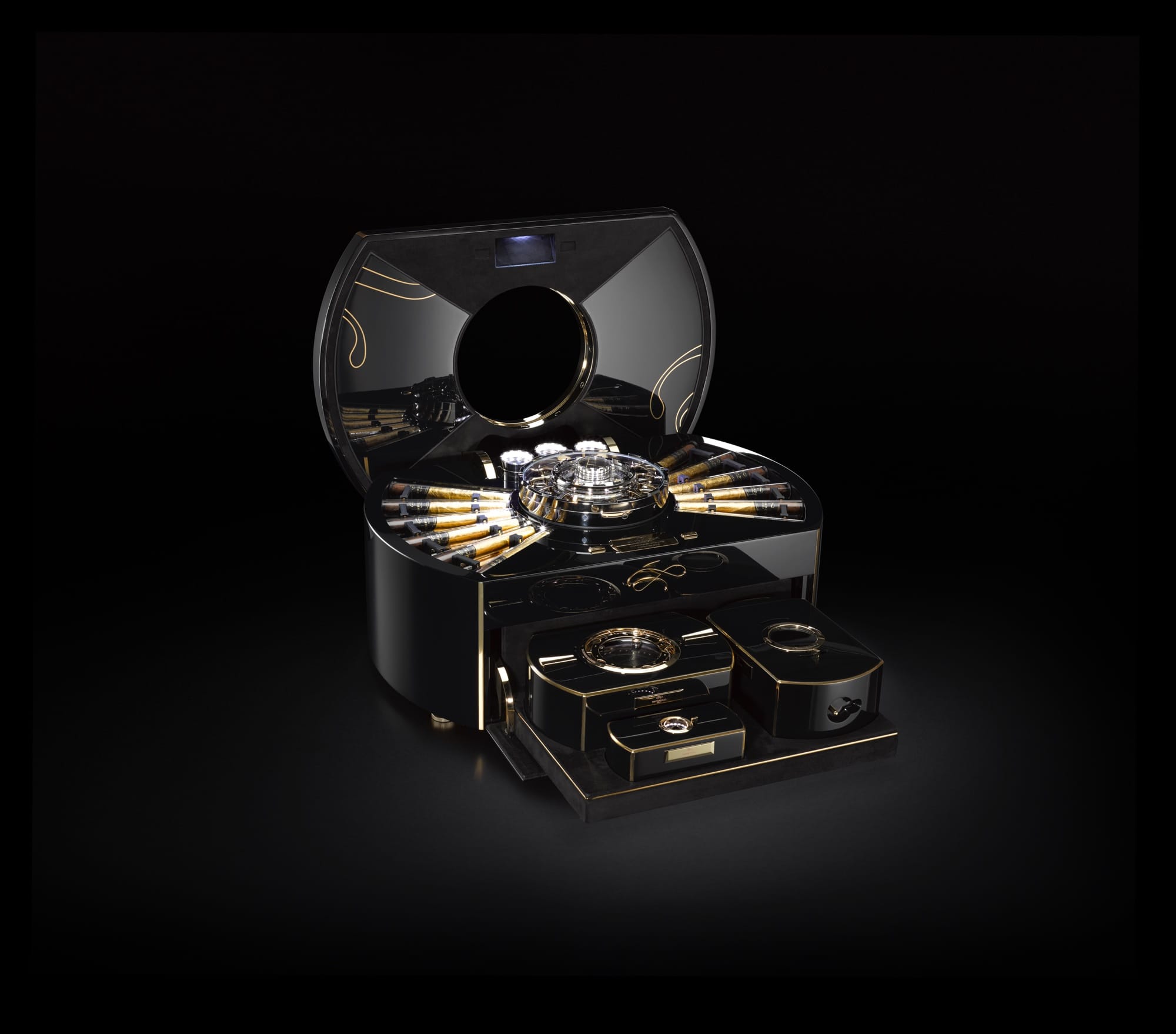
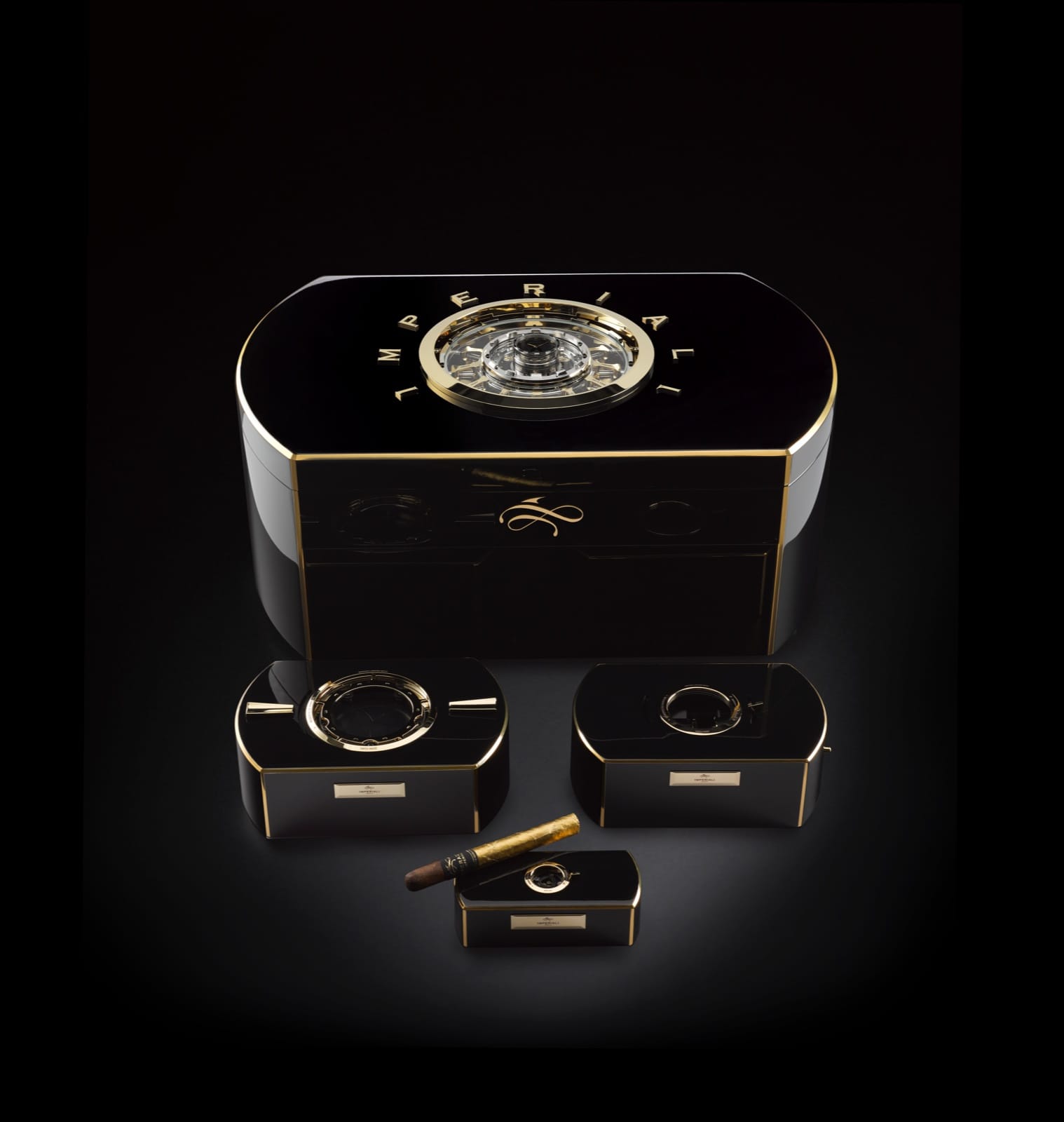
The Emperador is exceptionally complex, and though it could at first be mistaken for a luxury safe, it’s definitely not enough to merely call it a humidor. For one, it looks like something out of a James Bond film – a gleaming, vinyl-like chest weighing almost 40 kg with an imperceptible LCD display that activates the moment you come close to the touch-sensitive gold-plated logo at the top, which itself is arranged around a fabulously large 323-part custom-designed tourbillon. There are three indicators regulating the level of humidity (70 per cent) and temperature inside (between an optimal 16 and 18 degrees Celsius), the power reserve (up to 80 hours) and the number of cigars remaining (out of a total of 24). Enter your secret (programmable) code and the drama continues. The lid opens to reveal the cigars sheathed in gold leaf, positioned radially in glass tubes.
So what does the Emperador actually do? Well, everything. That is, everything associated with the cigar ritual, and some more. It transforms the experience of smoking, cutting, and storing a cigar. As Nazzal puts it, “You’ll only need to hold a cigar in your hands.” If we start with the tourbillon, it has its own self-winding apparatus, meaning that even though it remains immobile most of the time, (unlike a watch on your hand) it winds itself every 24 hours through a groundbreakingly clever electronic system that operates the crown (at 21,600 vibrations an hour) and therefore, doesn’t need to be manually wound, ever. This was done against considerable odds. “We wanted to combine the resources we have in this country – and what we do well here is watchmaking technology,” Nazzal says. “But when we knocked on the doors of watch workshops and said this is what we wanted, they said that we were crazy,” he pauses, smiling. “We are dreamers, but I don’t’ think we’d be here today unless we had a bit of crazy.”
“And I ask you, why not cater to the 1 per cent who want something off the hook? Our concept is to create exceptional products for the few, and work on future patents for the remaining 99 per cent, inventions that can be distributed to the market. Our temperature and humidity regulator, for example, has endless possibilities in terms of applications not only for cigars but the medical, food and beverage industries as well.” In fact, Imperiali has claimed the world’s first self-regulating humidity system that measures the temperature and humidity level of each cigar compartment once a minute. Unlike a regular humidor, it uses thermoelectric cells to cause heat displacement so it’s hot on one side and cold on the other, and so that the humidity needed for cigar preservation is generated by air (and not water), in a closed circuit that doesn’t need any human intervention. To protect the machinery, they’ve even improved on a composite created by NASA in the aerogel that they use for insulation, normally used to protect spacesuits and Mars rovers.
The Emperador also comes with three hidden accessories: a table lighter that has three nozzles for ignition, a filling valve and incorporates detection of the gas level in the reservoir, an ashtray fitted with sensors to allow it to open for the ash when the cigar is near (“so that in windy areas or on a yacht, you don’t need to worry about flying ashes,”) and a cutter, where you have the choice of either a clean guillotine cut or a puncher to perforate holes in different sizes (6, 10 or 14 mm). All you need to do is insert the cigar, touch a button, and a laser beam will position the cut or punch.
Here, I cannot help thinking of the man who would spit out his cigar tips and I wonder aloud if cigar lovers would want all this work to be done for them, instead of lighting up your own cigar, for instance. Nazzal urges me to try one. And I do, watching in awe as the hand-applied gold leaves (four on each cigar) - the same kind used in gastronomy – burn theatrically like gold dust.
Smoking an Emperador cigar is less like strong coffee and more like smooth chocolate. Velvet and earthy, it isn’t too strong or spicy. And there’s the spark produced by the machine, the three flames that combine into one that isn’t too short (so it doesn’t release all of the cigar’s flavours) or too strong (so as not to burn the outside layer and break the oils) – they actually studied how to create the most perfect, even flame. “By creating a product that’s fully automated, we are removing the margin of human error,” Nazzal asserts.
Although this might not be a cigar ritual that’s for everyone, what you lose in the tactile element of the experience, you gain in precision, and a state of perfection, where nothing is left to chance. Before I could properly comprehend that my moment with the cigar was over, I realised that I had just smoked one of the most limited edition cigars from the most expensive box on the planet.
WHAT Emperador
BY Imperiali
PRICE 1 million USD
WHY Limited to 12 units a year, this is for only the most discerning cigar aficionados and aesthetes. Holding two-dozen bespoke cigars that were aged for 4 years, it does everything from telling the time to cleaning up the ashes, itself.