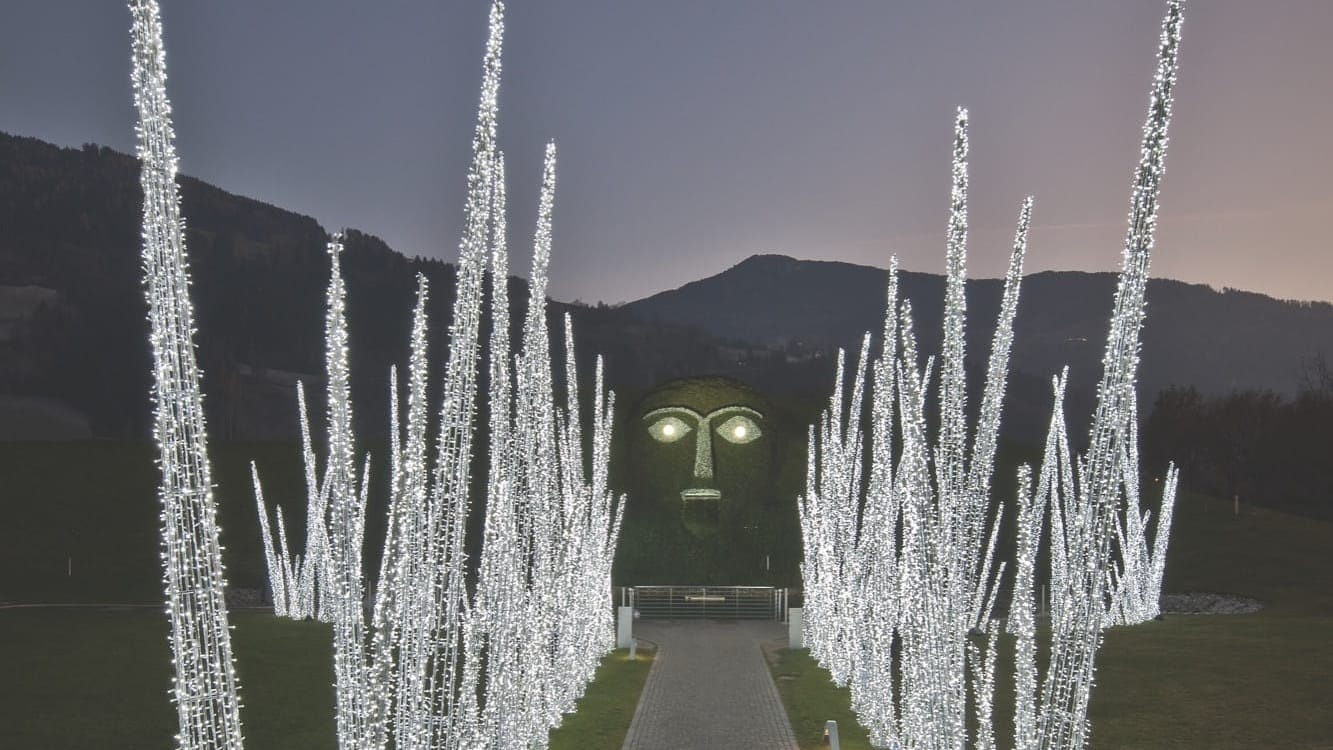
Well, this isn’t what I expected. After an hour-long drive from the chic, historic ski resort of Kitzbühel, I’ve come face to face with a giant. Not only is his visage vast but his eyes are glowing, crystal orbs and, even more peculiarly, he appears to be built into the side of a mountain. Before you attribute this to too much Gluehwein, I’m actually standing before the little-known epicentre of very well-known Austrian crystal crafters, Swarovski Kristallwelten, or, for those of you better versed in English, Swarovski Crystal Worlds.
But don’t let the name mislead you into picturing some sort of glittering Austrian Disney, Crystal Worlds is more art museum than theme park. It’s located in Wattens, the town where founder Daniel Swarovski, a glass-cutter from Bohemia in what is now the Czech Republic, set up shop in the late 19th century. The ‘Worlds’ is home to 14 Chambers of Wonder, which are decked out with pieces by high-profile international artists and designers, whose sole brief was to create their own fantasy worlds, incorporating Swarovski crystals, of course.
Ranging from subtle to showy and overseen by André Heller – the Austrian multimedia artist, not the Brazilian footballer – the Worlds were conceived, as Heller explains, as “a place where crystal would merge with art to unleash powerful creativity” and “a little magic”. Heller is, apparently, a man who dreamed of “giants everywhere” and who created the aforementioned one, through whose head all visitors must walk, in order to enter the museum. Apparently, it’s designed to make visitors feel welcome.
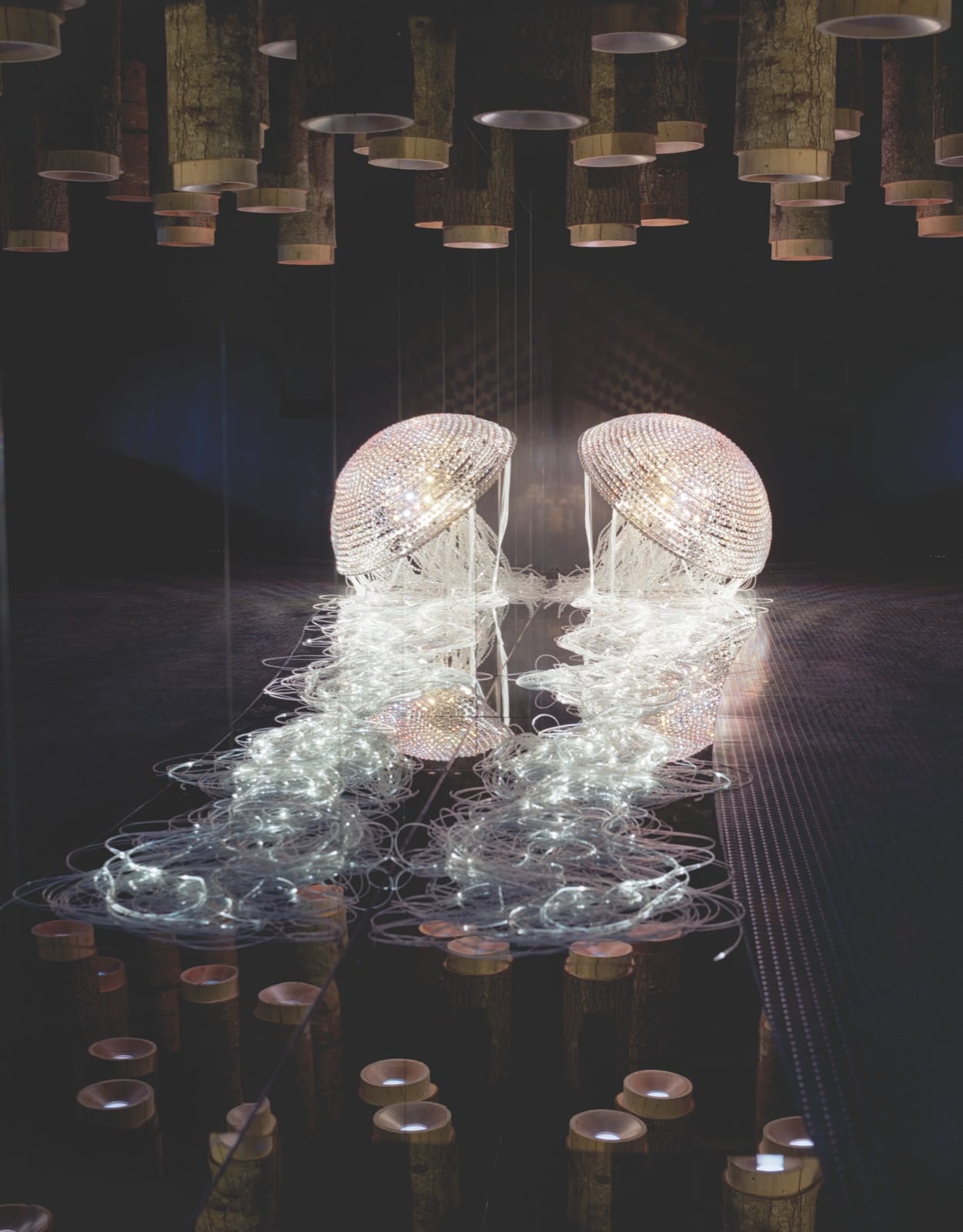
It’s also only the first of many more surprises inside. The high-ceilinged entrance hall – the inside the giant’s head – is adorned with crystal-centric works by Dali and Warhol, as well as the Centenar. This is the world’s largest cut crystal and weighing a whopping 310,000 carats, it would take a weight-lifting champion to wear. At the room’s centre is the Mediterraneo, a chandelier inspired by a jellyfish, which shimmers with every colour imaginable.
But this is only the beginning. Wandering through the rooms like a dazed and confused sleepwalker, I am met by all sorts of oddities. There are dancing mannequin body parts, creations of British artist and inventor John Whiting for his Mechanical Theatre room. Next, I’m inside what looks like a giant crystal, the Crystal Dome with its 595 mirrors. Popular as a setting for more alternative weddings, it was once host to a performance by Jessye Norman, whose distinctive soprano apparently reverberated off the cocoon-like space in strangely bouncy cadences. Over in The Wonder of Colour room, Naturopath, philosopher and Colourpuncturist, Peter Mandel, introduces his theory of immersive kaleidoscopic light therapy. Visitors are encouraged to lie back and watch the alternating colours, which are programmed to induce a state of complete relaxation. In Tord Boontje and the late Alexander McQueen’s room though, things take on a frostier feel, with a Christmas tree-like sculpture that looks as if it’s made from frosted white icicles. Other rooms contain surreal theatre props -including the giant’s gloves and his enormous ring - Russian video installations that feature naked backsides, as well as a mesmerising moving art installation by Brian Eno, master of ambient music, which complement the vibe of each room.

I exit, shaken and a little stirred, into a dazzling gift shop jammed with Swarovski-covered everything, from delightfully grotesque prowling tiger ornaments and crystal-covered bras to more subtle, velvety-black sexy drop earrings. To one side, there’s a snug VIP room with (apparently) free-pouring champagne.
While the items on offer here are typically and blingily Swarovski, my own impression of the brand has done a bit of a u-turn. I now think of it as having far more depth and eccentricity - soul, even. It’s obvious from the museum displays that the artists and designers involved were given free creative reign and the sheer ‘out there’ factor of many of the displays indicates a boldness at the heart of Swarovski. From Mr. Swarovski’s invention of an extremely precise crystal-cutting machine in 1892 to the company’s first watch collection in 2009, by way of crystal ribbons (1931), chandeliers (1965), jewellery (1977) and a new entertainment division (2008), which released its first production, a new film version of Romeo and Juliet in December last year, it seems Swarovski’s sparkle is growing brighter by the year.