It’s no secret that the worlds of Fashion and Architecture have long been used to express our ideas of the personal, the social and the cultural. However, recent years have seen a move beyond simple significations of value, status and belonging to more complex issues surrounding the notions of identity instead.
Through the increasing sophistication of computer-aided design, ever more complex surfaces and unusual forms now travel from drawing board to reality. This can be seen prominently in the work of many modern architects as well as in that of Japanese fashion designers like Comme des Garçons, Yohji Yamamoto and Issey Miyake, who have encouraged a more radical approach to fashion, influencing a new generation of designers to develop new forms, strategies and aesthetics.
A follower of this mindset is Dina Jisr, a Lebanese fashion designer based in Beirut. Growing up in Saudi Arabia until the age of 17, Dina moved to London to attend the Central Saint Martin’s programme in jewellery design followed by a stint at the Gemology Institute of America. Tracking through the ever-thinning boundaries of design, she moved back to Beirut to work for her father’s architecture and interior design company, which then lead her to evening classes at ESMOD in fashion design and pattern making.
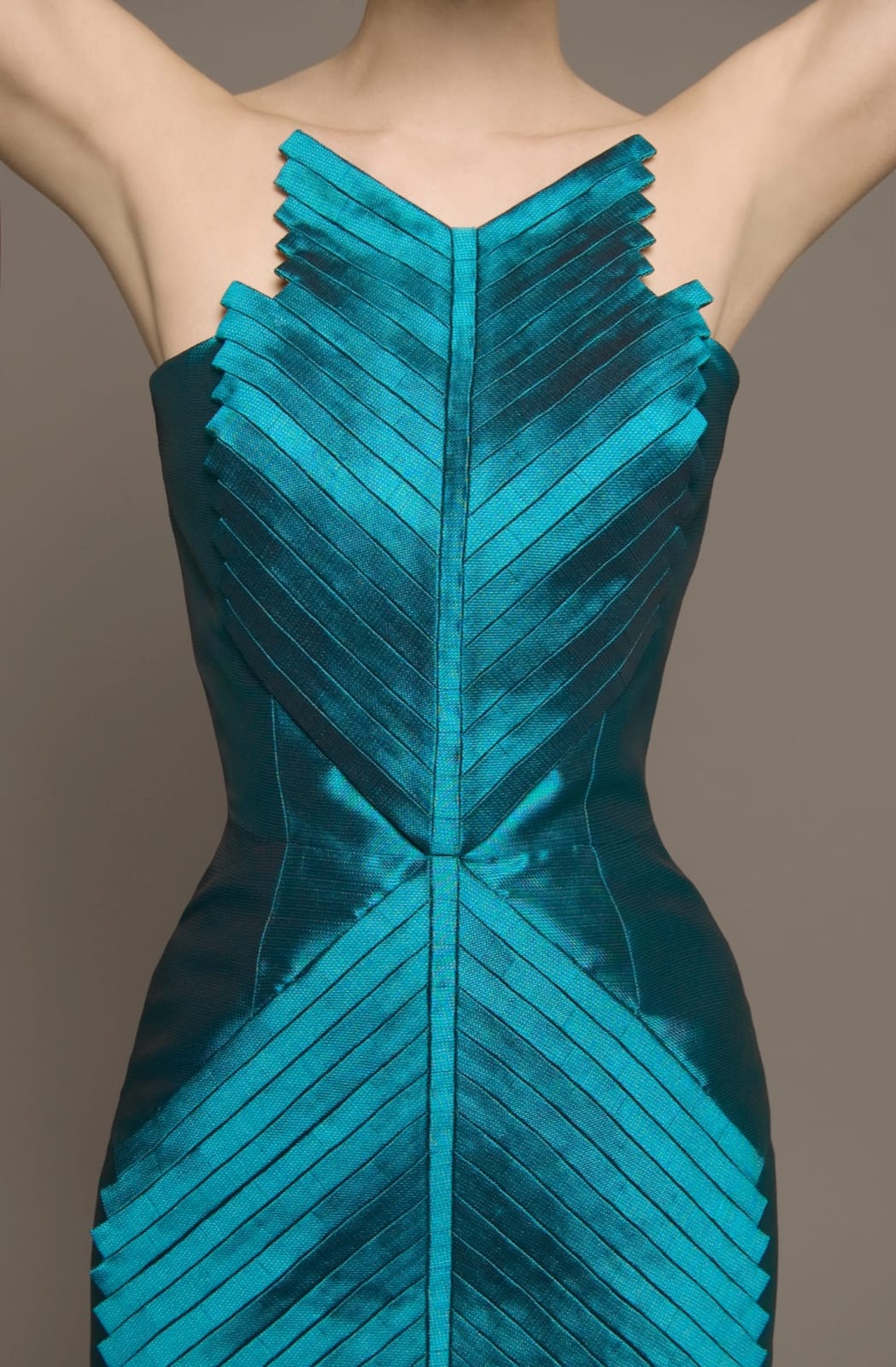
Three collections later and one in the making, Jisr’s designs are an avid homage to her admiration of architecture. Its influence is intricately fused into collections through plays on the rigidity and fluidity of fabrics, manipulated volumes, geometric cuts and structural lines. Her jewellery-making background is also apparent in her attention to detail, love of sculptural forms and the symbolic placement of certain elements throughout a garment.
I sat down with Jisr in her Saifi Village studio to learn more about the development process her collections – marketed under the Dina JSR label - undergo and how she bridges the gap between the urban gaze and the tip of a needle.
Dina’s office is filled with images of the swooping lines of modern buildings, detail shots of antique oriental doors and windows, colour combinations of ancient monuments and a few hints of her love for a good 1950s silhouette. “One important thing,” she tells me, “is to never let go of the elegance.”
The different cityscapes and lifestyles Jisr experienced in Europe and the Middle East have shaped not only her style but the kinds of clients to whom she appeals. “I think every city you live in helps you understand a culture in terms of what they like, what styles they have adopted, even their preferred colours and fabrics. For example, in Europe, they like cocktail dresses whereas the Middle East prefers long, colourful dresses.”
In the same way that architects have been questioning the traditional ‘bricks and mortar’ approach by using new materials and methods to create more versatile and adaptable structures, Jisr has reassessed her collections to address the needs of a modern, urban woman by using techniques and fabrics that adorn while maintaining mobility and identity. “The Dina JSR client represents all kinds of women today. Mainly, I’m inspired by the dynamic of my mother and sister. The women in my family all have different styles and occupations, but we still represent the Dina JSR woman.”
Generating form through geometry is a strategy shared by both architects and fashion designers. Dina’s designs convolute in twisting and continuous forms of circles, squares and ellipses with hints of more complex shapes like the torus and Möbius strip, to create complex interior spaces that shape the overall design. “It's the geometric patterns, the structures, the lines,” she reveals. ”To be honest, I’m not really sure why each collection’s research has naturally lead me back to architecture, but I have a feeling it will continue to be what represents the Dina JSR line in the future.”
The deeper we delved into the chronology of a Dina JSR collection, the clearer her architectural references became. Seeing that both fashion and architecture deal with creating space and volume out of flat, two-dimensional materials, each discipline has developed several shared techniques, providing texture, form and volume in intriguing ways where structure and façade join under a single surface.
For example, architects are looking to dressmaking techniques like pleating and draping to create more fluid and complex forms out of hard materials, while fashion designers, including Jisr, are employing engineering methods like cantilevering and suspension to create elaborate and often architectonic garments.
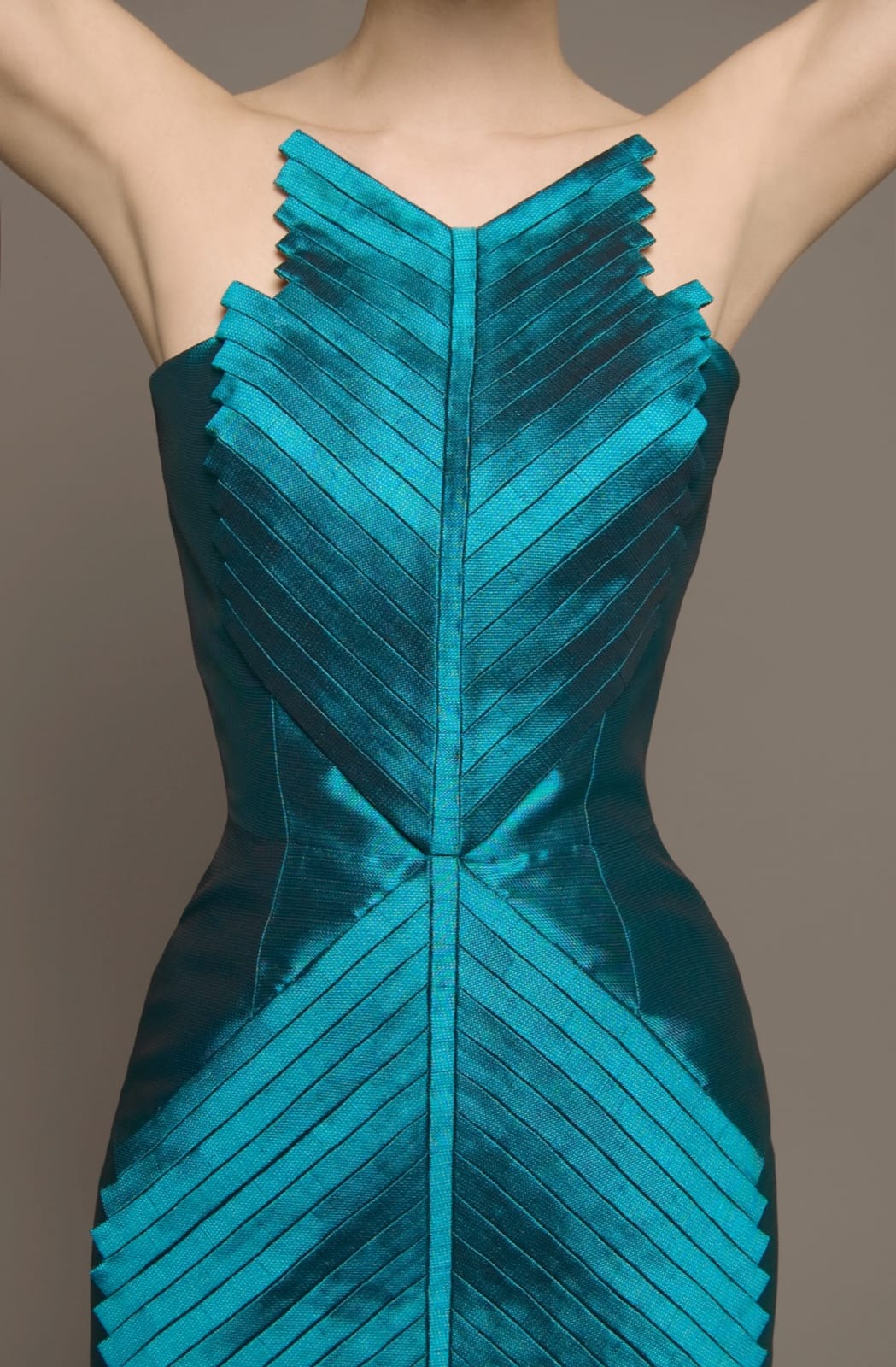
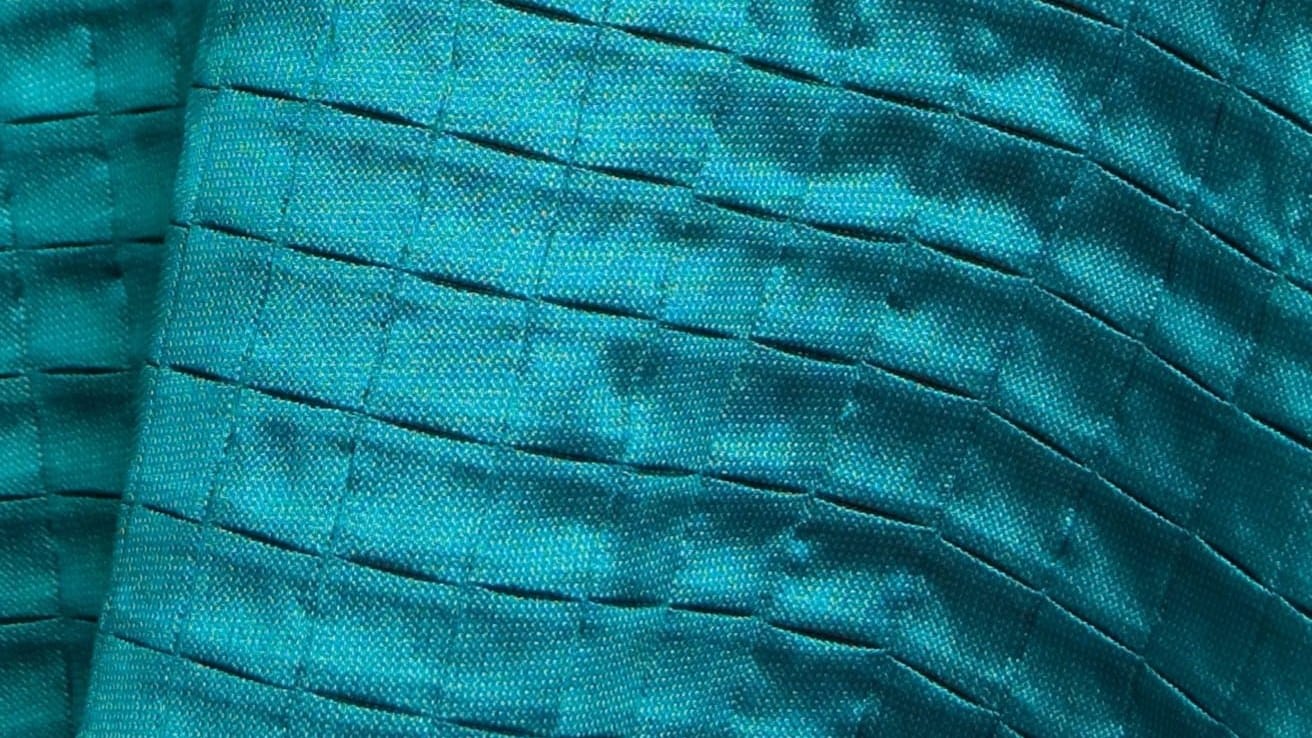
While Jisr’s designs hew to the traditional dressmaker’s technique of pleating to create unusual surfaces and amplify volume, she also uses stiff fabrics like silk gazaar and gabardine wool, which mimic architecture when manipulated into gentle curtain-like folds. Pushing ideas of how clothing can wrap the contours of the body, Dina’s designs explore distortion, challenging the prevailing female silhouette and creating a drape that is almost stiff in still sculptural form.
Since at least the early 1990s, architects have used ‘folding’ as a device to create dramatic effects of light and shadow on a building’s exterior and to manipulate the volumetric forms of the interior. Similarly, Dina uses folds in increasingly complex ways to give both structure and form to the construction of her garments. In addition, as architecture has adopted weaving to connect spatial volumes of buildings, she responds by using weaves in architectonic lacing, knitting and plaiting.
Particularly in the qualities of pattern and texture, some architects have chosen to wrap buildings in exuberant printed motifs to lend a narrative element to the structure, reflecting its identity or the context of its use in some way. The bolder prints in Jisr’s last collection similarly draw from architecture’s grammar of ornament and language. “I’m trying to do something new with each collection that slowly adds up to the upcoming ones,” she says. “ I’ll be adding more prints next season, which will slowly and subtly start defining my line.”
Since the blurring of boundaries between fashion and architecture, hybrid practices have developed that synthesize aspects of both disciplines. Dina JSR proves that the body is a perfect small-scale exercise in spatial design, a testing ground for ideas and techniques. She shows that we are all makers, operating on the same terrain and drawing on craft and technology.
“The way I see it, it’s going to be amazing” she smiles. “Technology is offering us an outpouring of opportunities and techniques that will help us stay curious and creative, which is what I think life is about, ultimately.”
WHO Dina Jisr
LABEL Dina JSR
SINCE Her first collection was for S/S 2012
WHY Designed in the Middle East but made in France, Dina JSR may only have three seasons under its belt but it has a very promising future ahead of it.