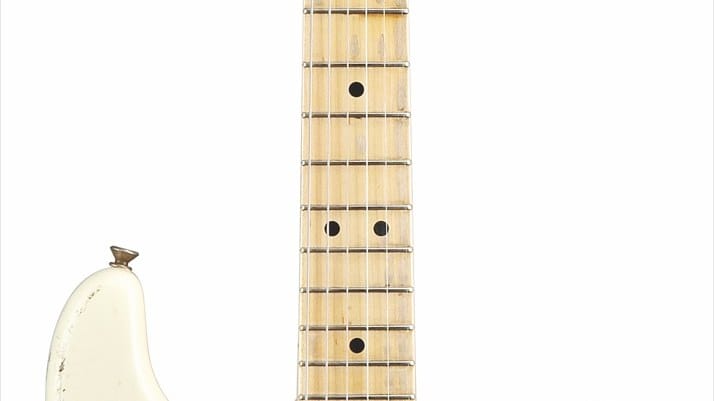
Vintage guitar repairer Georges Melhem was less than polite when a friend asked him to replace parts of an old electric number he had unearthed from his father’s attic and started practising on. “I said ‘get out of here, and take your guitar with you. You don’t appreciate what you have’,” says Melhem in his luthiers workshop north of Beirut. The salvaged treasure was a 1965 Fender Stratocaster, a premium vintage guitar, worth 18,000 USD. Had the owner not mutilated the instrument with a paint-job at a local car garage, it could have fetched 40,000 USD to 50,000 USD.
Rule number one? Never, ever change anything on a vintage guitar. Even the screws, dents and scratches should be authentic, says Melhem. If the words 'vintage guitar' conjure up images of Flamenco-style Spanish acoustic numbers, you’d be wrong, or at least straying into the world of antiques.
A vintage guitar is usually electric and dates from the early phase of the modern guitar age, starting from the 1920s to the late1970s, which ushered in the production line. Only the earliest part of that bracket is non-electric. “Not all old guitars are vintage, and not all vintage guitars are valuable,” says Melhem. Only certain models from the prime periods of pioneers such as Fender or Gibson are recognised – and priced – as classics.
Melhem’s own guitar expertise is more instinctive than taught. Aged nine, he swapped his catapult for a broken child’s guitar, took it home to fix, then built another out of a dismantled wardrobe. He went on to study music, electronics and everything related to electrical guitars, and set up his own business.
Guitar-type instruments have charmed lovers and entertained kings and caliphs for more than 5,000 years in the Near East and India. Ancient Persian statues have been found holding instruments resembling the sitar, the guitar’s ancestor. The Arabs took an early guitar to Spain with them, and it spread and developed in Europe over the centuries.
A Spaniard, Antionio de Torres, built the first classically shaped guitar, with gut strings, in around 1850, and gypsies in Spain developed it with the invention of flamenco music. But it was a German immigrant to the United States, Christian Martin, who in 1920 built the first flat-topped (as opposed to bowed like a mandolin) steel-stringed modern guitar that we know, more or less, today. Early Martin guitars are rare and fetch in the thousands of dollars, according to Melhem.
With jazz and big band music creating an ever-louder sound, the humble stringed instrument was struggling to compete, prompting a number of inventors to experiment with electrics. In 1936, the first commercially viable, working electric guitar, the 'frying pan' was built by George Beauchamp and Adolph Rickenbacker. But the landmark that launched a million riffs was the 1948 'Broadcaster' by guitar legend Leo Fender. “It was a real guitar sound,” says Melhem. “It was versatile and created a mood.” If one turns up in your attic it may be worth 60,000 USD to 70,000 USD. The instrument was renamed the 'Telecaster', three months later, in homage to a new-fangled invention, the television. The 'Stratocaster' was to follow in 1954. The 'Tele' and 'Strat' remain the two most popular vintage Fender guitar shapes, says Melhem. Their sound is “thin, Hawaiian” and suited to Blues.
Fender also set the stage for the electric guitar’s iconic status by making them look cool, and quite unlike cooking implements. Drawing on popular culture, Fender started customising his guitars with the same paints as the Chevys and Cadillacs of the 1950s and 1960s. Fender’s early guitars (they still make them) were high-quality and carved in a solid body out of matured maple, mahogany or ash.
From the early 1950s, the Gibson company posed major competition with their classic 'Les Paul' guitar, early models of which can now fetch 250,000 USD. The above makes are the most legendary, and the place to start your collection. Rickenbacker, Hofman and Gretsch are among other cult vintage classics.
Because many new guitars are mass-produced in Japan or Korea, the hand-made, high-quality American models are the ones to go for. Good condition is paramount, but scratches and dents on a lovingly played guitar are part of the value and should be left untouched, just as parts should be authentic. Owners of modern guitars pay good money, 6,000 USD to 8,000 USD to be precise, to get the vintage look, as Melhem illustrates, holding up a guitar to which he is adding "relics" with such technical paraphernalia as screws and a hammer.
Most of Melhem's vintage guitar repair-work – he also builds and repairs new ones – comes from customers in the United States and United Kingdom, the hubs of the market. Few collectors of vintage guitars exist in the region. Melhem knows of only 11 in Lebanon and believes there to be a few in the Gulf. "It’s all down to a lack of awareness," he says ruefully. “People just don’t know about vintage guitars. And most people would rather buy a car.”
Contact
Georges Melhem
Beirut, Lebanon
Tel +961 3 459 629
HYPERLINK "mailto:georgesmelhem@hotmail.com" georgesmelhem@hotmail.com