The Kiwi cartoonist Malcolm Evans once drew a poignant and compelling illustration of a two women walking past each other. One was wearing just a bikini and sunglasses and the other an abaya and a niqab. “Everything covered but her eyes! What a cruel male-dominated culture,” thinks the bikini girl. “Nothing covered but her eyes! What a cruel male-dominated culture,” thinks the covered girl.
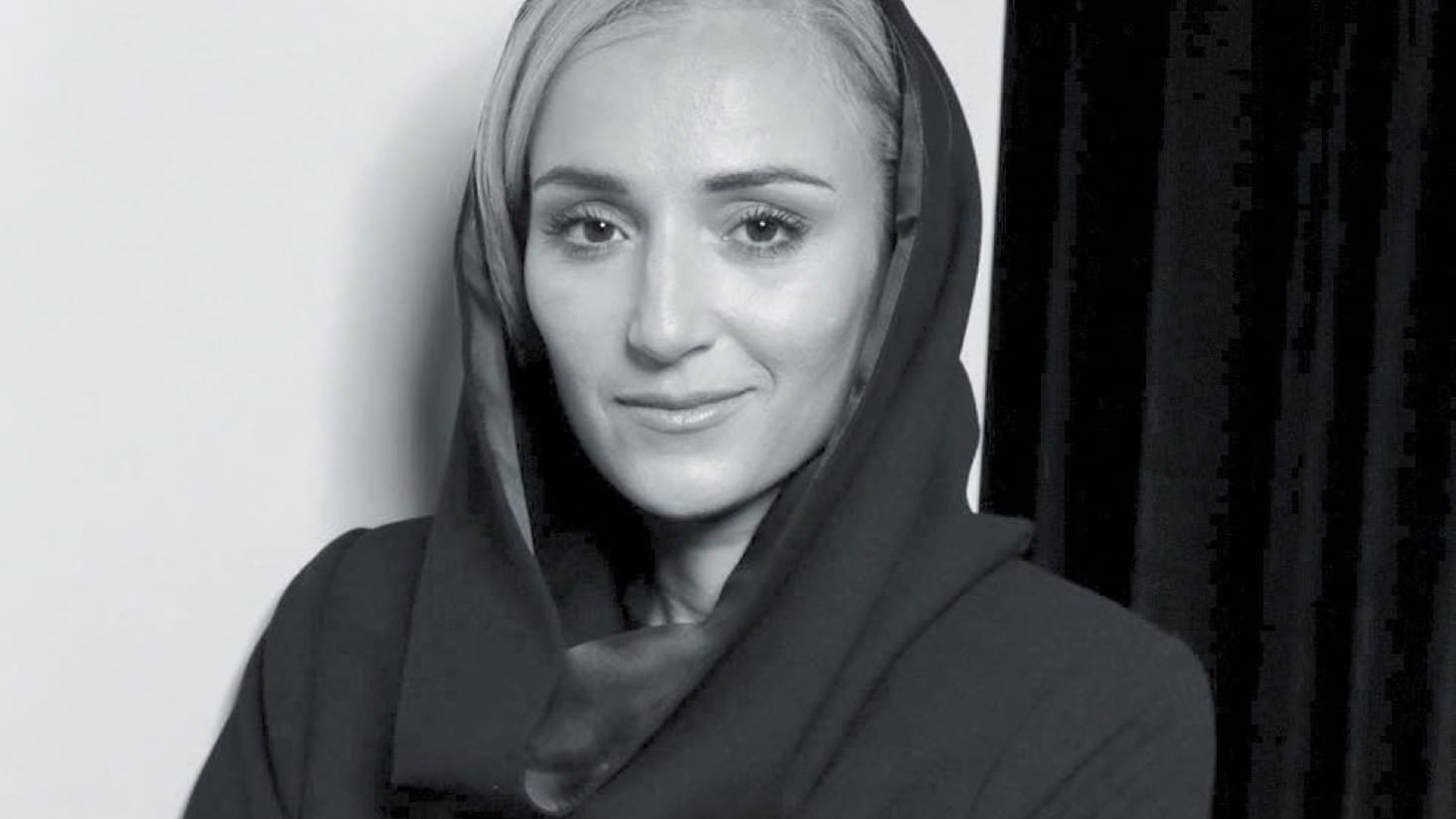
Humorous as it was, the cartoon perfectly encapsulates how two diametrically opposed perspectives could have been one and the same – it all depends on which lens you are looking through. Faiza Bouguessa, a self-taught fashion designer and founder of Bouguessa, a brand whose clothes are as cool as they are culturally appropriate, thinks the abaya has expanded beyond its religious context to become an elegant and stylish symbol. “There’s a huge number of young Muslim women across the world with a strong sense of style, and their fashion demands will of course have a huge effect on what retailers offer their customers,” she says, fresh from showcasing her latest collection at Paris Fashion Week.
Bouguessa herself recently saw evidence of such change while on the same trip in her native France, when she received a visit by Claire Distenfeld, founder of the carefully curated New York concept store Fivestory. “It would be a huge step for me to sell at her store,” she admits, before describing the meeting as the highlight of her fashion week. It certainly would be but it doesn’t need a leap of the imagination to picture her label’s spring/summer 2016 crisp white jumpsuit or perhaps the floor length trench in pink crepe, hanging next to Mary Katrantzou print dresses or a pair of Aquazzura heels inside Manhattan’s answer to Colette. But whatever happens, Distenfeld’s interest certainly confirms one thing: the Bouguessa brand’s fundamentals may be specific but its fashion appeal is universal.
It was as a schoolgirl in the southeast of France that Bouguessa, now 33, realised where her passion lay. “I was about 12,” she says. “One of my classmates told me that she wanted to be a designer and explained all that it entailed. I instantly realised that this what I wanted to do too.” Already able to sew and knit thanks to lessons gleaned from her grandmother, she pored over the stacks of fashion magazines that her mother would buy for her, absorbing everything she could. “I used to go through them over and over again. I suppose she must have sensed a strong interest in me. I was always very sensitive to the arts as a child,” Bouguessa says, adding that her upbringing in France (in the birthplace of the country’s luxury shoe industry in Romans-sur-Isère) also helped to shape her creatively. “Fashion is an important part of the culture in France,” she says. “Fashion weeks are always covered closely by media, and all sorts of documentaries about designers and fashion shows tend to be shown on television during this time.”
The young Bouguessa drank it all in and in 2014, she marched forth by launching her eponymous brand with its contemporary reinterpretation of the abaya, in her adopted home of Dubai. When viewed alongside the flowing black robes and teetering heels typically associated with women from the Emirates, the looks of Bouguessa – all clean lines and unexpected draping in crisp white, neutral taupes and icy pale pinks – are like a blast of cool air on a warm day. When black does creep in, it’s in the shape of a wide band on the bottom of a pair of beige linen trousers, or on a voluminous dress edged with white and styled with a pair of mannish brogues. Bouguessa is an edgy fashion forward label, despite its apparent modesty.
Yet Bouguessa has no desire to set her aesthetic apart – quite the opposite (she already counts members of UAE and Saudi royalty among her clients.) She is keen to emphasise how inspired she was by Emirati women when she first moved to Dubai. “The traditional abaya has always intrigued me,” she says. “I find women wearing it look very enigmatic, very feminine in the way they walk and carry themselves. I was surprised to see how a fully black, all-covering outfit can actually look so elegant and chic. The only thing was that I felt the selection of clothing was very limited to a single style, even if the emergence of coloured abayas was bringing in some sort of innovative element. The problem was there was nothing that resonated with my own style and I realised there had to be other women who felt this way.”
All of Bouguessa’s pieces are made in her Dubai atelier by a team of French-trained tailors. The young designer reveals that a collection can take up to two months to make and the inspiration process can take even longer. “Abstract art and modern architecture are two major sources of inspiration for me and most of the time, this inspiration will translate into some sort of a vision. Sometimes, I see a very clear garment in these visions, sometimes it is just a detail and I start sketching from there. But once I’m done, I like to close my sketchbook for a day or two and then go back and decide if I’m still happy with a design,” she says. If it passes muster, she starts researching fabrics, using samples picked up at the renowned Première Vision fabric fair in Paris, then gets to work on the toile. “I like fabrics that are suitable for the hot weather in Dubai, like triacetate, acetate, viscose and Cupro, as well as natural fabrics like high quality cottons, linen and silk.”
“Functional aesthetics” seems to be a recurring theme for Bouguessa whose collections aim for comfort as much as beauty. “Our pieces are beautifully made inside and out. What is very important to me is to create a durable and high-quality garment. Only using the best craftsmanship can achieve such a result but we are continuously learning and trying to improve our technique.” She’s even growing her team apparently, so as to ramp up production but she has no plans to expand beyond modestwear. “I’d be lost,” she says. “There are more than enough brands that offer ready-to-wear. I would like to respect my concept and continue to offer something that is new and different.”
Thus far, she is more than fulfilling the goal she has set for herself. In infusing one of the most traditional garments there is, the abaya, with the inspiration she draws from contemporary culture, Faiza Bouguessa has managed to create a brand with a clearly defined identity and aesthetic, despite still being in its infancy.