In a world that’s awash with oil, with a record of nearly three billion barrels of crude in storage around the globe, having another rig ready to bring another production well online isn’t a welcomed sight. Yet in southern Azadegan, which is this region’s biggest field of five, drilling is nearly complete.
After years of sanctions, it’s evidently a struggle, as can be seen from the patchwork of old and rusty equipment. And we were the first foreign television crew allowed into Iran’s largest oil find in the last three decades. One cannot overlook this extraordinary turn of fate as we toured the marshlands in a convoy of vans and SUVs, considering that this corner of Iran was once a battleground in the eight-year war with Iraq.
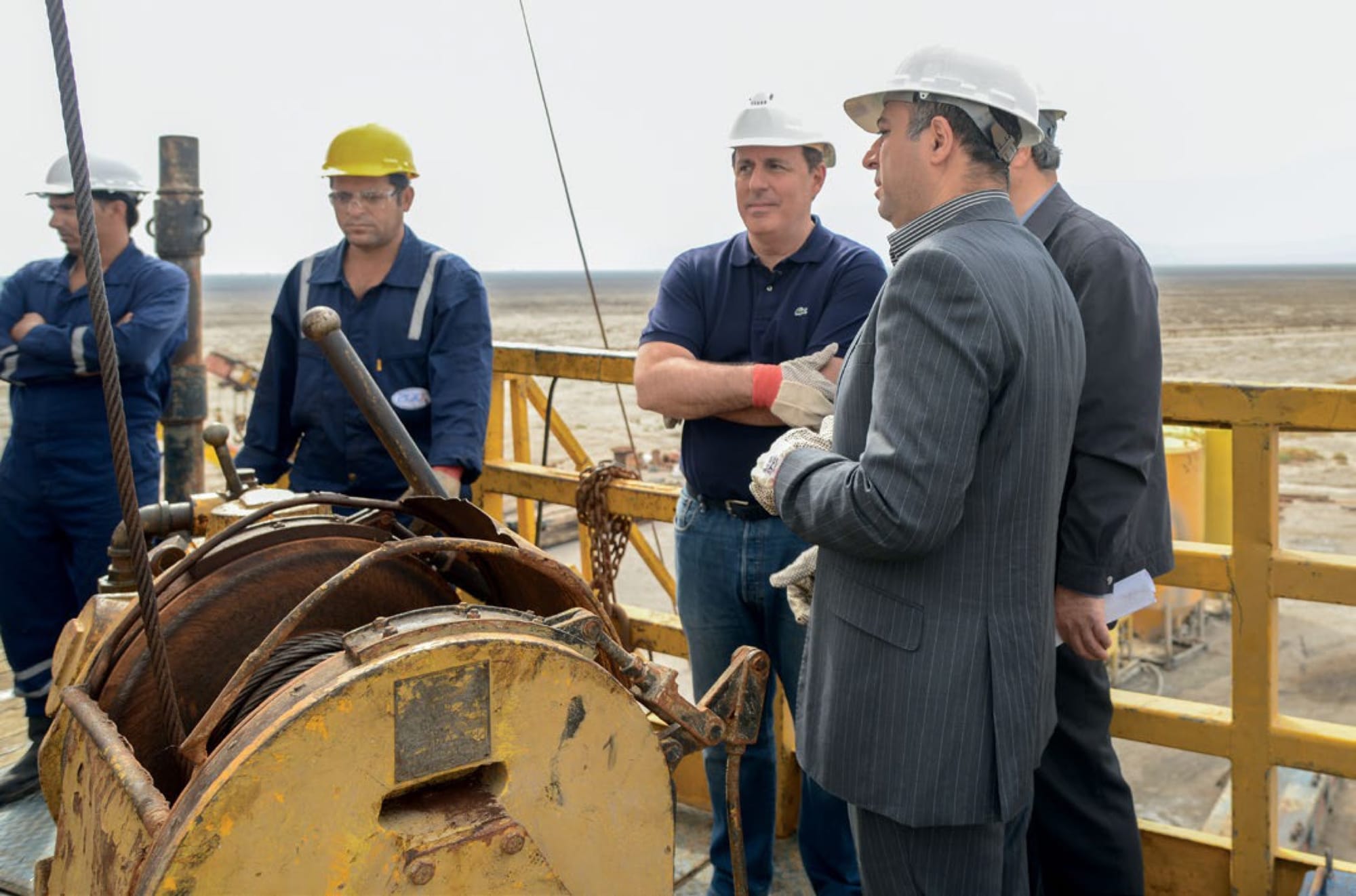
It is fascinating to witness first-hand how Iran has had to survive. On the platform where we were with a production team, the National Iran Oil Company is using a Chinese-built rig but it is actually American technology at the core, purchased before the sanctions took hold.
I toured the facility with Mahmood Marashi, an American educated project manager, who cannot wait for the day the shackles of Western-led sanctions are removed so that Iran can re-enter the global market. “We hope that after the sanctions are lifted we can move faster,” said Marashi, “Of course the quality is very important,” making reference to the tools he is forced to use now. A kilometre down the road, a new oil handling facility is going up but with pillion drivers that clearly hail from another era, as black smoke billows from the old machinery.
Crews are working like there’s no tomorrow, hoping to quadruple production in the West Quroon region to a hefty 700 thousand barrels a day in 2020 from just 160 thousand barrels currently. Project managers tell me that the oil ministry officials are asking for progress reports every two weeks to ensure strict timelines are met.
Perhaps this isn’t so surprising when you take into consideration that at 60 billion barrels of proven reserves, West Quroon alone has more oil than Africa’s largest producer, Nigeria. Abdolreza Hosseinnejad, Managing Director of the National Iranian Oil Company described it as “massive” but admitted that, “we have to work hard in order for it become a reality,” adding, “we are used to hard conditions, I hope that after sanctions life will be much easier.”
At 157 billion barrels, West Quroon makes up more than a third of Iran’s proven reserves and is at the centre of Iran’s ambitious agenda for the next year. Petroleum Minister Bijan Zangeneh has already formally presented his plan to the OPEC Secretariat in Vienna on December 4 but it was on the 15th floor of his ministry in central Tehran that he laid out his game plan.
Once given the green light, he will add half a million barrels a day immediately, plus another half-million by the start of Iran’s fiscal year in March, with a firm goal to add yet another half-million barrels by the end of 2016. This would mean Iran’s daily output would be back up to 4.3 million barrels a day, matching a pre-sanctions high back in 2008, thereby challenging its neighbour Iraq for the second position within OPEC. Iran would rank in the top five producers in the world but well behind the big three: Saudi Arabia, Russia and the United States, which each continue to pump out between 9 and 10 and a half million barrels daily.
“We are one of the oldest producers in the world, and the oldest producer in the Middle East. Can we lose our share in the market? It is not fair,” the minister declared alluding to domestic pressures to deliver. Two floors down, Amir Zamaninia, Deputy Minister of Petroleum for International Affairs, pointed to a map in his office with large green circles for oil fields and even larger red ones indicating gas finds. “All of these need to be developed. We need more than a few major companies to partner with to develop these fields,” said Zamaninia, “What we need is capital, technology and to some degree, project management.”
That ability to attract the International Oil Companies or IOCs will all depend on how generous the terms will be when Iran rolls out 50 oil, gas and petrochemical projects worth 185 billion USD starting in 2016 – I am told contracts can extend up to a 25 years with favourable production sharing rights.
Iran’s re-emergence will clearly tip the balance within OPEC, and what some call an overly ambitious plan may force Saudi Arabia to make way for its regional arch-rival. “If the Saudis decide to change tact, all they have to do is to take 1 to 1.5 million barrels a day from the market and the balance will come back, said Fereidun Fesharaki, Chairman of the global consultancy FACTS Global Energy. He insisted that the Iranians will not try to flood the market, but wants to prove to the world that it can build up capacity to nearly six million barrels a day by 2020.
Back in the fields, the team of engineers and project managers illustrate the steep hill they need to climb in terms of development over the next four years. Phase One in West Quroon sees 348 wells in production, which will double by 2020, but clearly not without the help of U.S. and European oil giants.