Leaning into the microphone, Jed Levy puffed his cheeks out, blew hard on his sax and, to a smattering of quick applause, launched into a blistering solo that had every ear in the house fixed front stage.
Rocking back on his heels as he came up for air a minute or so later, looking like he’d just been released from the grip of something powerful, Levy took a quick bow. Beaming like a Cheshire cat, he hopped back into the band and without missing a beat, the Alvester Garnett Quintet resumed its full, Jazzy flow.
The audience, knowledgeable fans judging by the way they clapped and whooped at exactly the right moments from the banquettes around the small, velvet-curtained stage, settled back, nodding heads, snapping fingers, for all the world behaving like extras in some Fifties flick about Beatniks.
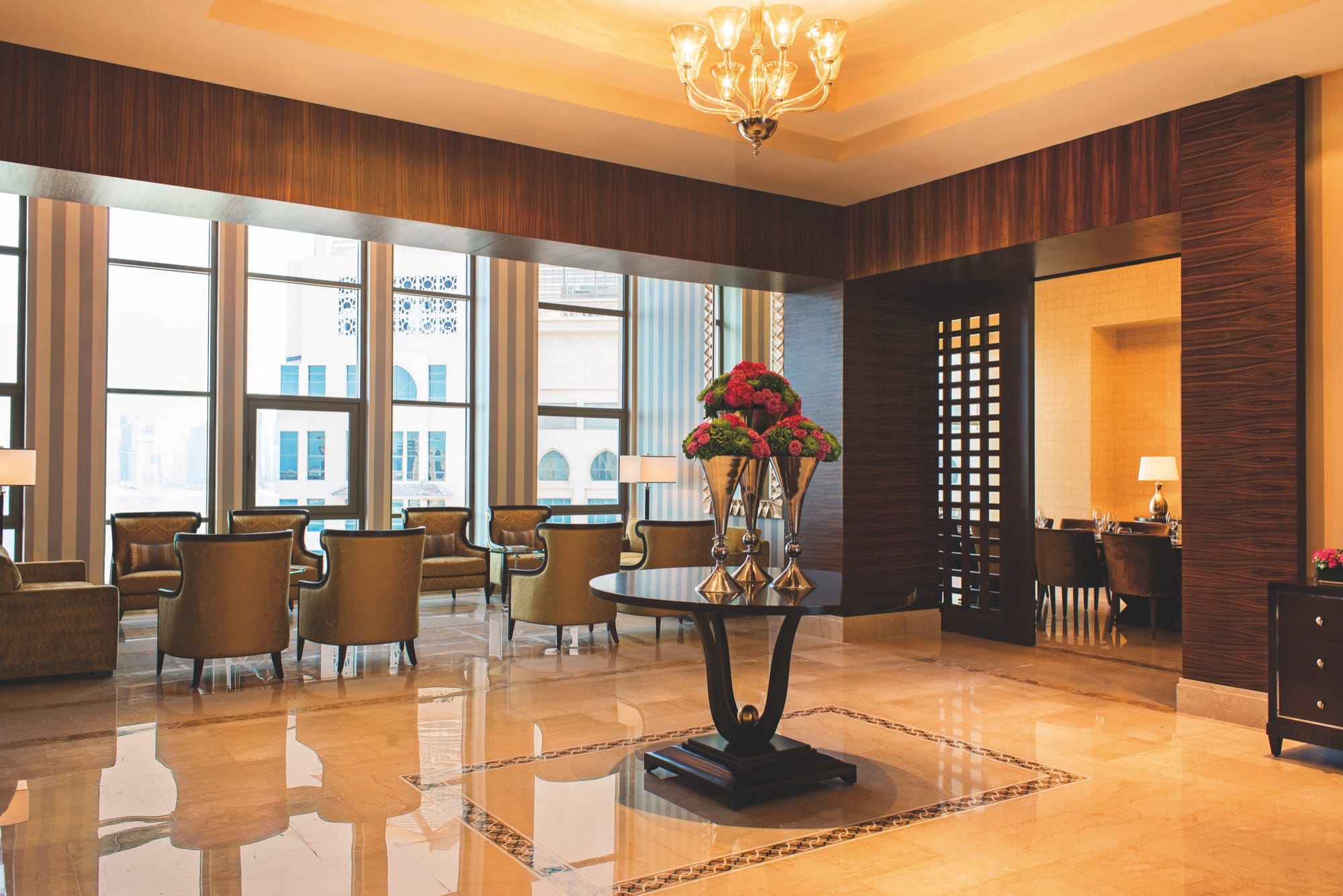
But if this was Bohemia – minus the ironed hair, berets or indeed sartorial ‘musician’ clichés of any kind – this particular outpost was not in some atmospheric basement north of West 52nd but on the Mezzanine level of the glossy St. Regis in Doha.
This wasn’t the only performance I stumbled upon during a recent stay. Having banished Muzak to the Eighth Circle of Hell (where it roasts alongside thieves, politicians and other falsifiers), the St. Regis prides itself on real music. This is why, while searching for a spot on the terrace, I was regaled by a reggae band and why, while enjoying afternoon tea (once I discovered it on my second day, my default choice became a delightful Chinese White called Pai Mu Tan), I was able to enjoy live piano music.
Even the hotel’s tinned offerings - and here I’m thinking of the soundtrack of light Jazz standards played at Vine during breakfast each morning - turned out to be of a high quality, which in this case meshed curiously with the restaurant’s sweeping views over the city, beach and Arabian Gulf.
For you see, more than mere hotel, Doha’s St. Regis aspires to be a small cultural centre in its own right and this in a city that has made the provision of culture in all its forms, a major part of its platform.
Set by the beach in West Bay and just minutes from Katara, Doha’s ‘valley of cultures’ and itself a venue for cultural events, the St. Regis is home to a dedicated outpost of the Lincoln Centre’s Jazz outreach programme. It’s a first for the region, the hotel and indeed, the Lincoln Centre. It may not however, be the last for following the enthusiastic reception in Doha – which draws as many local residents as it does guests – the Lincoln is apparently exploring the possibility of opening more.
If the idea of a dedicated jazz club is unusual – and it should be mentioned that it exists thanks to the passion of the St. Regis’ owner for Jazz – it’s very much in keeping with the brand’s past.
Back in the 1920s and 30s, the rooftop ballroom of the original St. Regis in New York regularly hosted the likes of Count Basie and Duke Ellington and became the plush locale where wealthy New Yorkers could enjoy a Midtown taste of what was then still underground culture, without having to ‘risk’ a trip Uptown.
Music is only one of the hotel’s standout features. Because, as we know, culture gives one an appetite. The St. Regis has ten different dining outlets, ranging from Middle Eastern to Modern. In addition to the recently unveiled branch of London’s Michelin-starred contribution to Chinese cuisine, Hakkasan and Lebanon’s toothsome seafood mezze specialist, Sultan Brahim, there are two by Gordon Ramsay (Opal, a lunch spot featuring his comfort-food-with-a-twist classics and the eponymous Gordon Ramsay, a fine dining outlet with echoes of a grand country house), an oyster bar and the very contemporary Astor Grill, a New York steak house with a menu of classic cuts enlivened by a selection of equally classic French treats.
The net result is a hotel that not only provides for its guests – the diversity of dining possibilities, coupled with the cultural programme, magnificent pool, pristine beach and tempting Avène spa means it’s easy to spend three or four days here and never leave – but also draws in local residents. The Sarab Lounge, for example, is a popular gathering place for ladies who lunch, while Opal is busy developing a smartly suited, slick-backed crowd of White Collar workers.
A further measure of just how unusual the St. Regis is lies in the fact that it is only now, towards the end of this article, that we get around to discussing the rooms. Take it as read that each is comfortable, equipped with all the cons one would expect of somewhere Mod, possessed of capacious Avène-stocked bathrooms and beds that encourage the deepest of sleeps because the real standout feature of the rooms – apart from the fact that seventy are suites, two of them Presidential - is that suite or single, all come with a butler.
Mine, a delightfully efficient lady from the Philippines called Fran, not only ensured that I got my complimentary pressings (two were offered as a part of my package) but explained that, should Sir so desire, his bags could be unpacked, his shoes polished, his turn-down times coordinated so as to not disturb and, should he so wish, his bath be drawn.
Unfortunately for Fran, Sir has grown up doing all of this for himself and worse, has a residual Protestant guilt/ethic that not even 30-plus years in the Developing World has managed to eradicate.
Sir rather suspects he may have disappointed Fran. All he requested was for a couple of shirts to be pressed and that his spa appointment be changed but he definitely slept more soundly in the knowledge that should he change his mind, Fran and her legion of St. Regis helpers were ready to spring into action, day or night.