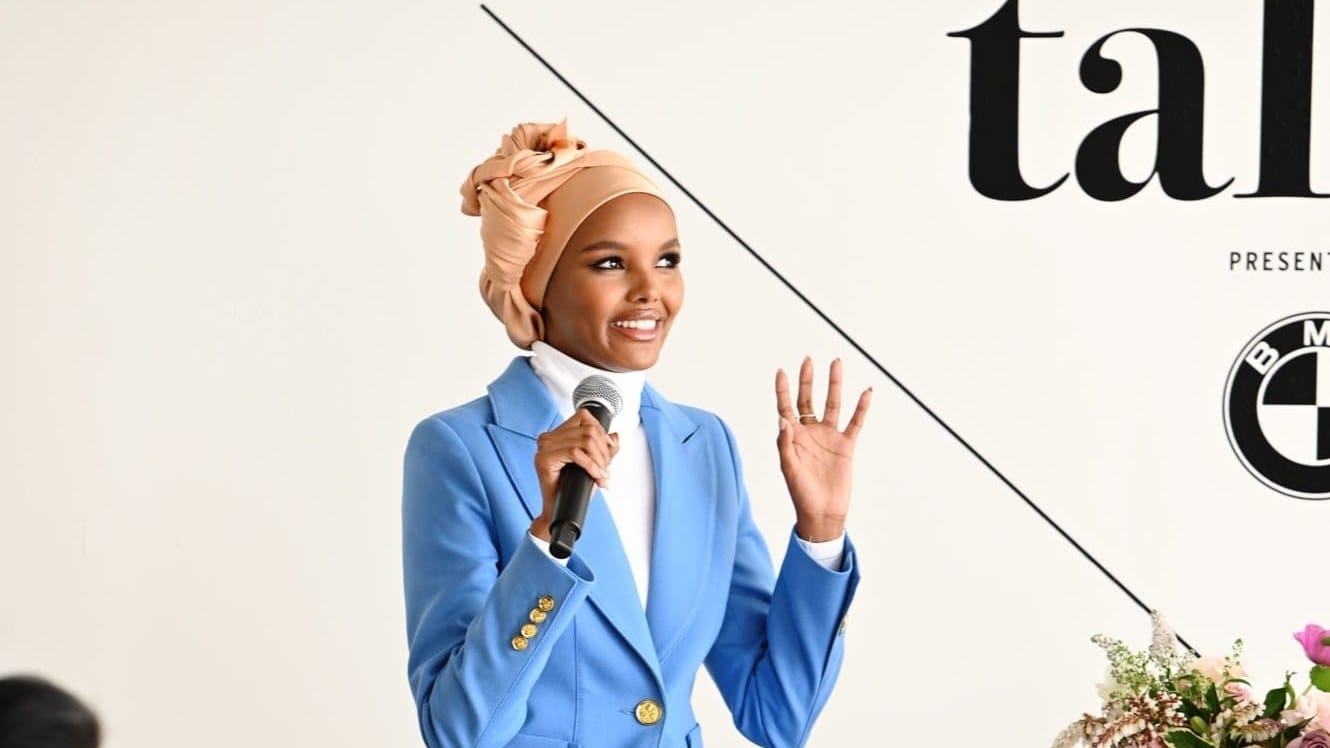
Halima Aden clicks her fingers. That’s how the fashion industry treats models, she says. “They are disposable. Replaceable. “So I wanted to give the fashion industry a taste of its own medicine. Thank you for these incredible four years, but just like you churn through all these bright, young people, I’m going to move on with my life and replace modelling with something better.” Click.
Has the first woman to wear a hijab on the cover of Vogue fallen out of love with fashion? She flashes a look suggesting that’s not even the half of it. “Oh, just a little bit,” she says.
For four years Halima Aden was fashion’s darling of diversity. She walked for Tommy Hilfiger, Alberta Ferretti and Max Mara. Kanye West and Rihanna wanted her to model their clothing lines. When she was an unknown 19-year-old, her contract stipulated a private dressing space at shows and no male stylists. Modesty was a must, the hijab non-negotiable. Sticking to her guns, she shot to the top. Then she quit.
Now, she wants to warn those who might follow in her footsteps about how exploitative the fashion world can be. “I opened the door to an industry that never was for us. I feel I have opened the door to the lion’s mouth. That’s why I also have to be the person who is going to speak up.”
Yet, turning her back on the catwalk was easy compared with quitting her role as an ambassador for Unicef, the charity that supports tens of thousands of children in the Kenyan refugee camp where she was born. Before she became a model, images of Aden as an impoverished child a – “from a baby until I was seven” – were used to promote the work of NGOs. Her first headshots, she says, were for Unicef.
She had hoped to make a triumphant return to the Kakuma camp as a Unicef ambassador in 2018, to give a Ted talk inspiring the next generation of young refugees to follow their dreams just as she had. It turned out to be a traumatic experience that left her questioning the whole queasy relationship between charity, fashion and celebrity endorsements.
It has been quite a journey and she’s still only 24, albeit she has two birthdays. As is common among Somali-Americans whose birth records were lost or destroyed in the civil war or not recorded by nomadic families, she was assigned an official birthday of January 1st on being granted asylum in the US. A chance encounter in a shopping mall with a family whose daughter was born on the same day revealed that she won’t actually turn 25 till September 22nd.
She idolises her mother, Rukia, who arrived in Kenya as a refugee, having walked for 12 days to escape the conflict in Somalia. Her father, a Somali taxi driver, disappeared from their lives – she would find out he died when she was 15 – and she was brought up collectively by her mother and the other “mammas” in the camp. Despite the regular bouts of malaria, the long queues for rice and drinking water – “my BMI is still lower than it should be because of the malnutrition I suffered as a child” – she says, “I still have yet to find anywhere else that has such a strong sense of community as Kakuma.”
When she was seven, they moved to the US, landing in St Louis, Missouri – “the first time I’d ever heard gunshots” – then relocated to St Cloud, Minnesota. Throughout junior high school she had two jobs, as a cleaner in a hospital and a carer for the elderly, sometimes going to 8am lessons after coming off the night shift.
When she became the school’s first hijab-wearing homecoming queen “and probably the first Muslim homecoming queen in the state of Minnesota”, her mother was furious. Afraid that her smart daughter was being distracted by pageantry, she broke her homecoming crown. “I’d never seen a Muslim kid win something like that, it was a big accomplishment for me, so to see my mum break that crown and discard it like garbage was heartbreaking.”
It proved to be the act that changed her life. “I thought, ‘I’m going to enter Miss Minnesota and get an even bigger crown.’” Although she didn’t win, reaching the semi-finals was enough to snag the attention of Carine Roitfeld, the French fashion editor, who flew her to New York. She was soon signed to IMG, one of the biggest modelling agencies in the world.
At the time, her hijab was often treated as a novelty. Reflecting on it now, she believes it gave her a legal protection the other girls did not have. It was a visible boundary in an industry where she found there were few.
She was unsettled to be the only one with a private dressing cubicle, while others were being stripped in full view of the press cameras.
Aden didn’t own a pair of shoes until she was seven, but even she found the desperation in fashion astonishing. “I’d never known of an industry with so many desperate people in it, who were willing to do anything under the moon to be there. I think it’s very sad because automatically you lose all your power when you get desperate.’’
She started allowing the stylists to style her hijab. It seemed to shrink with every shoot. “People were asking me, ‘Where is the hijab? It’s no longer even visible.’
“Despite me saying, ‘Don’t change yourself, change the game’, that was exactly what I was doing.” One “horrendous” magazine cover she regrets made her look like a “white man’s fetishised version of me”. The trailblazer began to feel like “a token”.
“I’m not saying it’s not right for other Muslim, hijab-wearing women, I’m saying it was not right for me. I wear a hijab, I’m a Muslim, I’m Somali, so yes, all these identities set me up to be the perfect token to check all the boxes. I felt like one of the biggest tokens in the industry. I always felt like an outsider in my own career.”
The Wizard of Oz moment came when she fulfilled an ambition to return to Kakuma as a Unicef ambassador. As a child, she recalled how the NGOs “would bring various celebrities back to the camp and we danced for the visitors. I remember that being a big part of my childhood.”
This time she was the celebrity. “I asked the kids, ‘Are they still making you dance for the visitors?’ They said, ‘Yes, but this time we’re doing it for you.’ That broke my heart.” At the time she continued with her earnest, positive messages about “being the human representation of the power of diversity”. Privately, she was in turmoil.
The more she speaks, the more tearful she becomes. “I cried on the flight all the way home. I spent that whole trip crying. There was a lot of survivor’s guilt.”
She gave a Ted talk that was broadcast from “huge monitor screens” in the camp. “It was over 100 degrees, a burning hot day. We got to be in the tent,” she says, the audience had to stand in the sun.
“It took four days to get all the technology to the camp, one of the most remote refugee camps in the world, but still the kids had no shoes. “It was performative activism. Real activism doesn’t have to be an act.”
She had taken on the role, she insists, because as a former refugee she believed she would be “more relatable than other ambassadors like [the singer and actress] Selena Gomez”, but the double standards hit home.
“In America I can’t take a picture of a minor without consent from their parents. If I were to go to the Hamptons and start photographing minors, I wouldn’t make it to midday. Yet it’s often the same celebrities who are fighting the paparazzi over photos of their own children who are the first ones to hop on a plane to Africa or Asia to photograph themselves with all these refugee children.”
She points to fellow model Gigi Hadid, who appeared in publicity pictures with young Rohingya refugees during a Unicef trip to Bangladesh in 2018, but then pleaded for her own daughter’s face to be blurred from photographs. “So why are you the one to then go to Bangladesh to be photographed with all those children?” Aden asks.
She is not criticising programmes that fed her, she insists. “I’m saying, ‘Let’s find new ways of doing things.’ Things are still being done the same way they used to be when I was there. “Don’t show me the children, show me how the classrooms are changing. Because when I went back the classrooms hadn’t changed.”
A Unicef spokesperson said: “We are grateful for Halima Aden’s three and a half years of partnership. Her remarkable story of resilience and hope has guided her vision for a world that upholds the rights of every child. We wish her all the best…. As a child rights organisation, Unicef advocates for children’s rights, including their rights to privacy and safety, all over the world. As such, child safeguarding is fundamental to how the organisation operates and communicates. Informed consent is obtained from a parent or guardian when photos are taken of a minor.”
Over Zoom from her home in Minnesota, Aden says: “I’ve spoken my piece, opened my heart and am moving on with the next chapter of my life” – which will include making documentaries and working with other charities.”
She hopes she has made it easier for other models to speak up. “If you don’t ask, you can’t receive it…” She also hopes to return to Kakuma once more, before the Kenyan government shuts it down this summer, offering residency to some refugees and repatriating the rest. “It’s a big wish. I hope it will happen.”