People rave about sunsets in Islamorada and I clearly remember my first. It was a balmy night and I was attending a dear friend’s wedding that was being hosted at a small white boutique hotel. Descending over the gazebo’s boat ramp, the vivid sun drenched the horizon with showers of indigo and magenta that radiated off the metallic greys and midnight blues of the nighttime ocean.
Although Islamorada was named by early Spanish explorers in the 1800s, and literally means ‘village of islands,’ it’s also known as Purple Island because of those striking violet sunset skies. Sadly, jet lag prevented me seeing more of them but it did mean that I was up and about in time for each and every sunrise. These were absolutely stunning, like abstract paintings – moody in colour, volatile and dramatic, hinting at hidden turbulence, like a storm about to set in.
The island of Islamorada is situated about halfway between mainland Miami and Key West, in the coral cay archipelago known as the Florida Keys. It’s easy to see how the natural beauty of these islands has inspired writers of the ilk of Ernest Hemingway, Robert Frost and Tennessee Williams, who penned some of their most important works about war, love and loss during their time here (from the 1930s to the 50s). It’s the kind of place that makes you want to write a novel. And from the outset, that is what I thought I would do.
I had it in mind to create something in the genre of historical fiction. I wanted to find out what it is that attracted these novelists and poets here and I thought it might be prudent to visit their favourite haunts to find inspiration. But due to a heavy case of post-festivities’ stress disorder, I ended up staying in Islamorada for a few days longer – it’s lucky I did though, or I might never have stumbled upon this story.
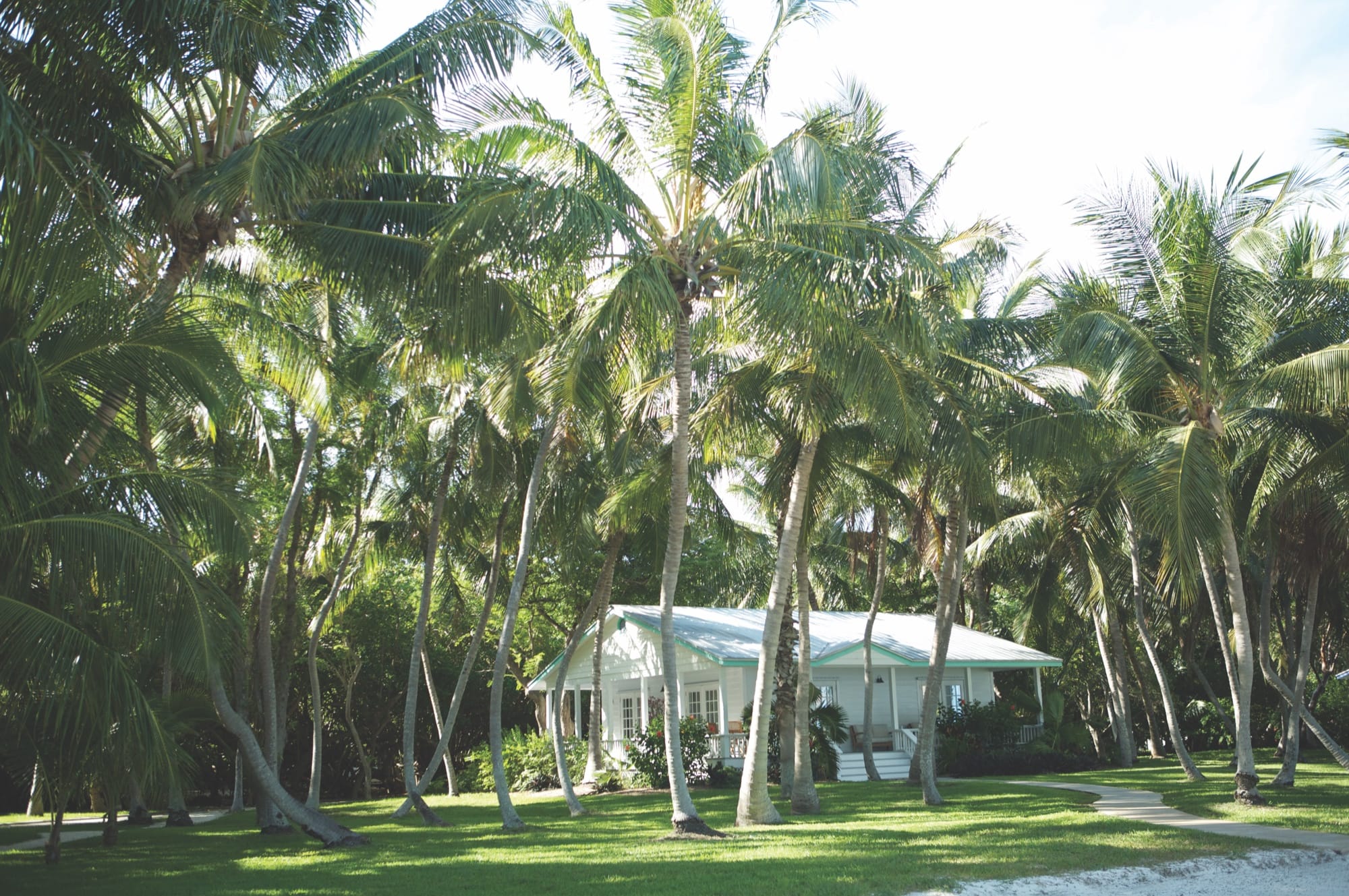
You see, the way the story begins is like this: there was a boy called Hubert Baudoin, who was born to French parents in the mid 1960s and raised on the Ivory Coast. He would later become quite the pro windsurfer and one day, as he was surfing these particular waters he managed to break his board on the reef next to a rundown former coconut plantation. This derelict place, named the Moorings, had a total of five modest bungalows, which were all due for demolition to make way for some ghastly 200-unit condominium complex. Now, while you or I might have kept on walking, Baudoin spotted a je ne sais quoi. He figured the place deserved a stay of execution and after extensive negotiations, succeeded in acquiring the property in 1988. Within just a year, he prepped and preened and added 13 new low-lying cottages that were perfectly in keeping with the architectural style of the originals – basically West Indies-style lodges replete with colourful shutters and private patios.
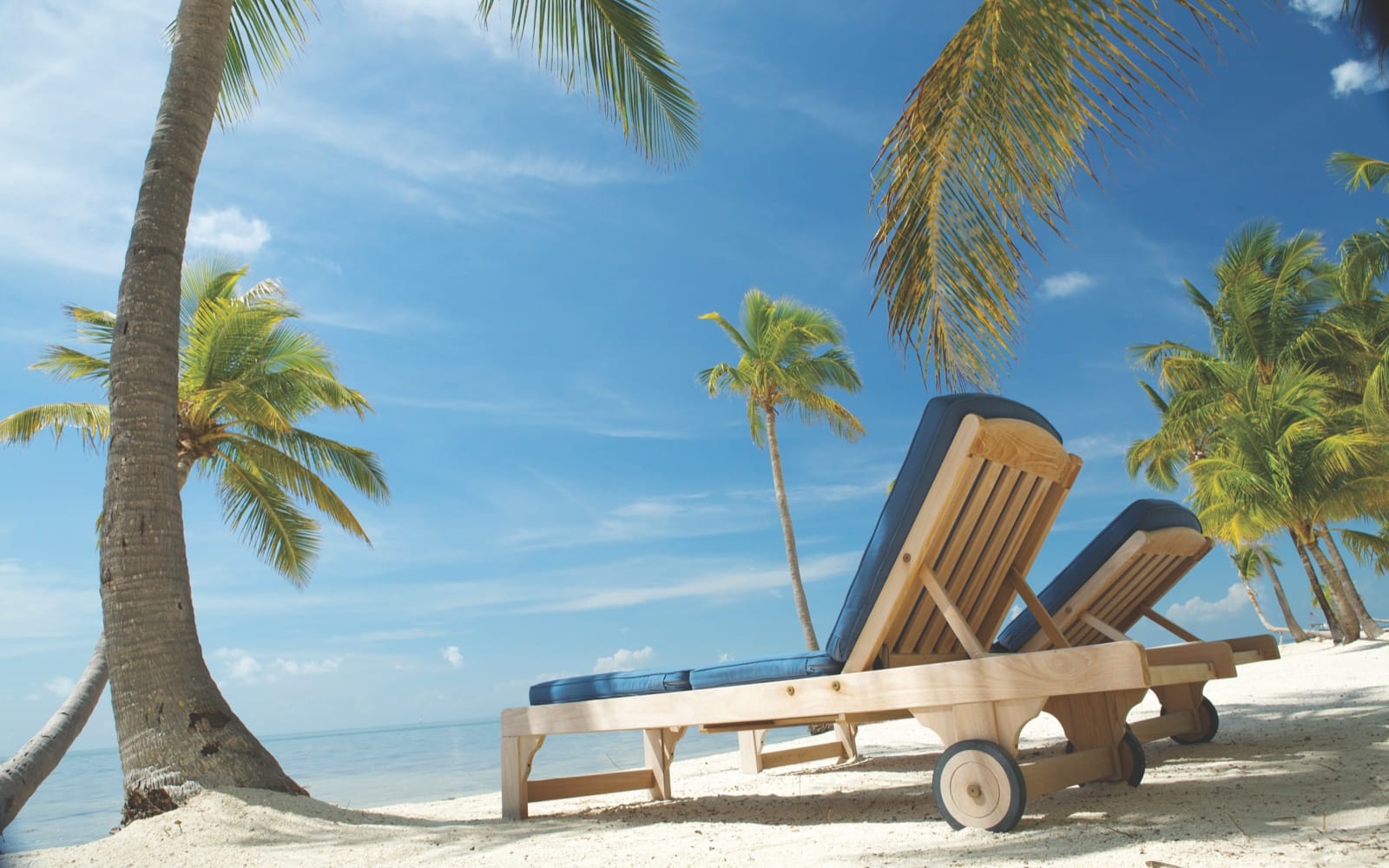
Highly intrigued, I checked myself into the exclusive hotel complex, now known as the Moorings Village & Spa. To get a gist of what it’s like, think cerulean waters, sugar-white velvety-soft sand beaches lined with wind-bent palms, mangrove bushes and lush greenery including orchids growing from trees. There are still only 18 elegant cottages, which is quite incredible when you consider the property is almost 7.5 hectares large. So although the place is fully booked at the time of my stay, I didn’t encounter more than two people that whole weekend. Most of the time, I didn’t see anyone at all. But I was surrounded by traces of this man who developed and maintained this stunning property.
Whether it’s at the production studio (yes, the Moorings has actually been a favourite backdrop for Vogue and Ralph Lauren swimwear shoots), where you’ll find what my guide referred to as the ‘owner’s playroom’, which has Baudoin’s Thunderbird, Aston Martin and BMW motorbike parked around a pool table, or at the Morada Bay Beach Café, a bistro he opened just down the road, where he has hung his collection of colourful surfboards and kite boards as a tribute to the great Hawaiian and American men of the sea like Duke Kahanamoku and Robby Naish, Baudoin’s presence was everywhere. This is a man who loves a thrill but is also no stranger to nonchalant beauty.
Here, I must put in a note about food at the Florida Keys. Though the place isn’t known for its fine dining, Baudoin did have the foresight to found an upscale French-fusion restaurant called Pierre’s, which is a stone’s throw from the Moorings. Unfortunately, I didn’t get the chance to try it because it was closed for renovation. This meant I became somewhat of a regular at the Beach Café, which is more of a laid back surfers’ pit with tables set in the sand. It also meant that I had to take frequent siestas after eating food that was far heavier than what I’m used to, often American-sized portions layered with cream or fried with cheese. Yet in comparison to the eateries in the area, it has a delightful blend of Caribbean, African and Cuban influences, with just the right amount of spice, especially in the case of the freshly caught seafood, including grilled spiny lobster tail, smoked grouper and mahi mahi in tacos. But it was rich nevertheless, and so during my heavy-stomach-induced, mid-afternoon relaxation spells, I got to deliberate a little more about Baudoin’s life.
I imagined he must be a very reclusive man, which is why he moves from island to island (he is building another property in the Bahamas) or that it was a love story that brought him to the Moorings in the first place, or he had an injury that prevented him from surfing, and so he went into hospitality as a business venture and found that he could be successful at it. I realised that there are so many roads I can take with this story, if I were to write it.
As you might have guessed, beyond these pages, I never finished the novella I intended to write. But I can tell you what I did instead: I ran by the ocean every morning, relaxed in the Moorings’ hammocks that are dotted across the property, walked along the meandering paths, and read by the 25-metre swimming pool that’s nestled among the colourful bougainvillea. The simplest of pleasures can keep you busy at the Moorings and I indulged in them all. Secluded away from everyone, in my quaint little cottage, surrounded by the thick bush, I almost felt alone in cosy, ultra-private little world.
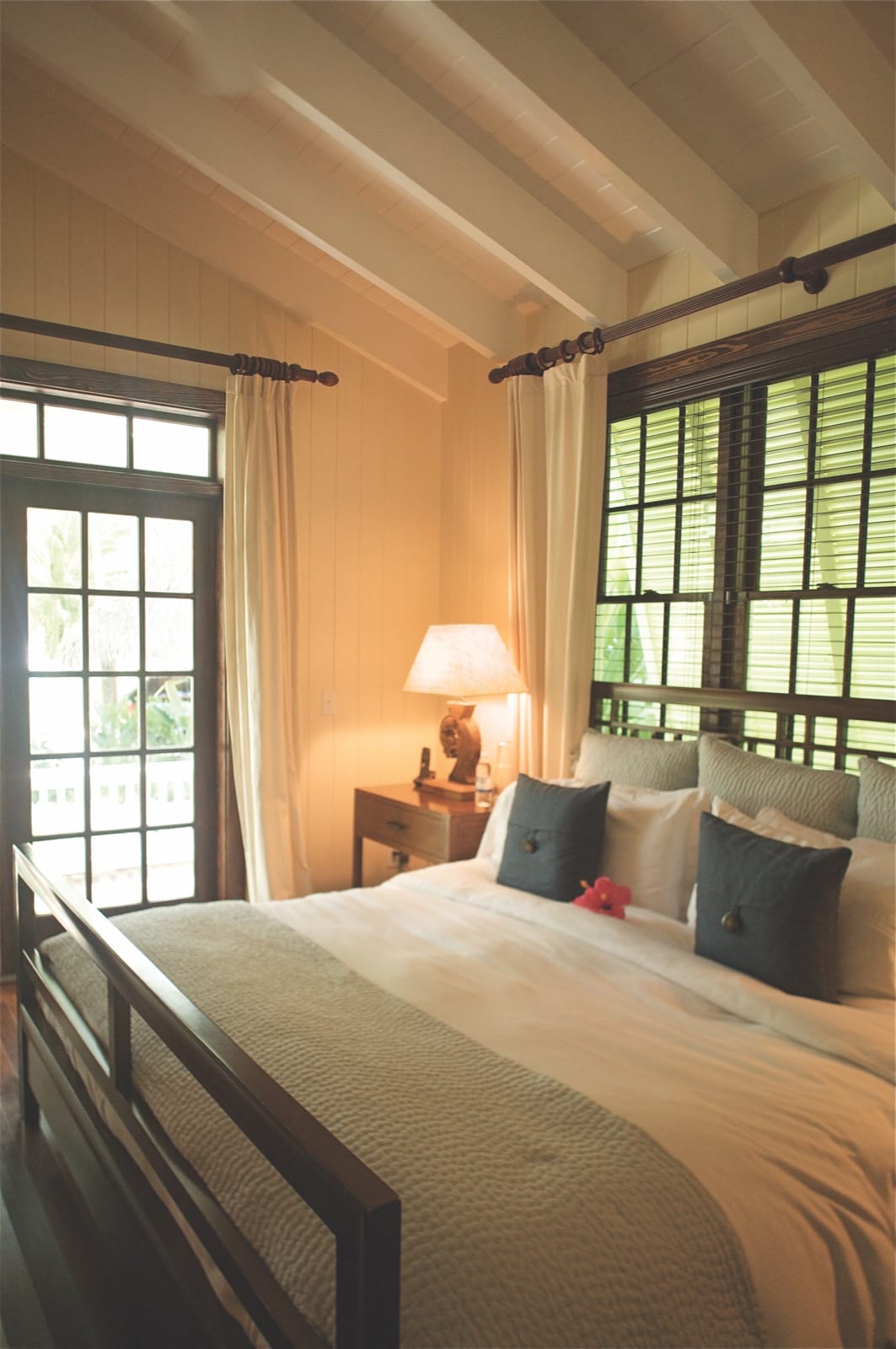
That is if a luxury bungalow with warm cypress and pine accents that’s furnished with simple wicker furniture and an eclectic collection of books could be your my world. It was liberating. Sheltered from the sun and any noise, except the soothing rustle of whispering leaves and the faint cawing of seagulls I really had no excuse not to write a sterling little novella. Perhaps it was the fact I was being too spoilt by staff who were remarkably unobtrusive yet attentive. For example, one day I got holed up away from the property and I called to ask what I could do about food after hours and when I finally got to my cottage, I found they had left well-chosen, still-hot meals waiting for me and my partner.
All in all, I settled easily into this languid island rhythm at the Moorings, this nonchalance, (which admittedly, goes rather well with the drowsiness of jet lag), that it was both refreshing and hard to leave. Even the creatures who inhabited the same ecosystem paid no heed to my being there. Take the large iguana I found by the pool as I was drying myself – it didn’t so much as twitch its spiky head in response.
On my last day, jet lag still hadn’t left me and I awoke again before the sun rose, taking the opportunity to paddle out to sea in one of the Moorings’ complimentary kayaks, soaking in the glorious glow of the blazing red sun as it peaked through the rusty-orange clouds. In the afternoon, I was treated to their signature scalp-to-toe massage, which can also be performed in a beachside cabana but by then, I had had my fill of the ocean - I could see it even with my eyes closed. After a very special Kobido treatment, a Japanese facial ritual that includes a lot of dancing fingers, stroking behind the ears and smooth gemstones on pressure points, I was ready to fall into a deep sleep and before I nodded off, I had a final thought. Although I have yet to write my novel, the Moorings taught me about the process of writing fiction, in a way that’s inspired by real life events.
Sometimes, imagination only needs to feed from what’s around you. As Baudoin once said, ‘The Moorings is the place where the simplest of things can become of great value. You can walk, swim, or just sit on your porch for hours – watching nature take her course.” I only wish I could wake up with the Moorings’ sun again, tomorrow morning.