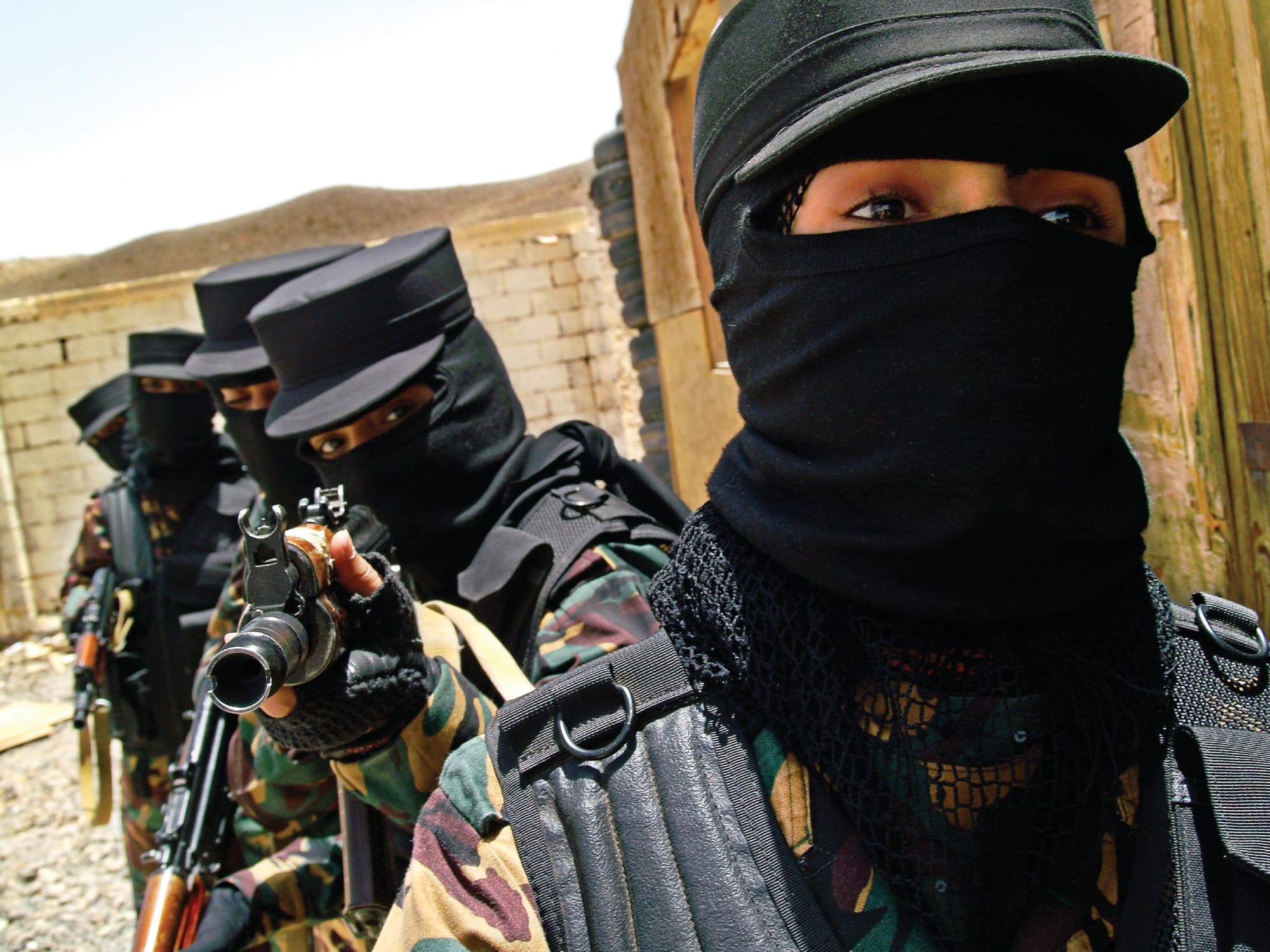
The Earth has shaken in Yemen. Thirteen women have passed their training and entered active service in the Yemeni army’s anti-terrorism unit: an elite group of 300 soldiers that had previously been an all male force. Reassigned from police desk jobs, they followed two years of specialised courses in the use of firearms, techniques of urban counter-insurgency warfare, driving armoured vehicles, liberating hostages, and even English language training (the latter presumably necessary for communicating with the aforementioned hostages). Now they have graduated, it’s time for them to prove their worth.
To get an idea of the magnitude of this event, and how it can easily be described as a revolution, you only need to take a look at Yemeni society. On paper, the constitution guarantees “equal political, social and cultural opportunities for all citizens”, but in practice women repeatedly see their rights denied, as the constitution is “reinterpreted” in a misogynistic way. Yemen remains a very tribal, traditional country and roles prescribed to women are limited to say the least.
Of the 301 seats in the Yemeni parliament, only one is occupied by a woman, while a proposed law to introduce a pink quota (15 per cent of the seats) was quietly sidelined. There are only two female ministers, another two women in the Shura (the senate, which has 111 members directly appointed by the president), and 35 female magistrates compared to almost 2,000 male counterparts. This notwithstanding, there are 170 NGOs in the country working for the rights of the ten million women who make up half of the population. As the lawyer Kalid Al-Anesi, director of the National Organisation for the Defence of Rights and Freedom, once said: “From a political point of view, women are used as ornaments for decorating the government. In the electoral campaign, they only count as voters: as candidates they are completely alienated.” Things are moving on, albeit slowly, and the graduation of these women to an elite antiterrorist unit is just one positive sign.
The Sana’a Police Academy began accepting women back in 2001, but early recruits were always assigned to secondary roles. Years later and they still have to deal with prejudice in society: “We can’t even think of directing traffic,” said one young first-year academy trainee. “No one would pay any attention to us.” Her words echo those in recent declaration by Khadija Al-Salami, cultural attaché at the Yemen embassy in Paris: “At eleven a Yemenite girl must become a woman, in that she is ready to be given away in marriage. And once she is a woman she is nobody.”
Out on the parade ground outside the Police Academy, it is clear that change is in the air. 400 first, second and third-year female students, their unofficial marrying age long since past, have all chosen to become something or someone: anything rather than the nobodies to which Khadija Al-Salami referred. And they do it even at the risk of either being rejected by their families and by the world, or, as one recruit put it, “passing their wholes lives under a disapproving gaze.”
Standing to attention, the platoons were perfectly lined up. Stoic and immobile under the midday sun, which baked the black veils around their faces, their expressions remained stony, while their hands, some allowed the indulgence of a ring, grasped rifle butts. Their bodies were packaged into olive-grey uniforms, underlining the steadiness of their posture, the steely determination on their faces.
Then it was time to show off what they had learned. They marched, then dismantled and reassembled a Kalashnikov in under 40 seconds - blindfolded. Pistol in hand, they demonstrated bursting into an apartment where a hostage was held captive. They stopped a car with two “suspected terrorists” inside, got them out, and searched and neutralized them. The car, ironically, belonged to one of the officers, and the hubcaps were decorated with the face of Saddam Hussein, a person who still enjoys enormous popularity in Yemen. But the message was clear – the police force was all the stronger for having women on the team.
Later, at the Bini Hushesh rifle range, hidden in the mountains around Sana’a, it was the army’s turn to show off. The 13 new additions to the anti-terrorism squad, dressed in immaculate uniforms and balaclavas, emptied the magazines of their Kalashnikovs with perfect coldness into silhouettes representing dangerous assassins, turning them in seconds into sieves. The women in both the police and the army are themselves happy to testify as to how far they have come. “Relations with our male colleagues were difficult at first,” admits Saban, an officer with the antiterrorist force. “But eventually we developed a camaraderie based on mutual respect, and now they even defend us when anyone criticises our career choice.”
“The opposition from society that I and my female comrades encountered was incredibly bitter at first,” adds policewoman Fatima. “But now we rarely encounter problems, except from misogynists who despise women and don’t want to see us compete with men.” Her colleague Fatehia echoes those sentiments: “When I joined the police, the problems didn’t come from my family: on the contrary, my parents were proud of my choice. The objections came from people who had known me for a long time and couldn’t accept the fact I would be wearing a uniform.” Before becoming a policewoman, her dreams were extremely limited. “But my years as an officer gave me strength and self-confidence, and I have much bolder aspirations now.”
Altaf joined the police to fulfil a childhood dream. “I only hope this society will eventually get rid of its prejudice and recognise the importance of the role women play, both in the police and in other fields,” she says. “A uniform can be a terrible barrier in this society, especially when it’s worn by a woman: it is intimidating and causes automatic mistrust. We, as policewomen, must be extra careful with the people we’re dealing with: we have to make them feel safe in order to win their trust.”
Despite all this, says Amira: “being a policewoman shouldn’t necessarily affect my private life as a woman: I feel like building a family and becoming a mother, and I believe I’ll be able to manage the two roles perfectly at the same time.” It is clear that Yemen needs the women’s fierce determination more than that of their male colleagues, especially since theirs is fuelled by the bitterness of constantly having to fight for their basic rights. The country has gone through one of its more difficult periods since re-unification in 1990: autonomist movements in the oil-rich south are beginning to make their voices heard (and those of their armies); and the inhabitants accuse the government of abusing resources without guaranteeing an adequate economic return. They use three words to describe this, in familiar terminology: “Sana’a the Thief”.
In recent years armed attacks on police cars have become more daring and violent (several agents have been killed), and they are happening nearer the capital, so much so that the key ministries in the city seem to be under siege, encircled by concrete barriers to protect against car bombs. This however, was not enough to stop one rebel group firing three mortar shells at the American embassy in broad daylight. Even though they missed the target by 500 metres, they landed on a school, killing one student and injuring 19 others. Nor did it prevent an attack on the customs agency, just metres from the Ministry of Finance and the Italian embassy.
The government points the finger conveniently at al-Qaeda, but it could easily have been a tribal or separatist matter. In this country, it is sometimes difficult to understand who did what and who is allied with whom. Besides oil, one cause of the insurgency could be recent increases in food prices, aggravated by a heavy drought that forced the government to ration water. This in turn compromises the harvest of qat, the bland stimulant leaves that are chewed by nine out of ten Yemenis for half of every day, and represent their one and only diversion. Yet in response to this crisis, rather than trying to calm the metaphorical waters, President Ali Abdullah Saleh (evidently inspired by Marie Antoniette and her plans to distribute brioches), said of his people that: “the price of cereals has increased all over the world, so they should just resign themselves. And the thirsty can always drink the waters of the Red Sea.”
Amid the chaos, it is the police (where tactical decisions are always made by men) who have made the biggest fools of themselves. They were tested and found wanting twice in as many months by the assaults against targets they were supposedly obliged to protect. Their self-esteem dropped so low that a mere two hours after the attack on the customs office, the roads were reopened without a hint of a roadblock.
But who knows? It may well be those 13 women in their balaclavas, and all the young police recruits swathed in their olive green aprons, who finally give the security forces a bit of vigour. But whatever happens, before Yemenis can truly count on them, the first hostages they will have to liberate must be themselves.