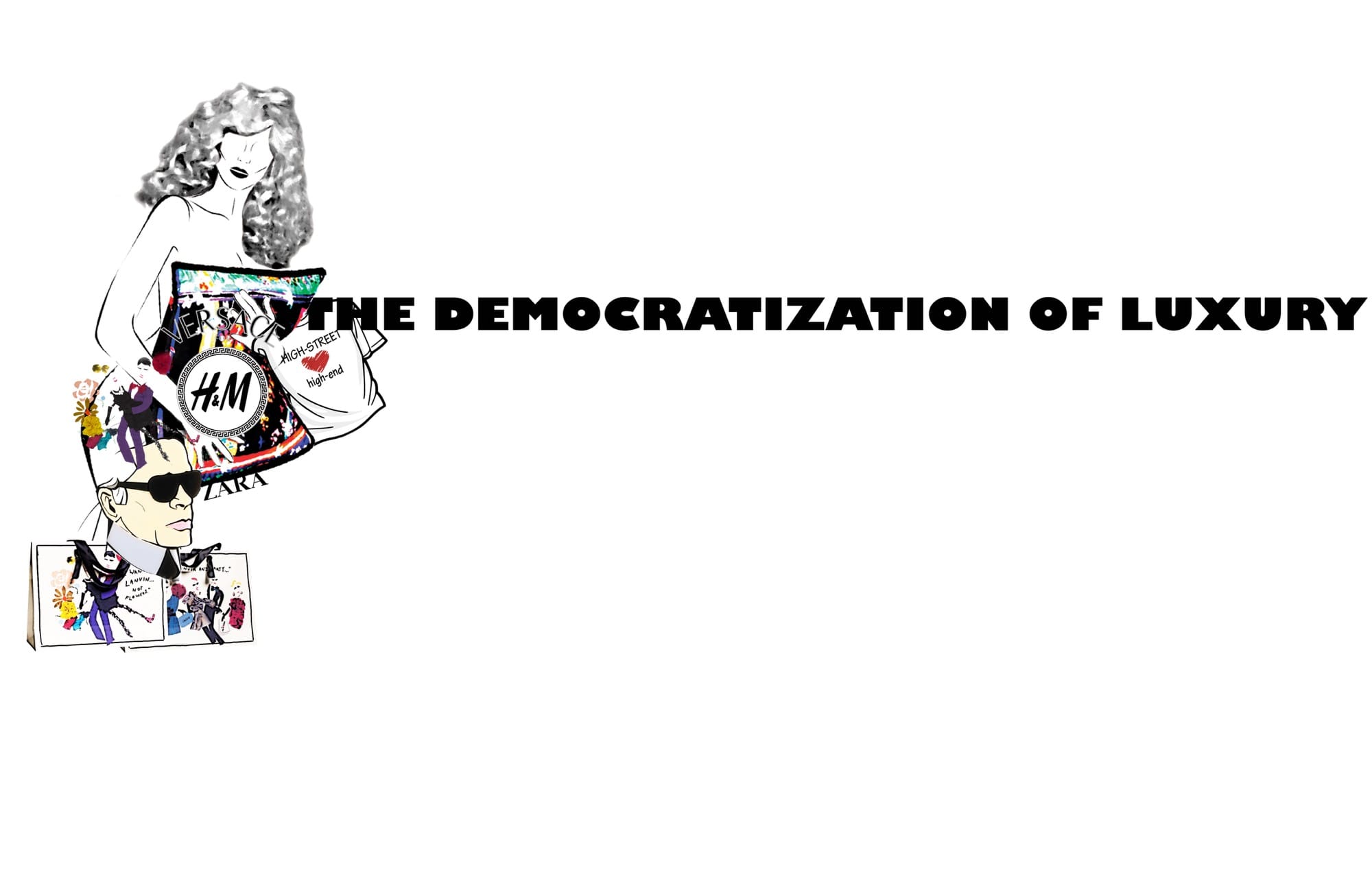
Premium fashion brands are redefining their branding and marketing strategies reflecting a moment in history where the luxury market faces competition from the mass fashion market. By opening in major fashion capitals, employing aggressive campaigns, celebrity endorsements and undertaking luxury/mass design collaborations, both markets increasingly compete for the same customer.
This change has resulted in the mass market enjoying an ability to ‘trade-up’ by acquiring luxury products and luxury labels ‘trading-down’ by mixing with mass brands. Welcome ‘the democratization of luxury’.
Karl Lagerfeld was the first designer to launch the mass/luxury hybrid, collaborating with high street retailers H&M in 2002. He was followed by others, such as Stella McCartney and Victor & Rolf. Lagerfeld’s collaboration wasn’t a complete success. The designer felt that H&M did not produce his clothes in sufficient quantities, disappointing many people and defeating the collaboration’s purpose.
“I don't think that is very kind,” Lagerfeld commented at the time, “ especially for people in small towns and countries in Eastern Europe. It is snobbery created by anti-snobbery."
This evolution stirred hopes in the industry that luxury/mass collaborations might bring forth something fresh and autonomous, with enough knock-off copies around, it wouldn’t be enough to slap a name on a low-cost product. Not everyone was convinced.
“I have never even considered [a collaboration]. It's because I don't like what a bad copy does for the main brand,” Miuccia Prada explained. “ If I had an ingenious idea to do fashion that costs less but that wasn't a bad copy of something else, with completely different criteria and ways of doing things, I would do it. “
Christophe Lemaire, the artistic director of Hermès, associates the excessiveness of fast fashion with a lack of authenticity. He says this perverse need for quick consumerism is the ‘malady of our industry’ and ‘a global disease of our time’.
Alber Elbaz, artistic director of creative affairs at Lanvin described the house’s collaboration with H&M in 2010 as ‘giving a child away for adoption’ before justifying the move by adding that “everything in life is timing… the world is changing”. Well, that doesn't seem like very good parenting to me.
Although critics have expressed doubts that tie-ups could damage a luxury brand’s image, Jean-Jacques Picart, Art Director of Lanvin and Senior Consultant for LVMH believes that the co-branding made mass consumers more knowledgeable about luxury brands. The advantage for high street brands is obvious but why would high-end labels jeopardise themselves this way? Greater publicity? Perhaps.
The real reason is profit. The collaborations led to dramatically increased sales. Even designers who had previously declined offers to collaborate are being seduced. Donatella Versace, who was approached by H&M in 2008 and declined, launched a Versace line for the store in January, 2011.
"I respect everyone who does it" Versace explained the first time she turned down the Swedish brand. "But the reason I didn't do it is because I work very hard to put the Versace line in the luxury section. I think to put the Versace line in H&M would confuse the brand."
Really? Well now she isn’t the only one.