The recent announcement that Qatar will host the 2022 FIFA World Cup came as a surprise to Western commentators and the football community at large, many of whom seemed to know little more about Qatar other than it was excruciatingly hot and somewhere near Dubai. Oh, and apparently, alcohol would be a problem.
Faced with global curiosity, since securing the competition last December, Qatar finds itself the cynosure of the world’s footballing community. The Gulf state is hardly the first name that leaps to mind when one discusses the culture of football worldwide. And how will traditional Western notions of football fandom, complete with frequent, copious refreshment, flourish in a country where public drinking is outlawed, temperatures in mid-summer top the 50 degree Celsius mark and the nation’s national football team is currently listed 95th in FIFA's world rankings and has never qualified for a World Cup tournament?
Qatar, proud owner of one of the world’s fastest-growing economies, is firmly convinced it can. For Doha, the winning bid is proof that football is as much a part of the country’s social fabric as it is in London, Buenos Aires or Milan. And ever since the massive public jubilation that greeted Sepp Blatter’s announcement on December 2nd, 2010, a mood of optimism pervades Doha, as colossal onslaught of activity gearing up towards 2022 gets underway. Already, assurances have been made that visiting football fans will be able to consume alcohol in designated fan zones and budget-priced hotel rooms will be abundantly available. Yet, these issues aside, that there is something serious going on only becomes apparent when faced with the statistics.
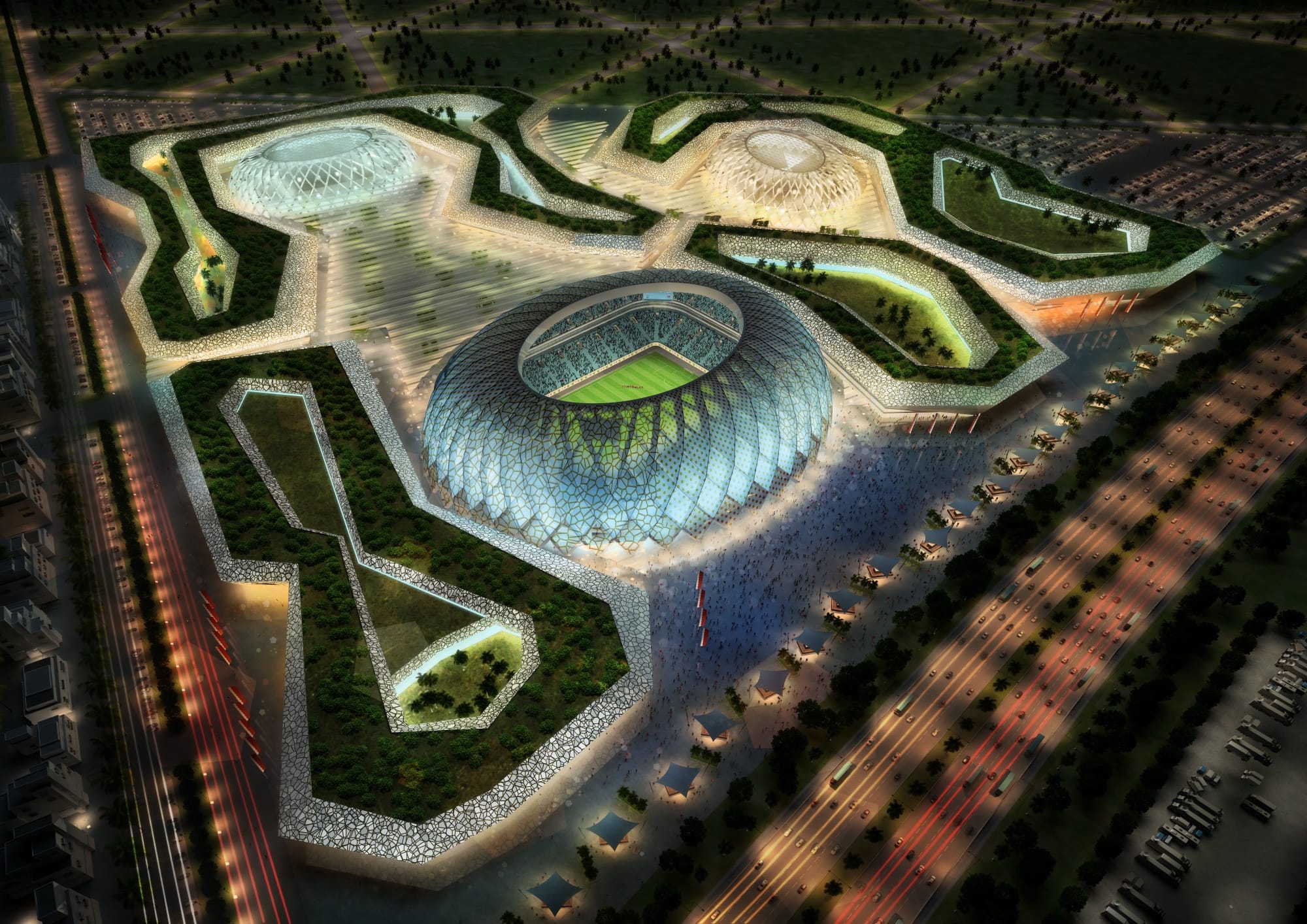
The costs involved are staggering. Conservative estimates predict the state’s final bill for World Cup-related spending in excess of 200 billion USD. (To put this in some kind of perspective, FIFA estimates the profit generated from hosting a World Cup tournament for a host country to be approximately 5 billion USD). Whereas many countries might give their existing stadia a lick of paint and perhaps an exciting new logo, Qatar is building six gigantic new footballing venues, revamping an existing three, doubling its present hotel capacity to 90,000 rooms (including a 6,000 room docked cruise ship), supercharging its transport infrastructure, developing pioneering heat-busting new technologies to dispel the ferocious summer temperatures and for good measure, building Lusail, a new city just north of Doha which will host the flagship waterborne 86,250-seat Lusail stadium. In addition, existing infrastructure will be boosted with a 25 billion USD rail network, a 5.5 billion USD deep-water seaport and an 11 billion USD airport as well as a further 20 billion USD on new roads. Despite Qatar being the smallest country to host a World Cup, at least since brave little Uruguay back in 1930, it’s already clear that the 2022 event will not only be a seismic occasion for Qatar, but will bring this quiet, ambitious state to the world’s attention as never before.
The stadia under construction, which are currently being planned by noted German firm Albert Speer & Partners, look colossal in scope. (The Al-Khor Stadium, for instance, will have a capacity for 45,330) It’s being promised that post-World Cup, these stadia will be dismantled and rebuilt as gifts to poorer nations.
Key to the decision to award the tournament to Qatar was the state’s promise to deal with the scorching summer heat. Unable to move the event to cooler winter months, Doha has unveiled an ingenious solar-powered carbon-neutral cooling system, devised by Arup in the UK, which will be integrated into each of the new stadia. The system sees electricity being generated constantly, alternating between powering the stadium while knocking around 25 degrees Celsius off the prevailing temperatures, ensuring players and spectators enjoy the game in comfort. Realising that the 50 degree Celsius heat in the summertime would render most guests null and void after a few minutes outdoors, there’s also talk of bringing these cooling systems to public areas where fans will be congregating. The 2022 Qatar Bid chairman Sheikh Mohammed bin Hamad bin Khalifa al-Thani, acknowledged this at the country’s presentation: “We will have to take the help of technology to counter the harsh weather,” he said. “We have already set in motion the process. A stadium with controlled temperature is the answer to the problem. We have other plans up our sleeves as well.”
So, why is this Gulf state going to such lengths to stage the spectacle? It might seem obvious: it is the World Cup after all. But it’s also due to Qatar’s buoyant spirit of ambition, fuelled by its superlative economy. Being the first Arab state ever to host the world’s premier football event is achievement enough in of itself. Qatar is seizing the opportunity for an unprecedented degree of social engagement with the Arab world and the rest of the globe, by converging through this love for the sport. The political and international benefits to be reaped are huge – no other event could take the tiny state to such international prominence, demonstrating to the world that this stable, progressive and energetic country is a serious player on the global stage.
The acquisition of the 2022 FIFA World Cup is Qatar nation-building 21st century Gulf-style and as Western states continue to totter helplessly under faltering economies and depleted public spending programmes, out in Qatar, the sun shines daily upon the booming city, where things look very promising indeed.