“And all of this land,” she paused, “was of sand-fields and stardust.”
Her grandchildren knew the story - all too well. Everyone knew this story all too well, but she didn’t care. “Now glass-fields and car-dust,” she continued looking out of the windows across the room, “glass-fields and car-dust.”
Salma took a final sip of her cardamom coffee and placed her floral cup on the table next to her. She looked at everyone in the room, stood up and walked out, tracing a straight line. Four steps down, Hekmat was waiting in his old silver Mercedes, with the back door open. Four steps forward, Salma gently closed the door and sat herself down in the driver’s seat instead. Four minutes later, she would be driving out of this city and its obsession with blue ribbons.
“Tell me when I need to turn right,” she said. Right was the desert, at least what was left of the desert she was in love with. “We need to get there before dusk.” Hekmat popped a cassette into the radio, lit Salma a cigarette and pressed play. Salma inspected the fading city in her mirror and took slow puffs on her cigarette as she drove away from it.
“So, how was it this time?” Hekmat asked. Salma held his hand as she drove silently to the music. She wasn’t a car conversationalist, nor did she appreciate sharing Al Atlal with anything. Or anyone. He knew she would tell him all about it when they got to their destination. She knew he knew. She held his hand as they listened to the music.
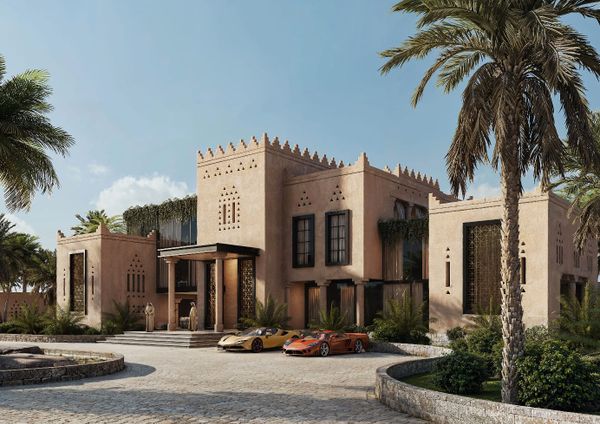
Salma had been holding a monthly majlis at her grandfather’s estate in Ein el-Sama long before she met Hekmat. She gathered her friends and their friends, to think. Sometimes they thought and sometimes, they just looked at each other. Some of them stayed and some of them left. The majlis was a way to cope, both with the time that passed and the time that remained. They wrote poetry and drew sketches. They discussed words and debated the city.
As the years passed, Salma gathered her children, her children’s friends and their friends, to think. Gathering after gathering, they grew less enthusiastic. The city became more powerful than its people and yet Salma continued to gather her grandchildren and the grandchildren of her departed friends and their friends, to think. Thinking, Salma thought, was a thing of a bygone era, a commodity alien to the fast-paced present to which she could not abide.
“And all of this land,” she always began, “was of sand-fields and stardust.” Everyone knew the story - all too well - but none of them thought about it. Salma had met Hekmat fifty years ago, before it had all started. He had been driving his old silver Mercedes along the creek to Ein el-Sama playing Al Atlal on the radio. She’d stopped the car and asked him where he was going. “Nowhere,” he’d answered. They’d been friends ever since.
Salma drove, into the music and away from the city towards the waha, an oasis Hekmat had taken her to a long time ago. The waha had no water, birds or palm trees. It was a place on the western side of the desert, a wide slab of rock in the middle of acres of sand. She parked the car and walked towards it. Hekmat followed. They sat, their backs to the city, looking outwards to the darkening horizon.
“What’s the Arabic for perspective?” Salma asked. Hekmat did not approve of the word’s counterparts. “What’s the relevance of perspective in the desert?” he replied.
“Stone,” Salma said. “Stone, and us.”
Hekmat smiled as she continued.
“How did this happen? How could we go from being the centre of the world to being the faint shadows of imaginary trees? Where are we? When are we? This is surreal,” Salma paused. “What’s the Arabic for surreal?”
“Surriyali,” Hekmat answered.
“Surriyali? Neither sur nor riyali are of Arabic origins. What’s the Arabic for it?”
“I don’t know.”
Salma was furious. Her anger was rooted in her refusal to live in ruins. But whether she liked it or not, she did. She lived in the ruins of century-old constructions of ideas. She lived in a present of pretentious presence, a present that pretended the past had never existed, “Every month at the majlis, everyone acts like it’s a competition. Everyone wants to be first.”
Salma was furious.
“But what does being first mean when time passes so quickly?” Salma says waiting for Hekmat’s confirmation of her sanity, “Nothing, really…”
Hekmat nods, as he knows that in an hour, she will stand up, look to the horizon and then turn back to the city reframing it according to her desires. She would reshuffle its perspective, as unnecessarily surreal as that sounds, then sit in the backseat of the car and ask him to drive her home.
He nods. He knows that on the way back, she will be reconstructing time and space, the same way she expects her guests at the majlis to. She will play imagined scenarios of people who don’t say what they do for a living when she asks who they are, people who have failed to install their logic upon the circuitry of the world but who are still trying, people who are still trying to win back the city, people who won’t ever mistake The Golden Era for a jewellery collection. People who know the Arabic for ‘surreal’.